• About Me
    • EXPLORATION SERVICES
Mineral Exploration Geology  –  finding value in the world around us

ARKENSTONE EXPLORATION – Exploring for the Heart of the Mountain

Mineral Exploration Geology – finding value in the world around us

About Me
Exploration Services
Blog
  • When the Market Listens: Apple, the Pentagon, and the Rise of American Rare Earths

    July 16th, 2025

    Sometimes, the invisible hand of the market needs a little nudge. Other times, it needs the full force of the Pentagon’s wallet—and apparently, that’s all it takes to wake the giants.

    Just one week after MP Materials landed a $400 million deal with the U.S. Department of Defense, tech behemoth Apple swooped in with a stunning $500 million commitment to secure domestically sourced rare earth magnets. That’s not just validation—that’s velocity.

    Together, these two powerhouse deals sent MP stock surging to all-time highs, but more importantly, they sent a thunderous signal to industry: this is where the future is being built.


    Pentagon First, Apple Fast Follows

    The sequence is telling.

    The DoD’s investment was more than a show of support—it was a strategic move to anchor domestic supply chains for critical defense technologies, from fighter jets to satellites. It gave MP Materials the capital and credibility to move forward with large-scale production and magnet manufacturing out of Fort Worth, Texas and Mountain Pass, California.

    Enter Apple. With an eye toward vertical integration and supply chain resilience, Apple’s deal includes co-developing neodymium magnet lines for its products, launching a rare earth recycling initiative, and helping fund the R&D needed to improve magnet performance—using U.S. materials, refined and manufactured on U.S. soil.

    For a company that famously said “Designed in California,” this is now about “Sourced in America,” too.


    What This Means for Exploration

    Deals like this don’t just move markets—they reshape exploration narratives.

    While Apple and MP Materials are focusing their initial efforts on established facilities, the next logical step is new discovery and development. And that brings us to the Bear Lodge carbonatite complex in northeast Wyoming—an underappreciated, world-class REE deposit in one of the most mining-friendly states in the U.S.

    Long known by geologists and quietly held in industry circles, Bear Lodge has sat in a state of limbo due to market pricing, lack of offtake agreements, and, frankly, a lack of momentum. That changes now.

    As capital floods into domestic rare earth supply chains, Bear Lodge looks like a near-term winner—especially with permitting pathways and community sentiment in Wyoming often far more supportive than coastal counterparts. Expect renewed attention, joint ventures, and perhaps a long-awaited move into production-ready territory.

    And don’t sleep on Nevada. While known for lithium and gold, the state harbors critical mineral potential across a range of underexplored terrains—from bastnaesite showings to overlooked thorium-rich systems that could offer the same kind of radiometric pathfinding used at Mountain Pass.


    The New ESG: Exploration, Sovereignty, and Guidance

    It’s tempting to view these deals through a traditional ESG lens—jobs created, emissions reduced, supply chains localized. And that’s all true. But this isn’t your father’s ESG report.

    This is ESG 2.0, where Exploration is prioritized, Sovereignty is defended, and Government plays a guiding hand—not by overregulating, but by strategically investing to de-risk the private sector’s next move.

    Apple didn’t just show up with a half-billion dollars out of pure idealism. They responded to a roadmap set by the federal government. The Pentagon pointed, and Apple followed—not blindly, but confidently. This is what good governance looks like: coaxing industry in the right direction by reducing risk and increasing reward.

    That’s not just smart policy. That’s nation-building—from the periodic table up.


    Final Thoughts

    In the wake of these historic deals, one thing is clear: the age of foreign rare earth dominance is over. America is not just responding—it’s repositioning.

    Exploration geologists, developers, and entrepreneurs—take note. Whether you’re sampling carbonatite in Wyoming or chasing radiometric highs in Nevada, the tide has shifted. The question is no longer if domestic supply chains will grow, but where you want to stand when they do.

    Now is the time to stake, explore, invest, and build—because the future of tech is being built from the bedrock up.

  • Magnets, Mountains, and Momentum: What MP Materials’ $400M Pentagon Deal Signals for Exploration and Industry

    July 11th, 2025

    The bedrock just shifted — and not because of tectonics.

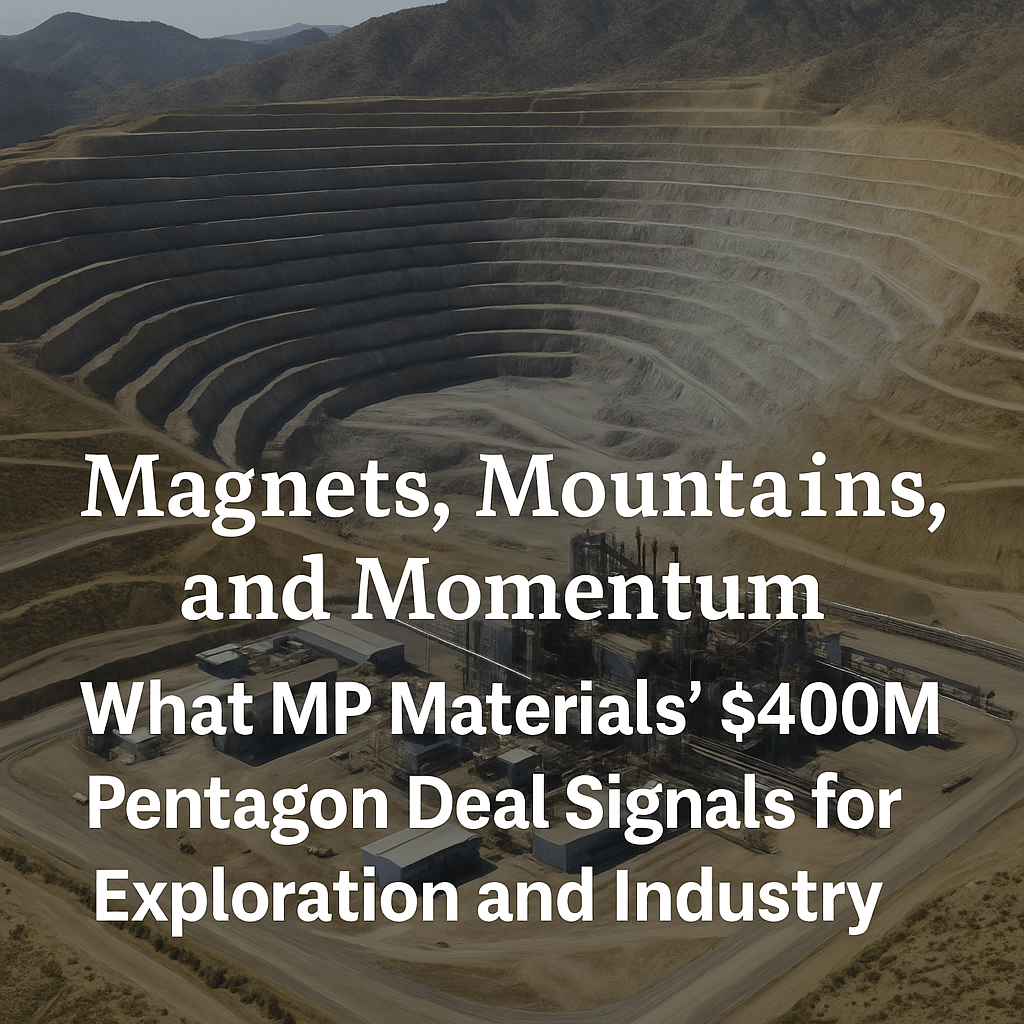
    MP Materials, the sole U.S. producer of rare earth elements, has inked a $400 million deal with the Department of Defense. The investment cements the Pentagon as its largest shareholder and catalyzes a deeper realignment of America’s critical minerals strategy. But this isn’t just a finance story — it’s a geological one, a strategic one, and potentially a transformational one.

    Let’s crack it open.


    From Mountain Pass to Magnet Hubs: Rebuilding a Domestic Value Chain

    The heart of this deal is vertical integration. MP Materials will use the funding to construct a second magnet manufacturing facility — dubbed the “10X Facility” — bringing total planned U.S. magnet output to 10,000 tonnes per year by 2028. Meanwhile, the Mountain Pass mine in California, already a rare example of integrated mining and refining, will undergo a major upgrade to process heavy rare earths, a capability that’s currently nonexistent within U.S. borders.

    Together, these efforts represent the scaffolding of a fully domestic mine-to-magnet supply chain — a national security asset in its own right, with magnets destined for F-35s, EV drivetrains, satellites, and hypersonic missiles alike.

    The Pentagon isn’t dabbling here. This is a decade-long offtake agreement, a price floor of $110/kg for NdPr, and a $1B private financing commitment to ensure downstream buildout. It’s the kind of market-making intervention that turns a company into a cornerstone — and an industry into a priority.


    A Signal to the Mining Sector: This Is Industrial Policy in Action

    For those of us swinging hammers in the field and flipping core trays in the trailer, this deal resonates loud and clear: Critical minerals are no longer just a speculative asset class. They are now the subject of coordinated national policy.

    This move sets a precedent. The government isn’t merely supporting production; it’s underwriting it — mitigating price risk, anchoring demand, and becoming a shareholder in the supply it wants to see developed.

    That playbook doesn’t end at rare earths. Expect copycats — or cousins — across lithium, cobalt, niobium, tellurium, and even uranium. The message is: if it feeds national defense, the energy transition, or technological sovereignty, the U.S. is now willing to back it with more than words.

    For geologists and explorers, this means:

    • Increased funding for early-stage discoveries in critical mineral belts.
    • Stronger pull-through for domestic projects that show scale, purity, and ESG performance.
    • More favorable permitting conditions when aligned with national goals.
    • A growing appetite for substitutes and analogues — think heavy REEs outside China, battery materials outside Congo, or even thorium and scandium as byproducts.

    Pathfinders in the Radiogenic Shadows: Thorium, REEs, and the Exploration Model

    The Mountain Pass model — carbonatite-hosted rare earths with a radioactive signature — remains one of the most studied (and still underutilized) exploration templates in North America.

    Thorium, often treated as a nuisance, is actually the glowing breadcrumb in the geochemical hunt for similar deposits. Mountain Pass was identified in part because of elevated thorium readings during postwar radiometric surveys — a technique that’s ripe for revival with modern tools.

    Imagine reanalyzing old radiometric surveys across the Basin and Range or Rockies with a critical minerals lens. With airborne gamma spectrometry, machine learning, and hyperspectral satellite data now at our fingertips, we’re not just walking old ground — we’re re-seeing it.

    This deal should reignite interest in:

    • Thorium pathfinder anomalies in alkaline systems and pegmatites.
    • Heavy REE-enriched districts in Wyoming, Texas, and Alaska.
    • Tailings and waste rock with underexplored critical mineral content.
    • REE byproducts in carbonatite-associated copper or phosphate systems.

    Mountain Pass wasn’t a fluke — it was the result of recognizing radiogenic clues and metallogenic context. We have the maps. We have the data. What we need now is the will.


    What’s Downstream is Upstream’s Business Now

    This is a case where downstream developments — like magnet manufacturing — change the calculus upstream. With the Pentagon as a guaranteed buyer and long-term partner, magnet supply chains gain the financial predictability needed to invest in innovation, expansion, and diversification.

    And that demand rolls uphill.

    • Copper miners could find offtake markets for dysprosium or terbium as trace byproducts.
    • Phosphate producers may re-evaluate their monazite waste streams.
    • Uranium explorers, especially in thorium-rich systems, might start looking at REE recovery circuits.
    • Industrial mineral companies, often ignored, could become critical suppliers if they sit on the right fluorite, barite, or bastnaesite-hosted systems.

    Where once there was only risk, now there is signal — a big, bold signal saying Build it here. Mine it here. Sell it here.


    Final Thoughts: A Turning Point for Geologists, Not Just Manufacturers

    This MP–Pentagon deal is more than capital infusion — it’s a tectonic affirmation of our industry’s relevance. It says that what we explore, discover, and extract matters not just economically, but strategically.

    We’re used to asking: “Is this deposit feasible?”
    Now we also get to ask: “Is this deposit vital?”

    And the answer, more often than not these days, is yes.

    So as rare earths take center stage and thorium-laced anomalies begin to glow again in the collective memory of the geological community, the message is clear: The drill rig is back in fashion — not just in markets, but in national strategy.

    And that, my friends, is worth staking some ground for.


    — Mark Travis, CPG
    Founder, Arkenstone Exploration
    Writer, Rock Whisperer, Advocate for the Sacred Duty of Discovery

  • Cobalt’s Crossroads: How Crisis Became Catalyst for a New Mining Era

    June 23rd, 2025

    By Mark Travis, CPG | June 23, 2025
    President, Arkenstone Exploration

    “In every supply chain lies a seam. And when pressure builds, the whole system can slip.”

    In March, the cobalt market trembled.
    In June, it roared.

    What began as a localized export ban in the Democratic Republic of Congo (DRC)—the world’s undisputed cobalt kingpin—has now widened into a seven-month disruption with no clear end in sight. Prices have surged. IPOs have crumbled. Investors are watching from the edge of their seats. And somewhere in the hills of Idaho, Alaska, or northern Quebec… a junior explorer is unrolling a map and whispering: Now is the time.

    Let’s step back and trace the arc—from instability to opportunity—and explore what it means for the U.S., for the mining sector, and for the future of secure, ethical critical minerals.


    Part I: March Madness – When the Ban First Dropped

    The story began in February 2025, when the DRC suspended cobalt concentrate exports. Officials cited oversupply and weak EV demand as justification—though insiders speculated on broader motivations, from domestic processing ambitions to geopolitical posturing.

    By mid-March, chaos was rippling through the global cobalt chain:

    • Eurasian Resources Group declared force majeure at Metalkol.
    • Cobalt prices hit $12.25/lb in Europe, climbing nearly 12% in China.
    • Analysts buzzed about “structural fragility” in a market too dependent on one country’s copper byproduct stream.

    I wrote then that this disruption was a “wake-up call” for domestic mining, a rare window where investors, policymakers, and industry leaders might finally align around the urgent need for U.S.-based production.


    Part II: June Reverb – The Shock That Keeps On Shaking

    Now, the DRC has extended the ban by another three months—pushing the total supply interruption to over half a year, and pulling an estimated 100,000 tonnes of cobalt off the global market.

    The price reaction was swift and sharp:

    • Cobalt futures on China’s Wuxi Exchange surged 9% overnight to $35.34/kg.
    • Cobalt sulphate—critical to EV battery cathodes—has rebounded 80% from January lows.
    • Glencore, the world’s #2 cobalt producer, followed ERG in declaring force majeure.
    • Cobalt Holdings scrapped its anticipated $230M London IPO, spooked by instability.

    While CMOC claims its Congo-based operations remain steady, the market at large is anything but.

    Behind the headlines, a deeper current is pulling: the realization that this isn’t a one-time hiccup—it’s a systemic vulnerability. One that threatens the clean energy transition at its roots.


    Part III: The U.S. Response – Still Waiting for the Drill to Turn

    So here’s the paradox.

    We know the problem: too much cobalt comes from too few jurisdictions.
    We know the stakes: EVs, grid storage, military tech, even aerospace all need cobalt.
    And we know the solution: develop domestic resources.

    Yet exploration companies still face:

    • Multi-year permitting timelines
    • Inconsistent federal support
    • Lack of processing capacity
    • Skeptical capital markets burned by previous busts

    The opportunity is clear, but the runway is short. If the U.S. wants to seize this moment, we need policy shifts, capital infusions, and a cultural reawakening that mining matters.


    Part IV: From Fragility to Fortitude – What Comes Next

    The cobalt crisis of 2025 is more than a spike in futures charts. It’s a stress test of global supply chains, and a preview of coming attractions for lithium, rare earths, and beyond.

    This is the inflection point where:

    • Domestic juniors can shine with the right support and strategy
    • Investors can reposition toward hard assets with real leverage
    • Governments can double down on permitting reform and resilient infrastructure

    Cobalt is the canary—but it’s singing a warning in a mine shaft lined with copper, nickel, lithium, and rare earths.


    Final Thoughts: The Claim is Staked—Will We Act?

    As a geologist, I’ve seen firsthand how resource trends bend history.
    As a project manager, I’ve wrestled with the real costs of getting a mine off the ground.
    And as someone who believes in the long arc of human progress, I see cobalt not as a crisis, but a catalyst.

    A catalyst to return to the rock, to the root, to the real work of supplying a world in transition.

    Let’s not miss this window. Let’s dig deeper—literally and figuratively—into our own potential.


    Mark Travis is a Certified Professional Geologist and President of Arkenstone Exploration. He believes in building resource resilience from the ground up, and writes frequently on the intersection of exploration, policy, and the human spirit.


  • ⚛️ Turning Points and Tailwinds: The American Uranium Industry Awakens

    June 20th, 2025

    By Mark Travis, CPG | June 2025

    “There are decades where nothing happens; and there are weeks where decades happen.”
    – Vladimir Lenin (and, let’s be honest, every energy sector analyst this month)


    For years, the phrase “American uranium renaissance” has lingered in industry headlines like the smell of a diesel rig that never quite fired up. Promising starts faded. Policy support came in fits and starts. And those of us in the trenches—operators, geologists, engineers—held on to a vision of domestic nuclear revival that never quite made it out of committee.

    Until now.

    The last few weeks have delivered something different: not just press releases, but permits, production, and political will—aligned, accelerating, and actively reshaping the landscape of uranium in the United States. From Wyoming to Utah to Texas, major players are pushing forward with restarts, expansions, and acquisitions, emboldened by a rare trifecta: market fundamentals, government policy, and infrastructure readiness.

    Let’s take a tour of the sector’s seismic shifts.


    🚨 Policy First: Washington Opens the Gates

    It started at the top.

    In April and May, the Trump administration rolled out a flurry of Executive Orders aimed at reviving the nuclear fuel cycle. These included:

    • Emergency Declarations identifying uranium as a strategic national asset
    • A ban on Russian uranium imports (signed into law in May 2024)
    • Federal directives to streamline permitting for domestic uranium and vanadium projects

    The creation of the National Energy Dominance Council brought policy coordination to a new level, explicitly calling out uranium as an “amazing energy asset.” That might sound like political theater, but in an industry as permit-constrained as ours, it’s hard to overstate what a signal like this does to capital flows and operational confidence.

    And the results? Almost immediate.


    ⛏️ Anfield Energy: Permitted at the Speed of Policy

    On May 27, Anfield’s Velvet-Wood Project in San Juan County, Utah, became the first uranium mine approved under the new emergency declaration. The U.S. Department of the Interior wrapped environmental review in just 14 days—a process that once took years. This was not a pilot or demonstration; this was the green light to go.

    Anfield’s position is even stronger when you consider their Shootaring Canyon Mill, one of only three licensed conventional uranium mills in the U.S. With mill capacity in place and a $238 million pre-tax NPV (PEA combined with Slick Rock), Anfield’s production pipeline is now a strategic national asset.

    In June, Uranium Energy Corp (UEC) doubled down, acquiring 170 million Anfield shares and boosting its stake to over 37% (partially diluted). In doing so, UEC is anchoring itself not just as a producer, but as a portfolio architect of the American fuel cycle.


    🛠️ IsoEnergy: Restart Plans with a Permit-First Strategy

    Also on May 27, IsoEnergy Ltd. announced it had kicked off technical optimization programs at its fully permitted Tony M Mine in Utah. These included:

    • Ore sorting with Steinert’s sensor-based technology
    • High-Pressure Slurry Ablation (HPSA) for improved uranium recovery
    • Enhanced evaporation to speed up dewatering and reduce pond buildout costs

    All of IsoEnergy’s mines in Utah—Tony M, Daneros, and Rim—are fully permitted. With a toll milling agreement already in place with Energy Fuels’ White Mesa Mill, IsoEnergy is poised to become a low-capex, near-term producer with minimal regulatory hurdles.

    A restart decision is anticipated by the end of 2025. From where I sit, that’s not just likely—it’s inevitable.


    🧭 Ur-Energy: Expansion Secured, Basin Rising

    In early May, Ur-Energy received final approval from both Wyoming DEQ and the EPA to expand its Lost Creek ISR project by six additional mine units. While production in those areas is several years out, the regulatory legwork is now done—a rare luxury in our industry.

    More immediately, Ur-Energy’s focus is on the Shirley Basin Project, with construction underway and startup expected in early 2026. When combined with Lost Creek, Shirley Basin increases Ur-Energy’s licensed production capacity by 83%.

    And just in case you missed it: according to EIA data, Ur-Energy was the top U.S. uranium producer in 2024.


    🧮 Production Reawakens: The Data Don’t Lie

    Fourth-quarter 2024 U.S. uranium production reached 375,401 pounds U₃O₈—the highest since 2018. Here’s how the key players stacked up:

    CompanyQ4 2024 U₃O₈ OutputNotables
    Energy Fuels157,525 lbsWhite Mesa Mill + Pinyon Plain (AZ)
    EnCore Energy127,293 lbsAlta Mesa ISR (TX)
    Ur-Energy74,006 lbsLost Creek ISR (WY)
    UECRestarted 2024Christensen Ranch ISR + Irigaray processing
    Peninsula Energy2,669 lbsLance ISR (WY), full output expected mid-2025

    UEC also added Rio Tinto’s Sweetwater Mill to its portfolio—a massive 4.1 million lb/year licensed facility. Plans are underway to retrofit it for resin-based recovery from ISR feedstock, creating a centralized processing solution for Wyoming’s next chapter.


    🔮 What It All Means

    We’ve crossed a threshold. These aren’t speculative PEA-stage juniors poking around the desert. These are licensed facilities, operational mines, and full-cycle infrastructure moving into motion under the influence of:

    • Strong uranium prices
    • A domestic supply crisis
    • And now—at last—unified federal support

    The combination of ISR assets (UEC, EnCore, Ur-Energy) and conventional mine-mill pairs (Anfield, IsoEnergy, Energy Fuels) represents a diversified, scalable, and increasingly de-risked supply base.

    More importantly, this isn’t a rerun of 2010s false starts. The Russian ban is real. The mills are licensed. The ore is moving. The politics are aligned.


    ✍️ Final Thoughts: The Clock Is Ticking—and We’re Finally Ticking With It

    For years, the U.S. uranium industry has been a paradox—essential, but ignored; strategic, but unsupported. Today, that paradox is breaking.

    What’s emerging is not just a domestic comeback. It’s a structural reawakening—where geology, capital, and policy are syncing into rhythm. As a geologist and project manager in this space, I’ve never seen the lines on the map feel so alive.

    From drill rigs in Wyoming to boardrooms in Toronto, the message is clear:

    The uranium engine is no longer idling. It’s revving. And this time, we’re going somewhere.


    Mark Travis, CPG is a consulting geologist, writer, and uranium exploration advocate based in Nevada and Wyoming. He is President of Arkenstone Exploration and serves as Acting Vice President of the Nevada Mineral Exploration Coalition.


  • Uranium’s Double Pulse: Trust and Traction in the New Energy Epoch

    June 16th, 2025

    In uranium, timing isn’t everything—it’s the only thing.

    As the world grapples with a grid-hungry AI boom, mounting energy security anxieties, and geopolitically constrained supply chains, the market’s response is starting to feel like a heartbeat quickening. And this week, we heard a double pulse.

    On one end of the spectrum, Sprott Physical Uranium Trust (SPUT) announced a blockbuster US$200 million financing, upsized thanks to overwhelming demand. That’s no minor tremor—it’s institutional confirmation that the long-game on uranium isn’t just alive, it’s marching forward. Every pound of U₃O₈ or UF₆ they buy is physical removal from spot availability. It’s inventory that’s off-market. And for juniors and developers? That tightening vice around supply is pure oxygen.

    On the other side of the coin, down in the sagebrush plains of Wyoming, Peninsula Energy is rolling out a hard-earned reset at its Lance Project. Years of technical hurdles, construction delays, and contractual straitjackets are being shed like a winter coat. Three major uranium delivery contracts—1.95 million pounds’ worth—have been mutually terminated, freeing Peninsula to align with a more realistic, flexible production profile. EPC disputes? Settled. Phase II construction? Wrapping up. Commissioning? Set to start this month.

    We are seeing confidence and caution dance in unison—capital entering the market at scale, while producers retool with clear-eyed pragmatism.


    What This Means for the Industry

    🟢 Exploration gets tailwinds, not headwinds.
    With physical demand locked up and fewer term contracts muddying the waters, the spot market is now the main stage. That’s good news for juniors and mid-tier explorers who thrive on price movement, equity leverage, and the anticipation of scarcity.

    🛠️ Production reboots are back in vogue.
    From Lance to La Sal, previously sidelined projects are squinting into the sun again. But success will favor the nimble, the data-rich, and the socially literate—teams who can derisk geology and permitting.

    📈 Market sentiment is no longer speculative—it’s structural.
    This isn’t just a dead cat bounce. It’s policy-driven, supply-constrained, and electrification-dependent. The uranium thesis is now being played out in project finance, plant commissioning, and long-term physical stockpiles.


    What This Means for Investors

    💡 Trust the Trust.
    SPUT’s growing war chest is a bullish indicator. Their NAV-based pricing model means they aren’t operating like a hedge fund—they’re a vault. One that accumulates when the market’s moving in the right direction. Think of it as the uranium savings account for the global energy conscience.

    🧭 Reboots offer asymmetric upside.
    Peninsula’s decision to renegotiate its entire delivery framework signals an investor-centric evolution: eliminate liabilities, reframe timelines, and potentially position for better pricing later. Those watching for second-wave uranium plays would be wise to note who’s rebooting with intent—not desperation.

    📣 Watch the infrastructure, not just the headlines.
    CPP construction, contract terminations, financing settlements—these aren’t hype tweets. They’re structural milestones. And in uranium, fundamentals tend to lag narratives—until they don’t. That’s when the returns happen, often suddenly.


    Final Core Sample

    We’ve entered a phase where uranium is not just reacting—it’s resetting.

    Capital is no longer shy. Developers are no longer apologizing. And the exploration business, long-starved of attention, is suddenly strategic again. We’re not chasing ghosts anymore—we’re charting toward grid parity, geopolitical resilience, and market relevance.

    So to my fellow geologists, financiers, policy wonks, and metal heads: the core’s warming up. The drills are turning. The vaults are filling.

    The atom has awakened—and this time, the rhythm is real.


  • The Atom Awakens: Uranium’s Rebound in the Age of AI and Energy Security

    June 12th, 2025
    New dawn on nuclear power and domestic uranium mining!


    “The real mineral isn’t uranium. It’s certainty—and we’re finally getting some.”


    May didn’t just mark a seasonal shift—it signaled a reawakening. According to the latest Sprott Uranium Report, spot uranium prices surged 5.51%, uranium miners jumped 16.22%, and junior equities followed with a 14.20% gain. The long-dormant bull is back on its feet, stretching its legs after a long geopolitical hibernation.


    But this isn’t just a technical bounce. This is structural. This is systemic. And this time, the shift is underpinned by more than just momentum.


    🏛️ Policy Tailwinds: From the White House to the Well Pad


    The uranium market is finally getting the political oxygen it needs. In May, the Trump administration issued bold executive orders and championed pro-nuclear legislation—the most comprehensive federal support for atomic energy since the original Atomic Energy Commission got to work.


    Fast-41 reforms are unclogging the permitting arteries. DOE-backed loans and funding for uranium stockpiling are creating predictable offtake demand. For once, government policy isn’t a roadblock—it’s a rocket booster.


    ⚡ AI’s Atomic Appetite: Powering the Machine


    Layer on top of that the digital frontier: AI is hungry, and the grid is starting to feel the burn.


    Data centers, crypto miners, and AI models like mine are guzzling electrons at an unprecedented rate. Utilities are scrambling for solutions that are scalable, steady, and carbon-free. Spoiler: it’s not just more solar panels.


    It’s nuclear.


    Base-load nuclear power—quiet, dense, long-lived—is emerging as the only viable way to keep up. And for the first time in decades, utilities are signing long-term uranium offtake contracts again. The supply-demand equation is shifting—and fast.


    🌍 The Global Uranium Chessboard: Security, Sovereignty, and Strategy


    Geopolitically, uranium is no longer just a commodity—it’s a chess piece. With Russia being phased out of Western nuclear supply chains and Kazakhstan’s output under watch, the call for secure, domestic production is louder than ever.


    Meanwhile, China is racing ahead, locking down global uranium assets while ramping up its domestic nuclear buildout.


    This creates opportunity. American and Canadian uranium projects are back in vogue—not just for their geology, but for their jurisdiction.


    ⛏️ Where I Fit In: Drills, Data, and Domestic Revival


    At Nuclear Fuels Inc., now merged into Premier American Uranium, we just kicked off our 2025 drilling program—targeting over 100,000 feet at the Kaycee Uranium Project in Wyoming’s Powder River Basin.


    This isn’t proof-of-concept exploration. This is resource conversion. This is energy security in motion.


    As President of Arkenstone Exploration, I’m also working with other explorers across the West to position their projects for this new wave of capital, policy, and public support. The toolkit’s the same—maps, boots, gamma logs—but the stakes have never been higher.


    📈 The Junior Surge: From Penny Stocks to Power Brokers


    Let’s not forget the juniors. Sprott’s Junior Uranium Miners Index was up 14.20% in May alone, nearly matching the majors. Yes, they’re still down on the year (-3.34%), but that’s old news.


    Smart money is sniffing around the basin fringes again. The undervalued are becoming the unavoidable. And the “pounds in the ground” are rapidly becoming “projects in the pipeline.”


    🌐 Conclusion: The New Uranium Narrative


    This moment is bigger than price charts. Bigger than quarterly results. We’re watching uranium evolve from underdog to cornerstone—from toxic liability to strategic necessity.


    Nuclear is back. Uranium is rising. And we, the exploration geologists with dusty boots and gamma probes, are no longer shouting into the wind. We’re anchoring the grid. We’re feeding the data age. We’re building the future one drill collar at a time.
    “We don’t just find atoms—we ignite eras.”


    🔗 Follow for updates on the Kaycee Uranium Project, permitting trends, and the growing intersection of energy, policy, and AI.

  • Drilling Into the Future: The Kaycee Uranium Project Ramps Up as the Industry Realigns

    June 11th, 2025

    Recently here in June of 2025, Nuclear Fuels Inc. officially kicked off its 2025 drilling program at the Kaycee Uranium Project in Wyoming’s Powder River Basin. For those of us on the ground, this marks more than the start of another drill season—it represents a strategic pivot point in America’s race to revitalize domestic uranium production.

    Building on Discovery, Not Just Hype

    The 2025 program plans to complete at least 100,000 feet of rotary mud drilling, expanding on successes from late 2024 when the Outpost and Trail Dust Zones were discovered. Both zones returned solid intercepts of roll front-style mineralization—textbook ISR targets.

    • Outpost Zone: 0.082% eU₃O₈ over 6.5 ft (GT 0.532) at 767 ft depth
    • Trail Dust Zone: 0.0553% eU₃O₈ over 5.5 ft (GT 0.304) at 886 ft depth

    These aren’t headline-grabbing grades, but they’re meaningful, especially when contextualized within a district that hosts over 430 miles of roll fronts across a consolidated 55-square-mile land position. ISR uranium is a volume game, and Kaycee is one of the few districts in the U.S. where all three historically productive formations—Wasatch, Fort Union, and Lance—are present and mineralized.

    This is no small feat. It’s been four decades since this patch of uranium country was under single-company control. That historical fragmentation is exactly why it has been overlooked—until now.

    Fast-Tracking the Future? The Role of Fast-41 and Domestic Policy

    It’s also no accident that this kind of momentum is happening in Wyoming, a state that not only supports energy development but also operates under “Agreement State” status, streamlining the ISR permitting process in partnership with the NRC.

    Policies like Fast-41—first implemented under the Trump administration to accelerate federal reviews for critical infrastructure—are back in the conversation. And they matter. Fast-41 designations don’t just cut red tape; they elevate a project’s visibility, encourage inter-agency cooperation, and unlock capital that would otherwise sit on the sidelines due to regulatory uncertainty. In today’s geopolitical climate, where nuclear energy is being rediscovered as the linchpin of a clean and sovereign energy future, the uranium sector is moving from “interesting” to “imperative.”

    M&A: Consolidation Brings Clarity

    The recent announcement that Premier American Uranium will acquire Nuclear Fuels adds another layer of momentum. Once completed, the merger will create one of the largest pure-play uranium explorers in the U.S. with a portfolio of 12 key projects across several top-tier uranium basins.

    We’re seeing a broader trend across the sector:

    • Uranium Energy Corp. continues expanding ISR capacity via South Texas and Wyoming acquisitions.
    • enCore Energy, our strategic partner at Kaycee, is pivoting from explorer to near-term producer.
    • And legacy juniors are being rolled into larger vehicles that can leverage scale and permitting strength.

    These moves aren’t just about size—they’re about aligning technical teams, capital, and permitting expertise to match a coming uranium demand cycle that’s being driven by utility restocking, geopolitical stockpiling, and a resurgence of U.S. nuclear builds.

    My Role in the Shift

    As the Project Manager for Nuclear Fuels, and now part of the integrated team under the Premier American umbrella, my role remains the same in spirit but is growing in scope. I’ll continue overseeing the Kaycee exploration campaign—coordinating drill planning, target modeling, logging, and resource delineation. The groundwork we’re laying now isn’t just about proving pounds—it’s about positioning Kaycee as one of the next ISR uranium projects ready for resource definition and eventual development.

    Being a Qualified Person under NI 43-101, I’ve reviewed and signed off on the technical content of our news releases, but I’m also deep in the field: managing contractors, monitoring lith logs, and piecing together the kind of geologic story that excites engineers and investors alike.

    And I believe in that story.

    A Foundation for the Next Cycle

    We’re not in the discovery-for-discovery’s-sake phase anymore. The uranium sector is tightening, and developers with real ground, real data, and real people doing the work are rising to the top. The Kaycee Project has the hallmarks of a future ISR producer: favorable host formations, supportive jurisdiction, strong partnerships, and aggressive yet responsible exploration.

    So here’s to another season of mud, probes, logging runs, and long drives between rotary rigs. If you’re watching the uranium space, keep your eye on Kaycee. The pieces are coming together.


    Mark Travis, CPG
    Project Manager – Nuclear Fuels Inc. / Premier American Uranium
    Geologist, Permitting Liaison, and Explorer of America’s Energy Future


  • Fission for the Future: Meta, Nukes, and the AI Power Grab

    June 6th, 2025

    There’s a strange poetry in the digital dreams of Silicon Valley being powered by the dense, invisible force forged in the heart of an Illinois cornfield.

    Meta—the same company that gave us Facebook and our collective descent into the algorithmic abyss—is now hitching its AI ambitions to the atom. In a headline that’s as surreal as it is inevitable, Meta just inked a 20-year power purchase agreement (PPA) with Constellation Energy, locking in nuclear energy from the Clinton Clean Energy Center to help feed its growing fleet of data centers.

    And no, this isn’t just another “we’re buying some credits and planting trees” PR stunt. This is baseload. This is carbon-free. This is nuclear—and it’s a signal flare in the night sky of America’s energy future.

    When Data Demands a Dynamo

    AI is hungry. Really hungry. Think: city-scale electricity loads to run the silicon minds dreaming up everything from deepfake movie scripts to how your toaster should talk to your car. With natural gas still king and renewables playing catch-up, Big Tech is suddenly realizing that if you want round-the-clock, carbon-free electrons—you need to cozy up to uranium.

    Meta’s move doesn’t pull power off the grid. Instead, it’s a financial handshake: a promise to pay for the clean attributes of nuclear generation, offsetting their less-green draw elsewhere. It’s not about plugging servers straight into a reactor. It’s about giving that reactor a new lease on life—and making sure those precious electrons stay in the game.

    And here’s the kicker: the Clinton plant was already facing the ticking clock of a 2027 relicensing deadline. This deal doesn’t just keep the lights on—it funds relicensing, system upgrades, and possibly even paves the way for a second reactor on site. The term “lifeline” doesn’t do it justice. This is strategic resuscitation.

    From Meltdown to Momentum

    Meta’s deal follows a similar PPA struck between Microsoft and Constellation to restart the undamaged reactor at Three Mile Island. Yes, that Three Mile Island—the ghost of nuclear nightmares past, now being resurrected not by government fiat, but by the insatiable need for clean, scalable power.

    We’re witnessing something remarkable: the pivot of private capital into nuclear stability. It’s not ideology. It’s not politics. It’s demand pressure meeting supply crunch and realizing that the atom still has something to say.

    A New Playbook for Clean Energy

    Here’s why this matters far beyond Meta’s data closets:

    1. It validates nuclear’s role in the clean energy mix. Not just in theory—but in dollars and contracts.
    2. It provides a replicable model for other plants facing closure or uncertainty in competitive markets.
    3. It opens the door to expanding capacity—whether that’s uprating existing plants, building second units, or finally bringing small modular reactors (SMRs) off the whiteboard and into the dirt.

    Constellation’s CEO, Joe Dominguez, called it what it is: billions in capital risk, made bankable only through long-term certainty. And that’s exactly what these PPAs provide. We may not get new nuclear without solving our permitting and political paralysis—but we can shore up what we already have. And that’s no small feat.

    Why It Matters to the Rocks and Wires Crowd

    For those of us in the mining, exploration, and energy-adjacent world—this is music to our ears. It means demand for uranium is no longer just a function of geopolitical saber-rattling or reactor restarts elsewhere in the world. It’s increasingly being driven by the business case for domestic, carbon-free power.

    And let’s be honest—this gives us something new to say when we’re cornered at the barbecue by someone asking, “But isn’t nuclear dangerous?” You can now reply, “Dangerous to ignore, maybe. Even Facebook thinks so.”

    Closing Thoughts: AI’s Atomic Appetite

    Meta’s deal isn’t just about electrons. It’s about narratives shifting. It’s about legacy infrastructure finding new relevance. It’s about the atom rising again—not as the ghost of Cold War terror, but as the workhorse of our digital future.

    The AI age won’t be solar-only. It won’t run on vibes and wishful thinking. It’ll need something denser. More consistent. More resolute.

    And nuclear, once cast aside, might just be the steel backbone beneath our silicon dreams.


  • A New Era for U.S. Uranium: Premier American Uranium + Nuclear Fuels Join Forces

    June 5th, 2025

    Something big just moved beneath the surface—and not just geologically.

    On June 5th, it was announced that Premier American Uranium Inc. (PUR) will acquire Nuclear Fuels Inc. (NF), creating one of the largest pure-play uranium explorers in the United States. As someone who’s had the privilege of serving as Project Manager for Nuclear Fuels, I’m proud to share that this is not the end of a chapter—it’s the doubling down of a mission. And I’ll continue to be actively involved in this newly merged entity as we push forward across the map, the drill deck, and the development pipeline.


    What This Means: Consolidation with Purpose

    The new company brings together:

    • 12 exploration and development-stage projects across Wyoming, New Mexico, Utah, Arizona, and Colorado;
    • A land position totaling over 104,000 acres;
    • Historic and modern datasets from more than 4,200+ drill holes in Wyoming alone;
    • And a rare emphasis on ISR-focused uranium exploration, an area often overlooked but critically needed for the U.S. energy transition.

    This isn’t consolidation for consolidation’s sake. It’s strategic integration—combining NF’s flagship Kaycee Project in Wyoming’s Powder River Basin with PUR’s Cyclone Project in the Great Divide Basin, both sitting squarely within America’s most prolific ISR districts.


    Why Now? Because Timing is Everything

    We’re in a moment.

    In the last few months alone:

    • Uranium projects in the U.S. are being fast-tracked.
    • The Grants Mineral Belt in New Mexico—home to PUR’s Cebolleta Project—has received federal attention via the FAST-41 permitting program.
    • And domestic supply security has become more than a talking point—it’s a mandate.

    This merger lands at exactly the right time, with exactly the right assets, and exactly the right team.


    Kaycee: A Keystone Asset

    Let me take a moment to highlight what makes Kaycee so special—because I’ve walked it, mapped it, and logged more than a few of those holes myself.

    Kaycee spans a 35-mile roll-front system with over 430 miles of mapped trends, supported by historic drilling and modern work that proves uranium mineralization in all three major sand units: Wasatch, Fort Union, and Lance. That’s a rarity in ISR uranium, and it’s a big part of why this deal makes so much sense.

    Our 2023 and 2024 drill campaigns were among the largest ISR exploration programs in the U.S., and the trend is just beginning to heat up. With C$14M in combined cash on hand, the new company is poised to aggressively advance Kaycee and our other high-potential assets in the months to come.


    The People Behind the Rocks

    This isn’t just about drill footage and roll fronts.

    The combined company will be backed by some of the strongest strategic players in the space—Sachem Cove, enCore Energy, IsoEnergy, and Mega Uranium—and led by Colin Healey as CEO, with representation from both the PUR and NF boards. I’m honored to remain involved post-merger, contributing to the continued growth of the project portfolio and the technical strategy that guides it.

    Exploration geologists don’t often get to see their work reach critical mass. This is one of those rare and exciting exceptions.


    Looking Ahead

    U.S. uranium isn’t just coming back. It’s growing smarter. Sharper. More deliberate.

    With the Premier-Nuclear Fuels merger, we’re not just stitching together acreage. We’re assembling the kind of exploration-first, production-ready platform that’s been missing from the domestic uranium narrative. A platform with the data, the drilling history, the land, the resources—and the team—to make something enduring.

    This is about more than uranium. It’s about how we meet the energy future with boldness, science, and a little bit of grit.


    🔗 If you’re following the uranium sector, the time to pay attention is now. If you’re already invested—in industry, interest, or curiosity—this is a story worth tracking.

    And if you’re a geologist like me?

    You know what this really means: we’ve still got plenty of ground to cover—and we’re just getting started.


  • Silver in the Slipstream: When the Second Fiddle Sharpens Its Blade

    May 31st, 2025

    Gold gets the spotlight. Silver gets the surprise attack.

    Lately, a quiet tremor has been running through the metals market — not quite a roar, not yet a stampede, but a shift that’s caught the attention of those who know how to listen for the deeper rumble.

    As gold flirts with all-time highs and physical inventory on the Comex continues to dwindle, another metal has slipped into position behind it: silver. And if history is any guide, that’s when things get interesting.


    The Ratio That Roars

    The gold-to-silver ratio, currently hovering around 99:1, is a flashing signal to seasoned metals watchers. This ratio — how many ounces of silver it takes to buy one ounce of gold — has only breached these levels a handful of times in modern history. Each time, it preceded a violent correction. Not in gold. In silver.

    In 2008, the ratio hit 84. Within a year, silver doubled.
    In 2020, it breached 125 during peak COVID panic. Silver exploded shortly after.

    Now, with gold becoming harder to lease, roll, or deliver — and silver still relatively available — some speculate that a shift is coming. Not gradually. Not politely. But kinetically.


    Kinetic Capital: The Role Reversal

    Gold is the store of value. The deep reserve. The static capital.

    Silver? Silver is the pressure valve. When trust in paper markets frays, when delivery fails or premiums spike — silver moves. And when it moves, it doesn’t ask permission.

    In 2011, silver went from $18 to nearly $50 in under a year. Not because gold led, but because belief cracked. Demand shifted. Leverage unwound. And the second fiddle started swinging like a saber.

    We may be seeing echoes of that now:

    • Inventories are falling.
    • Delivery pressure is building.
    • Central banks are stocking up gold — and the shadow trade is sniffing around silver.

    Not a Conspiracy — a Cycle

    Let’s be clear: this isn’t about silver being “suppressed” by some nefarious cabal. That narrative is worn thin.

    But structurally, silver is smaller, more industrially consumed, and thinner in liquidity than gold. That makes it volatile — and volatility is where opportunity lives, especially for investors and explorers who know how to ride the rip.

    This isn’t just about prices. It’s about positioning. If gold is the safe bet for a nervous world, silver is the swing trade for a restless one.


    What It Means for Explorers

    For those of us in the trenches — geologists, explorers, financiers of the rocks that power our world — this is a blinking green light. Investors love a comeback story, and silver’s got one written into its veins.

    The question is not if silver will run again.
    The question is: are we staked, staffed, and ready when it does?


    Final Thought

    If gold is the sentinel guarding wealth, silver is the insurgent — underestimated, undervalued, and when the moment is right… unleashed.

    So tighten your boots, dust off the maps, and maybe—just maybe—rethink that silver project you shelved in 2016.

    Because when the pressure releases, it won’t be polite.


←Previous Page
1 2 3 4 … 7
Next Page→

Blog at WordPress.com.


Loading Comments...
 

    • Subscribe Subscribed
      • Mineral Exploration Geology - finding value in the world around us
      • Already have a WordPress.com account? Log in now.
      • Mineral Exploration Geology - finding value in the world around us
      • Subscribe Subscribed
      • Sign up
      • Log in
      • Report this content
      • View site in Reader
      • Manage subscriptions
      • Collapse this bar