
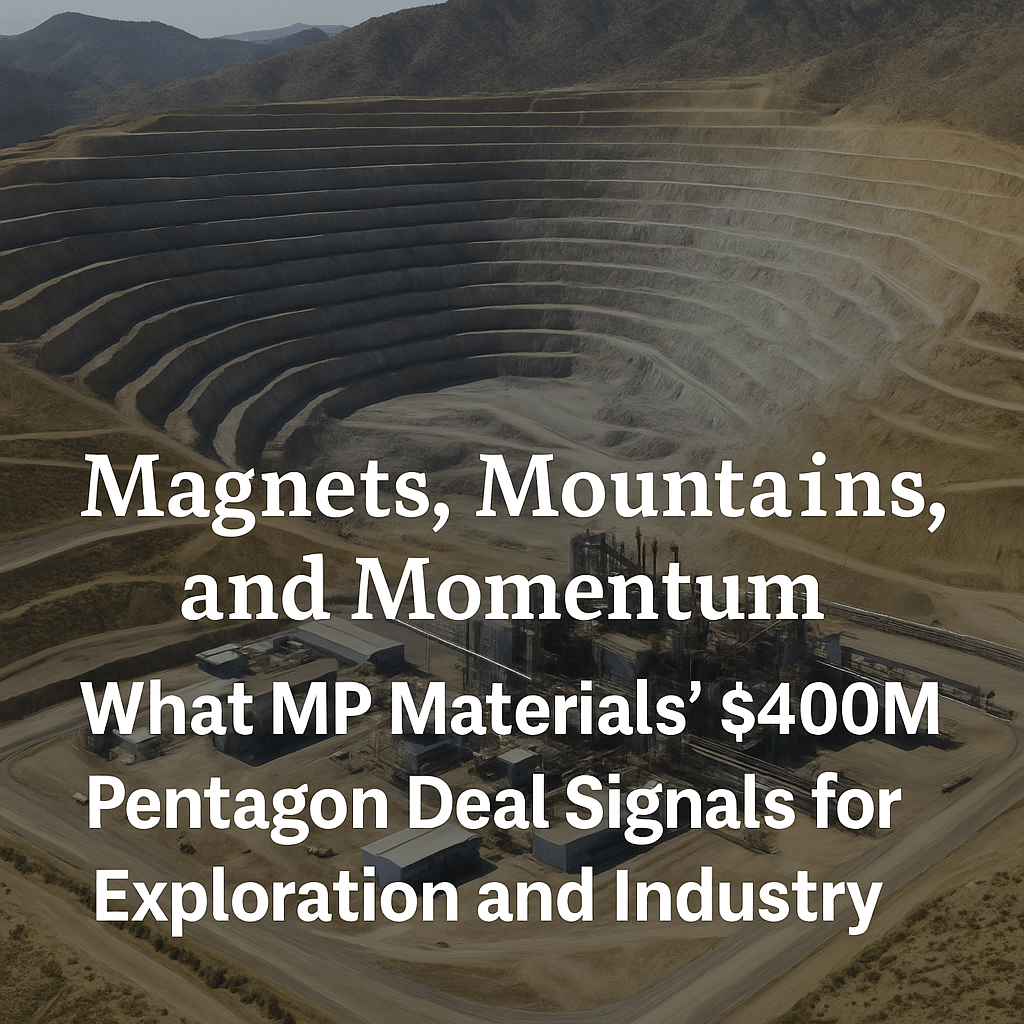
The bedrock just shifted — and not because of tectonics.
MP Materials, the sole U.S. producer of rare earth elements, has inked a $400 million deal with the Department of Defense. The investment cements the Pentagon as its largest shareholder and catalyzes a deeper realignment of America’s critical minerals strategy. But this isn’t just a finance story — it’s a geological one, a strategic one, and potentially a transformational one.
Let’s crack it open.
From Mountain Pass to Magnet Hubs: Rebuilding a Domestic Value Chain
The heart of this deal is vertical integration. MP Materials will use the funding to construct a second magnet manufacturing facility — dubbed the “10X Facility” — bringing total planned U.S. magnet output to 10,000 tonnes per year by 2028. Meanwhile, the Mountain Pass mine in California, already a rare example of integrated mining and refining, will undergo a major upgrade to process heavy rare earths, a capability that’s currently nonexistent within U.S. borders.
Together, these efforts represent the scaffolding of a fully domestic mine-to-magnet supply chain — a national security asset in its own right, with magnets destined for F-35s, EV drivetrains, satellites, and hypersonic missiles alike.
The Pentagon isn’t dabbling here. This is a decade-long offtake agreement, a price floor of $110/kg for NdPr, and a $1B private financing commitment to ensure downstream buildout. It’s the kind of market-making intervention that turns a company into a cornerstone — and an industry into a priority.
A Signal to the Mining Sector: This Is Industrial Policy in Action
For those of us swinging hammers in the field and flipping core trays in the trailer, this deal resonates loud and clear: Critical minerals are no longer just a speculative asset class. They are now the subject of coordinated national policy.
This move sets a precedent. The government isn’t merely supporting production; it’s underwriting it — mitigating price risk, anchoring demand, and becoming a shareholder in the supply it wants to see developed.
That playbook doesn’t end at rare earths. Expect copycats — or cousins — across lithium, cobalt, niobium, tellurium, and even uranium. The message is: if it feeds national defense, the energy transition, or technological sovereignty, the U.S. is now willing to back it with more than words.
For geologists and explorers, this means:
- Increased funding for early-stage discoveries in critical mineral belts.
- Stronger pull-through for domestic projects that show scale, purity, and ESG performance.
- More favorable permitting conditions when aligned with national goals.
- A growing appetite for substitutes and analogues — think heavy REEs outside China, battery materials outside Congo, or even thorium and scandium as byproducts.
Pathfinders in the Radiogenic Shadows: Thorium, REEs, and the Exploration Model
The Mountain Pass model — carbonatite-hosted rare earths with a radioactive signature — remains one of the most studied (and still underutilized) exploration templates in North America.
Thorium, often treated as a nuisance, is actually the glowing breadcrumb in the geochemical hunt for similar deposits. Mountain Pass was identified in part because of elevated thorium readings during postwar radiometric surveys — a technique that’s ripe for revival with modern tools.
Imagine reanalyzing old radiometric surveys across the Basin and Range or Rockies with a critical minerals lens. With airborne gamma spectrometry, machine learning, and hyperspectral satellite data now at our fingertips, we’re not just walking old ground — we’re re-seeing it.
This deal should reignite interest in:
- Thorium pathfinder anomalies in alkaline systems and pegmatites.
- Heavy REE-enriched districts in Wyoming, Texas, and Alaska.
- Tailings and waste rock with underexplored critical mineral content.
- REE byproducts in carbonatite-associated copper or phosphate systems.
Mountain Pass wasn’t a fluke — it was the result of recognizing radiogenic clues and metallogenic context. We have the maps. We have the data. What we need now is the will.
What’s Downstream is Upstream’s Business Now
This is a case where downstream developments — like magnet manufacturing — change the calculus upstream. With the Pentagon as a guaranteed buyer and long-term partner, magnet supply chains gain the financial predictability needed to invest in innovation, expansion, and diversification.
And that demand rolls uphill.
- Copper miners could find offtake markets for dysprosium or terbium as trace byproducts.
- Phosphate producers may re-evaluate their monazite waste streams.
- Uranium explorers, especially in thorium-rich systems, might start looking at REE recovery circuits.
- Industrial mineral companies, often ignored, could become critical suppliers if they sit on the right fluorite, barite, or bastnaesite-hosted systems.
Where once there was only risk, now there is signal — a big, bold signal saying Build it here. Mine it here. Sell it here.
Final Thoughts: A Turning Point for Geologists, Not Just Manufacturers
This MP–Pentagon deal is more than capital infusion — it’s a tectonic affirmation of our industry’s relevance. It says that what we explore, discover, and extract matters not just economically, but strategically.
We’re used to asking: “Is this deposit feasible?”
Now we also get to ask: “Is this deposit vital?”
And the answer, more often than not these days, is yes.
So as rare earths take center stage and thorium-laced anomalies begin to glow again in the collective memory of the geological community, the message is clear: The drill rig is back in fashion — not just in markets, but in national strategy.
And that, my friends, is worth staking some ground for.
— Mark Travis, CPG
Founder, Arkenstone Exploration
Writer, Rock Whisperer, Advocate for the Sacred Duty of Discovery
 Mineral Exploration Geology - finding value in the world around us