Skip to content
  • Strategic Advisory
  • About Me
  • Blog
Mineral Exploration Geology  –  finding value in the world around us

ARKENSTONE EXPLORATION – Exploring for the Heart of the Mountain

Mineral Exploration Geology – finding value in the world around us

About Me
Strategic Advisory
Blog
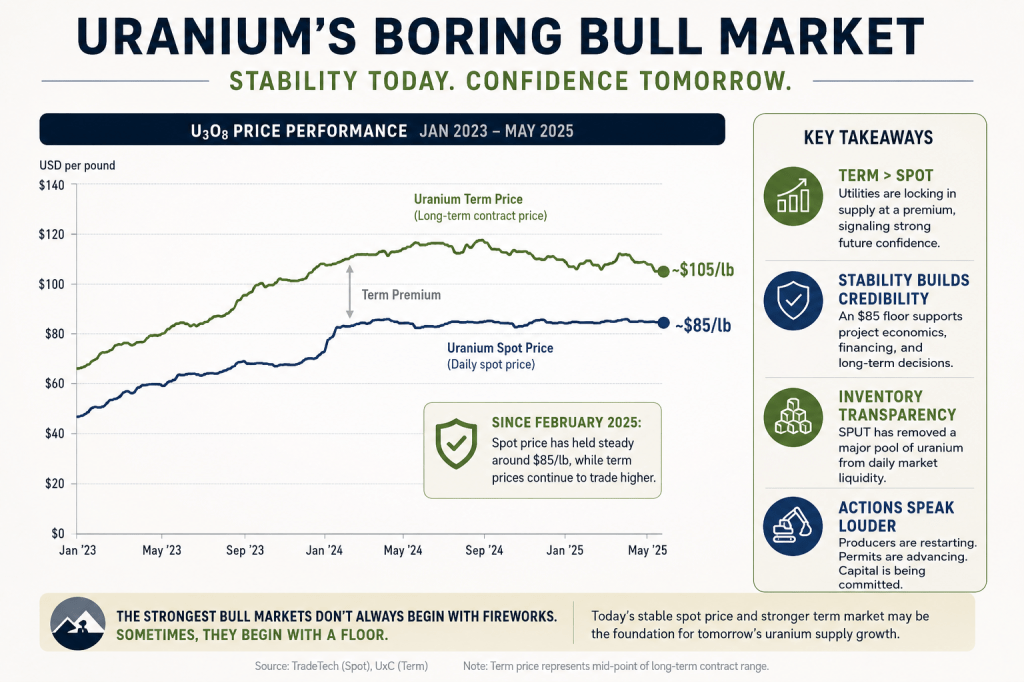
  • “Let Them Eat Cake”: Where Uranium Narratives Break Between Scarcity and Reality

    April 10th, 2026

    Spend five minutes reading investor-facing uranium content today and a familiar structure emerges:

    • Structural supply deficit
    • Reactor buildout
    • Energy security tailwinds
    • A coming “pinch point”

    The ingredients are always the same. The tone is increasingly confident. The conclusion feels inevitable.

    And then—almost as an afterthought—a company is inserted into the narrative as the logical beneficiary of that macro reality.

    The problem isn’t that the macro story is wrong.

    The problem is that it is often doing too much of the work.

    There’s an irony in how these narratives are constructed.

    The market is presented with “cake”—upside, scale, valuation expansion—while the harder question of “bread” is left unasked:

    What can actually be permitted, built, and delivered?


    The Narrative Engine

    There is a recognizable formula at play across much of the sector today:

    Step 1 — Establish inevitability
    Uranium is structurally undersupplied. Demand is visible. Supply is constrained.

    Step 2 — Borrow conviction
    Therefore, development-stage assets should re-rate.

    Step 3 — Introduce a lever
    A technical improvement, a recovery assumption, or a processing optimization becomes the hinge for value expansion.

    Step 4 — Add optionality
    The project could be built, joint ventured, or acquired.

    By the time the company is introduced, the reader is already convinced.

    The asset itself receives far less scrutiny than the story surrounding it.


    The Missing Layer: Where the Cake Replaces the Bread

    The market is not short on uranium narratives.

    It is short on projects that can:

    • be permitted
    • be financed
    • be constructed
    • and reach production inside the window the market is currently pricing

    This is where the gap lives.

    Between scarcity and production.
    Between concept and delivery.
    Between what can be imagined… and what can actually be delivered into the market.


    Clarity Before Commitment: A Decision Framework

    If uranium is entering a structurally tighter phase, then evaluation standards must tighten with it.

    A project is not defined by its resource alone. It is defined by the pathway required to convert that resource into production.

    That pathway can be evaluated across four intersecting domains:

    1. Geology

    • Grade, continuity, and distribution
    • Recoverability—not just presence
    • Variability across the deposit

    Not all pounds are created equal. Some are far easier to extract than others.

    2. Development Pathway

    • ISR vs. conventional mining
    • Processing requirements
    • Capital intensity
    • Timeline realism

    A shorter, simpler pathway often outweighs a larger, more complex resource.

    3. Permitting & Jurisdiction

    • Regulatory framework
    • Land status and access
    • Known constraints and precedent

    Time is not just a function of engineering—it is a function of governance.

    4. Stakeholder Alignment

    • Legacy context
    • Community positioning
    • Social license trajectory

    Projects do not exist in isolation. They unfold within systems of memory, governance, and trust.

    A project that scores highly in only one or two of these domains is not a development story.

    It is a conditional outcome.


    A Common Pattern Emerging

    Across current uranium narratives, a recurring structure is beginning to take shape:

    • A large, defined resource anchors the story
    • The development pathway is longer-dated and capital-intensive
    • A secondary asset offers a potentially faster, lower-friction route to production
    • The narrative emphasizes the larger asset while underweighting the more executable one

    This is not a geological problem.

    It is a sequencing problem.

    Value is being framed around what is big, not what is buildable.


    The Cost of Mis-Sequencing Value

    When narrative sequencing diverges from execution reality, several risks emerge:

    • Capital is allocated toward longer-dated uncertainty
    • Market expectations outrun permitting timelines
    • Technical improvements are treated as base case rather than upside
    • Stakeholder complexity is discounted until it becomes critical

    The result is not just delay.

    It is value erosion.

    The narrative offers cake. The market eventually demands bread.


    What the Market Will Actually Reward

    In a tightening uranium market, the winners are unlikely to be:

    • the largest resources
    • the most compelling narratives

    They will be the projects that can:

    • move through permitting with minimal friction
    • demonstrate repeatable, scalable extraction
    • align early and credibly with stakeholders
    • and reach production within the cycle being priced today

    Execution is not a downstream consideration.

    It is the entire game.


    Closing Reflection

    The uranium thesis is not new.

    Scarcity has been discussed for years.
    Supply constraints are well understood.
    Demand visibility is not in question.

    What remains uncertain is far more specific:

    Which projects can actually deliver?

    The next uranium cycle will not be defined by scarcity alone.

    It will be defined by which projects can translate that scarcity into production.

    That translation happens long before construction begins—
    in how projects are evaluated, framed, and sequenced.

    Clarity before commitment is not a preference.

    It is the difference between narrative and outcome.


    Not all pounds are equal.
    Some live in reports.
    Others make it into drums.

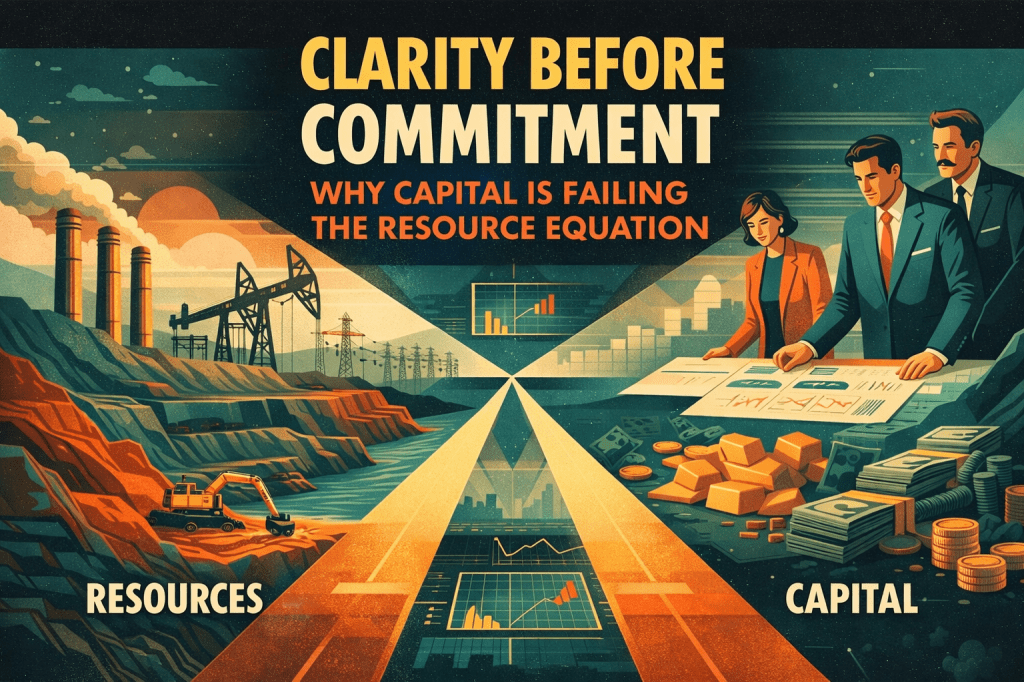
  • Clarity Before Commitment: Why Capital Is Failing the Resource Equation

    April 7th, 2026

    We’re watching markets debate interest rates, inflation prints, and employment data with near-religious intensity.

    Soft landing. Hard landing. No landing.

    The dashboards glow. The indicators flicker. The commentary flows.

    And yet, beneath all of it, something far more fundamental is being missed.

    We are debating the controls of a machine…
    without acknowledging that the machine itself is being rebuilt in real time.


    The Illusion of Control

    Modern financial systems are extraordinarily good at measuring motion.

    They track liquidity, price signals, labor participation, consumer demand—metrics that describe how the economy behaves within a given structure.

    But they are far less equipped to handle a more uncomfortable question:

    What happens when the structure itself changes?

    For decades, the global economic system operated on a set of assumptions that quietly underpinned everything:

    • Supply chains were global, stable, and optimized for cost
    • Inputs were available, fungible, and largely taken for granted
    • Energy systems, while imperfect, were sufficient
    • Capital efficiency mattered more than resilience

    Those assumptions are no longer reliable.

    What we are experiencing is not simply a cycle.

    It is a restructuring.


    Our Tastes Have Shifted (From Tea to Coffee)

    The system hasn’t just slowed down or overheated—it has changed its preferences.

    We’ve moved from a world that prioritized efficiency to one that increasingly demands resilience.

    From:

    • Just-in-time
      to
    • Just-in-case

    From:

    • Global optimization
      to
    • Strategic redundancy

    From:

    • Cost minimization
      to
    • Security of supply

    This shift didn’t happen overnight. It has been building quietly for years—through geopolitical friction, supply chain shocks, energy instability, and a growing recognition that dependency carries risk.

    But capital is still behaving as if the old system remains intact.

    It is analyzing signals within a framework that no longer fully applies.

    The inputs have changed.

    The expectations have changed.

    But the models have not.


    Capital Is a Claim, Not the Source

    At the center of this disconnect lies a simple but often overlooked truth:

    Capital does not create value. It claims it.

    Value still originates in the physical world:

    • In rock
    • In ground
    • In water
    • In energy
    • In systems that take time, labor, and expertise to develop

    Capital can accelerate, organize, and scale these systems.

    But it cannot replace them.

    And yet, markets often behave as though capital itself is the primary driver—as if liquidity alone can summon the materials required to sustain growth.

    This is where the misalignment begins.

    Because capital is being deployed into a world that increasingly refuses to respond on financial timelines.


    The Trillions Waiting on Reality

    There is no shortage of capital.

    Global institutions—JPMorgan Chase among them—have signaled trillions of dollars in potential investment toward energy transition, electrification, and infrastructure.

    On paper, the resources exist.

    But capital alone does not build systems.

    Resources do.
    Permitting does.
    Processing capacity does.
    Time does.

    And these are precisely the areas that have been neglected.

    We are attempting to deploy massive pools of capital into a system that has not been physically prepared to absorb it.

    That is not a funding gap.

    It is a capacity gap.


    Energy Reality and the Cost of Delay

    We continue to operate within a global energy framework heavily dependent on hydrocarbons.

    And with that dependency comes the same geopolitical tensions and conflicts that have shaped the past century.

    At the same time, viable alternatives exist:

    • Uranium as a dense, scalable energy source
    • Small Modular Reactors (SMRs) as a pathway to distributed, reliable baseload power
    • Electrification systems that underpin everything from transportation to data infrastructure

    These are not theoretical solutions.

    They are real, proven, and increasingly necessary.

    And yet, progress remains uneven.

    Not because the ideas are lacking—but because the execution requires something far more difficult:

    Materials, infrastructure, and time.


    Silver and the Myth of Infinite Supply

    Consider silver.

    Unlike gold, which is largely stored, silver is consumed.

    It is embedded in:

    • Electronics
    • Solar panels
    • Defense systems
    • Industrial applications

    It is burned, dispersed, and often unrecoverable at scale.

    Each year, more is used.

    And each year, the pace of replacement struggles to keep up with consumption.

    This is not a pricing anomaly.

    It is a physical reality.

    And it is emblematic of a broader truth:

    Some resources do not cycle cleanly back into supply.
    They disappear into progress.


    The Lost Decades of Downstream Development

    If we wanted to be competitive in this emerging landscape, we should have been building:

    • Domestic processing capacity
    • Refining infrastructure
    • Integrated supply chains

    Not recently.

    Decades ago.

    Instead, we optimized for cost.

    We offshored complexity.

    We deferred responsibility.

    We built a system that functioned efficiently—so long as nothing went wrong.

    Now, as conditions shift, we are left trying to reconstruct capabilities that were systematically dismantled.

    And we are discovering that rebuilding them is neither quick nor simple.


    Exploration: The Forgotten Foundation

    Beneath all of this lies the most overlooked component of the entire system:

    Exploration.

    Exploration is the research and development arm of mining.

    It is where future supply is discovered.

    It is where optionality is created.

    And it has been chronically underfunded.

    We are, in many cases, still drawing from deposits discovered decades ago.

    The pipeline of new discovery has not kept pace with rising demand.

    And this is not a problem that can be solved overnight.

    You cannot fast-track discovery.

    You cannot shortcut geology.

    You cannot will new deposits into existence through policy or capital allocation alone.


    The Compression Problem

    We now find ourselves attempting to compress:

    • Decades of underinvestment
    • Years of deferred infrastructure
    • Generations of overlooked exploration

    Into a single economic cycle.

    It will not work.

    Because time—the one input that underpins all resource development—is not compressible.

    You can accelerate capital deployment.

    You can streamline policy.

    You can incentivize production.

    But you cannot eliminate the time required to discover, permit, develop, and scale physical systems.


    The Inversion: Capital Follows Reality

    For much of the modern era, the prevailing assumption has been:

    Capital leads. Development follows.

    But in a world defined by physical constraints, that relationship inverts.

    Reality leads. Capital follows.

    Markets do not create supply.

    They respond to its presence—or its absence.

    And increasingly, they are beginning to encounter both.


    Decision Infrastructure: Bridging the Gap

    This is where the real work begins.

    Because the gap between:

    • capital that assumes
      and
    • geology that decides

    is widening.

    Bridging that gap requires more than data.

    It requires interpretation, context, and judgment.

    It requires understanding not just what is possible—but what is real.

    This is what I refer to as decision infrastructure:

    The layer of insight that connects:

    • physical reality
      to
    • capital deployment

    Before commitments are made.
    Before systems are built.
    Before value is assumed.


    Clarity Before Commitment

    We are entering a phase where physical constraints are reasserting themselves.

    Where inputs matter.

    Where access matters.

    Where time matters.

    And in that world, the cost of getting it wrong increases.

    Significantly.

    Because capital deployed without clarity does not just underperform.

    It compounds error.


    Where It All Begins

    Before capital deploys…
    Before infrastructure scales…
    Before policy succeeds…

    There has to be something real.

    Mining does not start at the mine.

    It starts at the decision to understand what is actually there.

    And until that connection between capital and reality is restored—

    We will continue to misprice, misallocate, and misunderstand the very foundation of the systems we depend on.


    This is not a cycle.

    It is a reckoning with reality.

    And reality, as it always does, will set the terms.

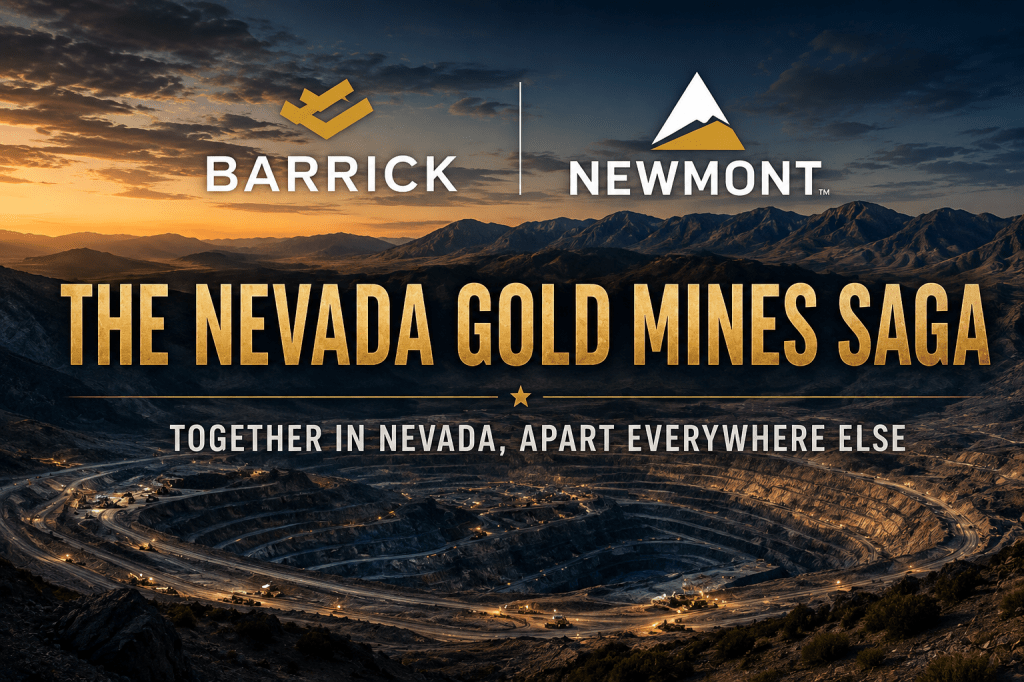
  • NGM Saga: Act III — Control Beneath the Surface

    April 2nd, 2026

    There’s a subtle shift underway.

    Not in the rocks. Not in the assets themselves.
    But in the tone surrounding them.

    What began as a forward-leaning narrative—an IPO, a carve-out, a reframing of North American gold—has quietly evolved into something more measured. More deliberate. More controlled. The kind of shift that doesn’t announce itself, but reveals itself in structure, in sequencing, and in the careful selection of who is placed where.

    And in this business, those signals matter.


    Act II Revisited — When the Fracture Became Visible

    The last time Barrick Mining Corp. moved decisively on leadership around Nevada Gold Mines, the context was unmistakable. It wasn’t strategic positioning in a vacuum—it was a response to pressure. A response to fracture. A response to a notice of default from Newmont Corp. that could not be ignored.

    The tone then was defensive, and appropriately so. Governance was reinforced. The perimeter was fortified. The introduction of figures like Ben van Beurden and Pekka Vauramo carried weight not because of what they would build, but because of what they would stabilize. Their presence signaled discipline, oversight, and a tightening of the system at a moment when it needed it.

    That move said, plainly: something is wrong—secure it.


    Act III — A Different Kind of Move

    This time feels different.

    Not reactive—but restrained.

    With the IPO pathway still in view, Barrick has introduced a new North American leadership structure anchored by Tim Cribb as Chief Operating Officer and Wessel Hamman as Chief Financial Officer. These are not external hires brought in to excite markets or reframe the story. They are internal operators—individuals steeped in the existing system, fluent in its rhythms, and capable of maintaining continuity.

    And that choice is revealing.

    Because this is not a leadership team assembled to expand the narrative. It is one assembled to refine it. To stabilize it. To present it in a way that emphasizes reliability over ambition, consistency over speculation.

    Not growth, but predictability.
    Not expansion, but credibility.

    In isolation, those are prudent choices. In sequence, they begin to tell a larger story.


    The Structure Beneath the Structure

    Perhaps the clearest signal lies in a detail that, at first glance, appears redundant: the presence of two Chief Technical Officers.

    Megan Tibbals assumes the role of Chief Technical Officer for North America, while Richard Peattie holds the Chief Technical Officer position at the global level.

    On paper, duplication. In practice, design.

    Tibbals operates at the asset level—grounded in Nevada, in operations, in the practical conversion of geology into production. Peattie operates above that layer—ensuring consistency, maintaining standards, and anchoring the technical narrative within Barrick’s broader framework.

    One advances the asset.
    One oversees its interpretation.

    This is not redundancy. It is governance layered directly into the technical function. A structure that allows the North American business to move toward a standalone identity while ensuring that the interpretation of that business—how it is framed, disclosed, and understood—remains firmly within controlled bounds.

    Because at this stage, technical work is not just geology.

    It is narrative. It is disclosure. It is trust.

    And trust, in an IPO environment, is not left to chance.


    The Questions That Remain

    For all the clarity introduced in leadership and structure, there is a parallel absence of clarity elsewhere.

    The deeper questions—those that define the system beneath the system—remain unresolved.

    What is the long-term trajectory of Nevada Gold Mines as a joint venture? Where does Newmont Corp. ultimately sit within that evolving structure? And how does the previously undisclosed royalty over Fourmile factor into valuation, control, and future optionality?

    These are not peripheral considerations. They are structural realities—elements that shape not only the asset, but the framework through which the asset is understood and valued.

    And yet they remain, for now, unaddressed.

    Not resolved.
    Not denied.
    Simply deferred.

    Not necessarily out of avoidance, but perhaps out of strategy. Because to resolve them now would be to fix variables that, in their current state, retain flexibility. And in a moment like this, flexibility has its own kind of value.


    From Defense to Presentation

    Taken together, a pattern emerges.

    The earlier leadership adjustments were about defending the structure—reinforcing governance in response to external pressure. The current moves are about presenting that structure—refining how it is perceived, stabilizing how it is communicated, and preparing it for external valuation.

    The asset has not changed.
    The complexity has not disappeared.
    But the objective has shifted.

    Operators are now at the forefront. Financial discipline is emphasized. Technical oversight is layered, not for expansion, but for consistency.

    This is not a team built to swing.

    It is a team built to steady.

    Because in the context of an IPO, the incentives are clear. Volatility erodes confidence. Complexity invites scrutiny. Scrutiny compresses valuation. And so the system responds—not by altering its core, but by refining its presentation.


    Beneath the Surface

    The IPO still stands. The assets remain Tier 1. The outward narrative holds.

    But beneath it, the structure is still evolving. Relationships remain fluid. The full shape of the system has yet to be completely defined.

    And yet, the process moves forward.

    Not in spite of that complexity—but alongside it.

    Because in markets like these, clarity is not always the immediate objective.

    Sometimes, it is optionality.


    Clarity Before Commitment

    There is a principle I return to often: clarity before commitment.

    Not as an abstract ideal, but as a practical discipline. Because in this industry—whether evaluating a drill program or structuring a multi-billion-dollar asset—decisions made without clarity do not eliminate risk. They relocate it. They move it downstream, where it becomes embedded in valuation, in partnership dynamics, in the fine print that only comes into focus once capital is already deployed.

    What we are seeing here is a different sequencing.

    Not careless. Not uninformed. But staged.

    A system in which structural clarity is still emerging—ownership dynamics, royalty implications, long-term governance—while capital formation advances in parallel.

    This is not unusual. But it is instructive.

    Because it suggests a willingness to allow the market to participate not just in the upside of the asset, but in the ongoing definition of the structure itself.


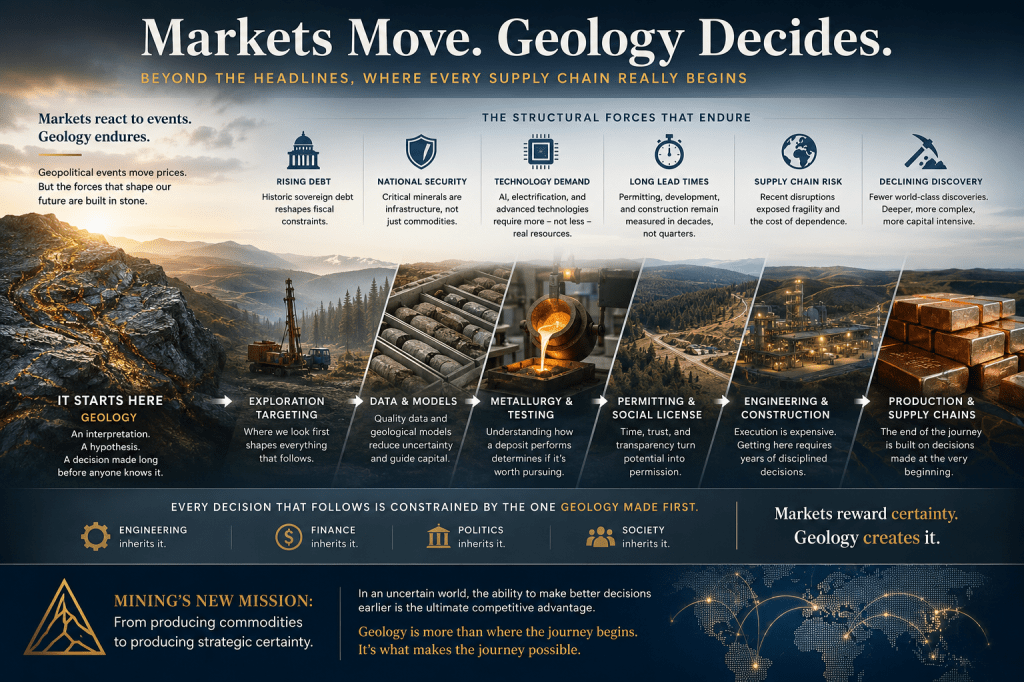
    Geology as Decision Infrastructure

    At its core, geology is not simply about describing what exists. It is about reducing uncertainty to a level where decisions can be made with confidence.

    Geology is decision infrastructure.

    It defines the constraints. It frames the possibilities. It delineates what is known, what is probable, and what remains open. From that foundation, decisions follow—disciplined, grounded, and defensible.

    But when the structure surrounding the geology is less resolved than the geology itself—when ownership, royalties, and governance are still shifting—then the infrastructure is not incomplete.

    It is misaligned.


    A Different Kind of Bet

    None of this diminishes the quality of the asset. Nevada remains one of the most prolific gold systems in the world. None of this precludes success in an IPO context. The market may well respond favorably to a narrative built on jurisdictional strength, established production, and operational continuity.

    But the sequencing matters.

    What is being advanced here is not just an asset, but a framing of that asset—one that emphasizes stability, predictability, and control, while allowing deeper structural questions to remain just beyond the immediate field of view.

    That is the bet.

    That the visible layers will carry the valuation, while the underlying complexity remains deferred, not denied.


    The Quiet Divergence

    From where I sit, the divergence is clear.

    My bias—my work—is to push toward clarity first. To map the system, define the unknowns, and establish the framework before capital is committed.

    Here, the approach appears inverted.

    Stabilize the narrative.
    Structure the leadership.
    Advance the vehicle.
    Let clarity follow.

    It is not wrong.

    But it is different.


    Closing

    The message has shifted.

    Not from confidence to concern—but from ambition to control.

    The upside remains. The system still holds more than is currently being expressed. But for now, the priority is not to expand that story. It is to contain it. To present something that behaves less like a dynamic exploration system and more like stable infrastructure.

    And in doing so, to meet the market where it is.

    The rocks may still be telling a story of growth.

    But the structure around them is telling a story of control.

    And somewhere between those two—

    is where the real valuation will be decided.

  • Silver in the Quiet Squeeze: When Utility Outpaces Narrative

    March 31st, 2026

    Introduction: The Metal That Refuses to Pick a Lane

    Silver has always been a contradiction.

    It is both money and matter.
    A relic and a requirement.
    A hedge… and a consumable input that disappears into the modern world.

    And right now, that contradiction is tightening—not explosively, not theatrically—but steadily, almost uncomfortably so.

    While gold commands headlines and central bank balance sheets, silver is doing something more subtle: it is being used up.


    The Structural Backbone: Industrial Demand Isn’t Cyclical Anymore

    Unlike previous cycles, silver’s industrial demand profile has shifted from cyclical to structural.

    This is not just about electronics anymore—it’s about systems:

    • Photovoltaics (solar)
    • Electrification infrastructure
    • EVs and battery systems
    • Advanced electronics and semiconductors
    • Defense and high-performance applications

    Silver’s unmatched conductivity—both electrical and thermal—makes it extremely difficult to substitute without performance loss. That matters in a world increasingly defined by efficiency and energy density.

    Organizations like the Silver Institute have consistently highlighted a growing supply-demand imbalance, driven not by speculation—but by fabrication demand.

    And here’s the quiet part that rarely gets airtime:

    Much of that silver is not coming back.

    Unlike gold, which is hoarded, stored, and recycled efficiently, silver is often dissipated in tiny quantities across millions of devices. It is, in many cases, economically unrecoverable.

    That’s not a trading dynamic. That’s a depletion dynamic.


    Supply Reality: Byproduct Metal, Secondary Priority

    Silver does not behave like a primary commodity in most cases.

    Roughly 70% of global silver production comes as a byproduct of mining:

    • Lead-Zinc
    • Copper
    • Gold

    This means supply is not primarily driven by silver price—it’s driven by base metal economics.

    Even if silver prices rise, you don’t suddenly see a proportional increase in supply. You see lag, constraint, and dependence on entirely different commodity cycles.

    Major producers tracked through exchanges like the London Bullion Market Association reflect this reality in liquidity—but not necessarily in physical tightness at the margin.

    And that margin is where things tend to break.


    The Monetary Layer: Silver Lives in Gold’s Shadow… Until It Doesn’t

    Silver’s price behavior is still tethered—psychologically and structurally—to gold.

    The gold-silver ratio remains one of the most telling indicators of sentiment imbalance. Historically:

    • High ratios → silver undervaluation relative to gold
    • Low ratios → silver outperforming in late-cycle or speculative phases

    But here’s the nuance worth paying attention to:

    Gold is being accumulated by central banks.
    Silver is not.

    Gold is a reserve asset.
    Silver is a pressure valve.

    When monetary stress intensifies—whether through currency debasement, geopolitical fragmentation, or liquidity shocks—capital flows into gold first.

    Silver follows later… but moves faster.


    Geopolitics & Fragmentation: The Quiet Multiplier

    Layer in current global dynamics:

    • Supply chain re-shoring
    • Strategic mineral security
    • Energy transition policies
    • Growing fractures in global trade alignment

    If the global system becomes more fragmented—whether through blocs like BRICS or regional industrial policy—then silver demand becomes more localized, less efficient, and more competitive.

    And importantly:

    More stockpiled. Less shared.

    That’s when a commodity shifts from “available” to “strategic.”


    The Mismatch: Paper Liquidity vs. Physical Reality

    Silver trades heavily in paper markets—futures, derivatives, ETFs—where liquidity is deep and price discovery is fast.

    But physical markets move slower. Tighter. More stubbornly.

    This creates a persistent tension:

    • Paper markets suggest abundance
    • Physical flows suggest constraint

    Most of the time, paper wins.

    Until it doesn’t.

    And when that gap closes, it rarely does so gently.


    What This Means (Without the Hype)

    This is not a call for a parabolic price spike.

    It’s something more grounded—and arguably more important:

    Silver is entering a period where:

    • Demand is structurally rising
    • Supply is structurally constrained
    • Above-ground inventory is quietly eroding

    That doesn’t guarantee explosive price action.

    But it does suggest something far more durable:

    A rising floor.


    Why This Matters for Exploration (Especially in the U.S.)

    For the domestic exploration narrative, this is where things get interesting.

    Silver rarely justifies a project on its own—but:

    • High-grade silver systems
    • Polymetallic CRDs (your wheelhouse)
    • Silver-rich epithermal systems

    …start to look very different when silver moves from “bonus metal” to “value driver.”

    In a world prioritizing domestic supply chains and strategic resilience, projects that were once marginal can become relevant again—not because of hype, but because of context.


    Conclusion: The Metal That Waits

    Silver doesn’t announce itself loudly.

    It builds pressure.

    Quietly. Persistently. Across supply chains, balance sheets, and industrial systems.

    And then, at some point—not on a schedule, not on cue—it moves.

    Not because the narrative changed.

    But because reality caught up.


  • Signal vs. Permission: The Lag Between Insight and Capital

    March 27th, 2026

    Out in the field, the pattern reveals itself quietly.

    Not with a headline—but with a hint. A subtle shift in structure. A geochemical whisper. A line of alteration that doesn’t quite belong unless something larger is at work beneath it. The kind of thing you don’t prove in a day… but you know in a moment.

    You call it early.

    You’re right.

    …and nothing happens.

    Weeks pass. Sometimes months. The market drifts, distracted by noise—rates, headlines, geopolitics, whatever storm happens to be passing overhead. Then, almost on cue, a note comes out from a major house. A strategist at Sprott or BlackRock or Goldman Sachs says the same thing you saw weeks ago.

    Suddenly, it’s real.

    Not because it’s new—but because it’s been authorized.


    Two Economies, One Market

    There are, in truth, two parallel systems operating beneath the surface of every commodity cycle.

    The first is the signal economy—the domain of geologists, analysts, independent thinkers, and those willing to look across disciplines and timeframes. This is where insight forms before it is fully defensible. Where incomplete data still resolves into coherent patterns. Where cause is glimpsed before effect is measurable.

    The second is the permission economy—the realm of institutions, funds, and capital allocators. Here, insight must be proven, repeatable, and survivable under scrutiny. It must pass through layers of risk committees, portfolio constraints, and reputational filters before a single dollar moves.

    The signal economy asks: What is happening?
    The permission economy asks: Can we act on it without regret?

    The market only moves when both agree.


    Gold’s Recent Lesson in Liquidity

    The recent drawdown in gold offers a clean case study.

    As outlined by Sprott strategist Paul Wong, the selloff was not driven by failing fundamentals, but by a global liquidity squeeze—forced deleveraging, reserve flow disruptions, and a tightening financial environment. These are not new observations. Variations of this thesis have circulated among macro desks, independent analysts, and commodity specialists for months.

    Yet it wasn’t until firms like Sprott formalized the narrative that the explanation began to anchor itself in broader market consciousness.

    This is the critical distinction:
    The information did not change.
    The authority behind it did.

    And with that authority comes consequence.

    Because by the time the large houses publish:

    • Hedge funds have already begun unwinding leverage
    • Sovereign flows have already slowed or reversed
    • Liquidity stress has already expressed itself in price

    The note doesn’t initiate the move.

    It explains the move—often after the first act has already played out.


    The Cost of Being Early

    There is a quiet penalty for those who operate ahead of consensus.

    Being early, in markets, carries the same outward appearance as being wrong. Positions move against you before they move for you. Narratives lag behind your thesis. Conviction is tested not by logic, but by time.

    Institutions are structurally designed to avoid this phase.

    A firm like Goldman Sachs is not rewarded for identifying a trend first. It is rewarded for allocating capital once that trend is sufficiently validated to absorb size without existential risk. Likewise, asset managers like BlackRock must operate within constraints that prioritize durability over discovery.

    So they wait.

    They wait for:

    • Data density across multiple indicators
    • Confirmation in positioning (derivatives, flows, leverage)
    • Narrative cohesion across markets

    Only then do they step in—not as discoverers, but as amplifiers.


    Narrative as Infrastructure

    Markets do not move on truth alone. They move on shared belief.

    A liquidity-driven selloff in gold is just a datapoint until it becomes a story that enough participants understand and accept. That story must be simple enough to travel, robust enough to withstand scrutiny, and credible enough to carry capital.

    This is where institutional voices play an outsized role.

    When Sprott frames gold’s decline as a liquidity event rather than a structural failure, it does more than interpret—it stabilizes expectation. It prevents a bearish spiral of misinterpretation and instead sets the stage for what may come next: policy response, monetary easing, and eventual reacceleration.

    In this sense, narrative is not commentary.

    It is infrastructure.


    Positioning Before Permission

    There is another layer—rarely discussed, but deeply felt by those paying attention.

    By the time the narrative is published:

    • Positions have already been adjusted
    • Risk has already been transferred
    • Weak hands have often already been shaken out

    The market has, in effect, already paid for the insight.

    Just not to those who first articulated it.

    This is the tension at the heart of the system.

    The signal economy produces value early.
    The permission economy captures value later—with scale.


    Why This Matters in Nevada

    For those of us working in Nevada’s mineral systems—gold, silver, lithium, copper, and the broader suite of critical materials—this dynamic is not abstract. It is lived experience.

    Nevada is, in many ways, the physical embodiment of the signal economy:

    • World-class geology long recognized before capital fully commits
    • Districts revisited multiple times before consensus aligns
    • Projects that oscillate between obscurity and prominence depending on macro narrative

    Consider how long certain Carlin-type concepts, lithium claystones, or uranium roll-front models lingered in the background before capital cycles brought them back into focus. The rocks did not change.

    The permission to act on them did.

    Today, as global supply chains strain and the strategic importance of domestic resources becomes clearer, Nevada sits at the intersection of signal and permission once again. The geology is known. The endowment is proven. The expertise exists.

    What remains variable is the timing of capital.

    And that timing will not be dictated solely by geology—it will be dictated by when institutions collectively decide:

    “Now is the moment.”


    Where the Edge Lives

    For those operating upstream—geologists, independent advisors, early-stage thinkers—the objective is not to wait for that moment.

    It is to recognize the sequence:

    1. Signal emerges
    2. Market uncertainty
    3. Institutional confirmation
    4. Capital deployment

    The opportunity resides between the first and the third step.

    It is an uncomfortable space—low clarity, high risk, minimal validation. But it is also where asymmetry lives. Where positioning can occur before the narrative hardens. Where insight has not yet been arbitraged away by scale.


    Closing Reflection

    It is tempting, in moments like these, to view institutional confirmation as tardy. To see it as a delayed acknowledgment of what was already evident.

    But that misses the deeper structure.

    The prospector finds the vein.
    The syndicate funds the mine.

    And the market only moves when both agree—

    even if one of them knew all along.

  • NGM Saga continues; Enter Stage Left: The Royalty Nobody Talked About

    March 19th, 2026


    When Great Discoveries Meet the Fine Print


    There are moments in mining where the story feels almost too clean.

    A major discovery emerges. The grades are exceptional. The scale is undeniable. The infrastructure is already there. The timelines begin to take shape. The narrative writes itself—efficient, elegant, inevitable.

    Fourmile, in Nevada, is one of those discoveries.

    It is, without question, a significant discovery. High-grade, long-life, strategically located within one of the most productive gold belts on Earth. The kind of asset that doesn’t just move a needle—it redraws the chart.

    And just as that story begins to crystallize…

    Enter stage left: Teck.

    With a quiet but very real reminder—
    a 10–15% net profits interest over a meaningful portion of the ground.

    Not a geological problem.
    Not a technical flaw.
    But something far more subtle—and far more powerful.

    A reminder that in mining, the story is never just about the rock.


    The Discovery Is Real—But So Is the Structure

    Let’s be clear: Fourmile deserves the attention it’s getting.

    Discoveries of this caliber don’t come around often. The grades, the continuity, the scale—these are the ingredients of a Tier 1 asset. In many ways, Fourmile represents the culmination of decades of understanding Nevada’s Carlin-type systems and the structural controls that govern them.

    But Fourmile is also something else.

    It is not a discovery made in isolation.

    It exists within a mature, heavily explored, and deeply transacted district—one where land positions, agreements, royalties, and joint ventures have been layered over time like stratigraphy itself.

    And that’s where the royalty comes in.

    Teck’s net profits interest is not new. It wasn’t conjured out of thin air. It is the product of prior ownership, prior deals, prior visions of what this ground might one day become.

    In other words:

    The geology may be newly revealed—but the ownership history is not.


    When the Ownership Stack Comes Due

    A 10–15% net profits interest is not a rounding error.

    It is a direct participation in the economic engine of the project. It touches cash flow. It influences valuation. It shapes how the asset is perceived—especially in the context of a broader corporate strategy like a spinout or IPO.

    And timing matters.

    As Barrick advances plans to carve out its North American assets into a new publicly listed entity, Fourmile sits prominently among them. It is a flagship. A cornerstone. A driver of future value.

    But value, in mining, is never just about ounces in the ground.

    It is about what portion of those ounces you actually control—and what portion has already been spoken for.

    This is where the narrative shifts.

    Not dramatically. Not catastrophically. But meaningfully.

    Because:

    Not all ounces are created equal.
    And not all of them are fully yours.


    The Quiet Reality: Discovery vs. Ownership

    This is where we step out of the headline and into the deeper layer—the one that often doesn’t get the same airtime.

    Fourmile is a significant discovery.
    But it is not, strictly speaking, true greenfield exploration.

    And that distinction matters.

    Fourmile exists within the broader Nevada Gold Mines ecosystem—a region with decades of drilling, data, reinterpretation, and evolving geological models. The discovery is the result of refinement, persistence, and deeper understanding, not the first recognition of a system in untouched ground.

    That’s not a critique. In fact, it’s a testament to how world-class districts continue to give—if you know how to listen.

    But it does come with a trade-off.

    Because mature districts carry history.

    And history, in mining, comes with:

    • Royalties
    • Legacy agreements
    • Joint venture structures
    • Fragmented ownership layers

    Each one subtle on its own.
    But together, forming an ownership stack that can materially shape the outcome.


    The Greenfield Contrast — The Purity of First Position

    This is where the conversation turns—and where the lesson sharpens.

    There is a reason that greenfield exploration still holds a special place in the hierarchy of opportunity.

    Not because it is easier. Quite the opposite.

    Greenfield exploration carries the highest geological risk. You are stepping into uncertainty. You are testing ideas against silence. You are, quite literally, asking the Earth a question and waiting for an answer.

    But if that answer comes back positive…

    You hold something rare:

    Clarity of ownership.

    No legacy royalties.
    No historical encumbrances.
    No prior claims on future value.

    Just you, the ground, and whatever you discover.

    That is the purest form of exploration.

    One risks the drill bit.
    The other risks the cap table.

    In brownfield environments like Nevada, the geological risk may be lower—but the structural complexity is higher. The discovery may be exceptional, but the value must flow through a pre-existing framework of agreements that were never designed with this exact outcome in mind.

    And when those agreements surface—like Teck’s royalty has—they don’t diminish the discovery.

    But they do redefine it.


    Geology Is Only One Part of the Equation

    This is the heart of it—and it sits squarely within the NGM lens.

    Mining is not just a story of rocks.
    It is a story of decisions layered over time.

    Geology.
    Land tenure.
    Agreements.
    Capital structure.

    Each one interacting with the others.

    Each one shaping what a discovery ultimately becomes—not just in technical terms, but in economic reality.

    Fourmile is a powerful reminder of this.

    It shows us that even the best discoveries in the world are not immune to the past. That ownership, once defined, has a way of echoing forward into the future—sometimes quietly, sometimes all at once.


    The Takeaway

    Fourmile remains one of the most compelling gold discoveries in recent memory.

    That hasn’t changed.

    But the emergence of a meaningful royalty over the project reframes the conversation—not by diminishing the asset, but by adding dimension to it.

    Because in mining, the win condition is not simply to discover.

    It is to discover and control.

    And when those two things diverge—even slightly—the market takes notice.

    As it should.


    NGM — Nevada Gold Mines, and the lessons beneath them.

    Because the rock was never the only story.

  • Strategic Mineral Reserves Only Work if the Geology Works

    March 9th, 2026

    Why permitted mines are only the beginning of America’s critical mineral supply chain

    Over the past year, a subtle shift has begun to ripple through Washington’s policy circles.

    Minerals—once treated largely as commodities governed by global markets—are increasingly being discussed in the language of national resilience. Copper, cobalt, antimony, and other materials have entered the conversation not merely as inputs for industry, but as strategic resources tied to defense, energy systems, and advanced manufacturing.

    Initiatives such as “Project Vault,” proposed with financing support through the Export-Import Bank of the United States, reflect this new thinking. The concept envisions a decentralized American reserve of critical minerals designed to buffer domestic industry from supply shocks, geopolitical leverage, or sudden disruptions in global supply chains.

    The idea itself is simple and compelling: if certain minerals are strategically important, the United States should ensure reliable access to them.

    Anyone who has spent time working on exploration and development projects knows that the journey from a mineral deposit to a producing mine is rarely simple.

    But strategic reserves do not begin in vaults.

    They begin in the rocks.


    A Short List of “Ready” Projects

    Recent policy discussions often point to a handful of U.S. mining projects described as “permitted and ready to deliver” the minerals needed for a resilient domestic supply chain.

    One such list circulating in policy circles includes projects like:

    • Perpetua Resources — Stibnite Project, Idaho (gold and antimony)
    • Hudbay Minerals — Copper World Project, Arizona
    • U.S. Gold Corp. — CK Gold Project, Wyoming
    • Highland Copper Company — Copperwood Project, Michigan
    • Arizona Sonoran Copper Company — Cactus Project, Arizona
    • Bunker Hill Mining — Bunker Hill Mine, Idaho
    • Gunnison Copper — Johnson Camp, Arizona
    • Sandfire Resources America — Black Butte Copper, Montana
    • Jervois Global — Idaho Cobalt Operations
    • Florence Copper — Florence Copper Project, Arizona

    Collectively, these projects represent billions of dollars in potential investment and a significant opportunity to expand domestic supply of metals essential to modern industry.

    From a policy perspective, the logic is straightforward: these projects have permits, therefore they represent near-term production capacity.

    From the perspective of someone who has worked inside exploration and development projects, the story is more nuanced.


    The Long Distance Between Permit and Production

    In public discussions about mining, permits are often treated as the final hurdle.

    In reality, they are closer to the starting line.

    Between a permitted project and an operating mine lies a long and uncertain stretch of road:

    • additional drilling and resource refinement
    • metallurgical testing and processing design
    • detailed engineering and feasibility work
    • capital financing
    • infrastructure development
    • construction timelines that often span years

    Even well-advanced projects typically require several years—and substantial capital—to move from permit to production.

    This is not a flaw in the system. It is simply the nature of building complex industrial operations around geological deposits that formed millions of years ago under conditions we are still working to understand.

    The rocks may be known.

    Turning those rocks into reliable supply takes time.


    Every Deposit Is Its Own Geological Story

    Another quiet reality rarely captured in policy lists is that no two mineral deposits behave exactly the same way.

    Copper porphyry systems differ dramatically from sediment-hosted copper deposits. Cobalt mineralization presents different metallurgical challenges than gold. Underground operations carry different cost structures than open-pit mines or in-situ recovery systems.

    Two deposits producing the same metal can require entirely different mining methods, processing technologies, infrastructure footprints, and capital investments.

    A list of projects may appear interchangeable on paper.

    In the field, each represents its own geological puzzle.

    Understanding those differences—and how they influence timelines, risk, and scalability—is where geological interpretation becomes essential.


    Strategic Mineral Policy Meets Geological Reality

    The renewed focus on domestic mineral supply is both welcome and overdue.

    For decades, the United States relied on global markets to deliver the materials needed for everything from electronics to defense systems. Recent geopolitical tensions and supply disruptions have exposed the fragility of that approach.

    Programs like Project Vault reflect an emerging consensus: supply chains for critical minerals deserve strategic attention.

    In policy circles this conversation is often framed in terms of supply chain resilience, industrial base security, and the need for friend-shoring or domestic sourcing of critical materials. These are important goals, and they reflect a growing recognition that minerals underpin modern manufacturing and defense systems alike. But achieving that resilience ultimately depends on something far more fundamental: understanding the deposits themselves—the geology, the metallurgy, and the practical realities that determine whether a mineral resource can truly become supply.

    Strategic policy must ultimately intersect with geological reality.

    Decision-makers in government agencies, manufacturing firms, and investment funds increasingly find themselves asking questions that sit squarely in the geological domain:

    • How robust are these resources?
    • How scalable are the deposits?
    • What geological risks remain unresolved?
    • How quickly could production realistically begin?

    These questions cannot be answered through policy frameworks alone.

    They require people who understand the ground beneath the proposals.


    The Quiet Role of Geological Judgment

    In mining, geology sits upstream of everything.

    Before financing, before engineering, before construction, there must first be a deposit—one that can be mined economically, processed effectively, and developed responsibly.

    Exploration geologists spend careers learning to read those signals in the Earth: the structure of the rock, the chemistry of the mineralization, the geometry of the orebody, and the countless clues hidden in drill core and outcrop.

    Those interpretations rarely make headlines.

    But they quietly determine whether a project becomes a mine—or remains a promising idea on paper.

    As strategic mineral initiatives expand, the need for clear geological interpretation will only grow. Policymakers and investors alike must translate mineral resources into timelines, risk assessments, and development strategies.

    In that process, geology becomes something more than an academic discipline.

    It becomes a form of decision infrastructure.


    The Opportunity Ahead

    The United States is rediscovering a simple truth that earlier generations understood well: civilization runs on the materials of the Earth.

    Copper wires carry electricity. Cobalt stabilizes batteries. Antimony strengthens alloys used in defense systems. Rare elements hidden in rock formations underpin technologies that define modern life.

    Ensuring reliable access to those materials is a legitimate strategic goal.

    But initiatives like Project Vault will succeed not because minerals are declared strategic in Washington.

    They will succeed because exploration geologists find deposits, engineers design viable mines, investors commit capital, and communities support responsible development.

    Strategic reserves may ultimately sit in warehouses, supply contracts, or financial instruments.

    Yet their origins trace back to a much older place.

    The outcrop.
    The drill core.
    The rocks beneath our feet.

    Because in the end, strategic mineral reserves only work if the geology works.

  • NGM’s Real Challenge Might Not Be Newmont

    March 7th, 2026

    For the past several weeks, headlines in northern Nevada’s mining world have focused on the dispute between Barrick and Newmont over Nevada Gold Mines (NGM). A formal notice of default, questions over the Fourmile project, and the expiration of a 30-day cure period have fueled speculation about what comes next for the world’s largest gold-producing complex.

    The corporate drama is real. But the boardroom fight between two global mining giants may not be the only force shaping what happens next in Elko County.

    A quieter shift may be underway across the district itself.

    And if it continues to develop, the most meaningful pressure on Nevada Gold Mines may not come from Denver or Toronto—but from right here in northern Nevada.


    The Era of the NGM Super-Operator

    When Barrick and Newmont formed Nevada Gold Mines in 2019, the joint venture consolidated the core of the Carlin Trend and surrounding districts into a single operational powerhouse.

    Carlin.
    Cortez.
    Turquoise Ridge.

    Combined under one management structure, NGM became something rarely seen in the mining industry: a single operator controlling the majority of a world-class gold district.

    The scale of that consolidation was enormous. NGM quickly became the largest gold mining complex on Earth, producing millions of ounces annually and employing thousands of workers across northeastern Nevada.

    The effect on the regional mining economy was equally significant.

    For much of the past decade, Nevada Gold Mines became the gravitational center of the district’s workforce. Skilled miners, engineers, geologists, contractors, and service providers largely orbited around the operations of a single dominant employer.

    In practical terms, if you worked in gold mining in northern Nevada, there was essentially one primary destination.

    NGM set the tempo.


    The Corporate Dispute

    That stability is now being tested.

    Earlier this year, Newmont issued a formal notice of default to Barrick regarding the Nevada Gold Mines joint venture, alleging that resources from the JV had been diverted to the Fourmile project—a high-grade gold discovery wholly owned by Barrick and located near existing NGM infrastructure.

    Under the terms of the joint venture agreement, Barrick was given 30 days to remedy the alleged breach.

    That deadline passed in early March.

    Both companies have publicly emphasized that local operations are expected to remain unchanged while discussions continue. Barrick has stated that it does not anticipate impacts to staffing or day-to-day operations, while Newmont has framed the dispute as a governance matter intended to ensure the joint venture is managed according to the terms of the agreement.

    For workers and contractors across Elko County, the message has been one of continuity.

    And at the corporate level, that messaging makes sense. When large mining companies are in dispute, the last thing either side wants is instability in the workforce or uncertainty in the district.

    But mining districts are dynamic systems.

    And outside the walls of corporate negotiations, the ground may be shifting.


    A District That May Be Waking Up Again

    For years, Nevada Gold Mines has operated in a regional environment with relatively limited direct competition for labor.

    That dynamic may be beginning to change.

    Two developments in particular could reshape the labor landscape across northern Nevada in the coming years.

    The first is Orla Mining’s South Railroad Project.

    Located in the historic Pinion district south of Carlin, South Railroad is advancing toward production and represents one of the most significant new gold developments in the region in years. Construction, development, and eventual operations will require a full complement of skilled personnel—from equipment operators and maintenance crews to engineers, environmental specialists, and exploration geologists.

    Even a few hundred additional jobs can meaningfully affect the labor dynamics of a community the size of Elko.

    The second potential shift comes from the north.

    First Majestic Silver has been evaluating pathways toward restarting the Jerritt Canyon gold mine complex. Once a major underground operation employing hundreds of workers, Jerritt Canyon has been idled in recent years as the company reassesses processing economics and operational strategy.

    A restart would not simply reopen a mine—it would reactivate an entire ecosystem of underground mining expertise, processing personnel, contractors, and exploration teams.

    Together, these developments suggest the possibility of something northern Nevada has not experienced in some time: renewed competition for skilled mining labor.


    Why Competition Matters

    Mining districts operate as interconnected systems.

    When multiple mines are hiring simultaneously, labor markets tighten quickly. Skilled operators, experienced underground miners, metallurgists, engineers, and geologists become highly mobile. Contractors and drilling companies find their schedules filling faster. Equipment availability becomes more constrained.

    Wages rise. Retention strategies change. Recruitment intensifies.

    In short, the balance of leverage shifts.

    For years, Nevada Gold Mines has had the advantage of scale. With multiple operations spread across the district and a workforce numbering in the thousands, the joint venture has been able to draw from and stabilize the region’s talent pool.

    But if new mines begin hiring and older operations return to life, the district itself begins to diversify again.

    And that changes the equation.


    The Workforce Factor

    Corporate statements about disputes tend to emphasize stability—and understandably so.

    When negotiations are ongoing, companies have little incentive to introduce uncertainty into the workforce or alarm local communities whose economies depend on mining.

    But historically, major corporate disputes and restructuring efforts have often produced operational changes once the dust settles.

    Management structures shift. Planning responsibilities move. Cost pressures ripple through contractor networks. Technology and automation strategies evolve.

    Those adjustments frequently appear first at the operational level.

    This time, however, workers across northern Nevada may find themselves in a somewhat different position.

    If competing operations are hiring, if exploration programs are expanding, and if previously dormant mines return to life, the workforce may have more options than it has had in years.

    And options create leverage.


    A District Larger Than Any One Company

    Nevada Gold Mines remains the dominant force in northern Nevada gold production, and its scale is unlikely to be challenged anytime soon.

    But mining districts are never static.

    They expand. They contract. Mines open. Mines close. Ownership changes hands. Exploration brings new discoveries. Old assets find new life.

    For years, NGM has defined the rhythm of the region’s mining economy.

    Yet if new operators begin hiring and old ones reawaken, the district itself may start setting the tempo again.

    Which raises an interesting possibility.

    The most consequential challenge facing Nevada Gold Mines in the years ahead may not come from a corporate dispute between its owners.

    It may come from the return of competition in the district it dominates.

  • The Cost of Being Wrong: What SME and PDAC Revealed About the Next Exploration Cycle

    March 6th, 2026

    Exploration cycles rarely end because the geology disappears.
    They end when the cost of being wrong becomes too high.


    By late Monday morning the Metro Toronto Convention Center was already in full motion. The North Hall of PDAC was humming — aisles packed, conversations layered one atop another, the low roar of thirty-three thousand geologists, investors, engineers, and executives circulating through what had become the largest PDAC in the conference’s history.

    The mining industry had gathered in force. Boots on polished floors. Lanyards swinging. Coffee cups balanced in one hand while the other gestured toward maps, models, and the promise of ground not yet drilled.

    Somewhere in the middle of that current, at the base of the escalators leading into the exhibit hall, a different sort of gathering was taking shape.

    Three or four dozen members of the Femina Collective had come together in the lobby — geologists, executives, entrepreneurs, and industry leaders who had spent years carving their own paths through a sector that has historically been slow to change. Within minutes they would ride the escalators together into the North Hall, briefly turning one of the busiest arteries of the convention into a visible moment of solidarity.

    What struck me wasn’t the spectacle.

    It was the alignment.

    The conversations in that room weren’t about promotion or optics. They were about values. Professional respect. The quiet realization that many people in the exploration industry are looking for something more intentional — a community that supports both their convictions and their better professional selves.

    Standing there, in the middle of the largest PDAC ever held, it felt less like a symbolic moment and more like a signal.

    And in many ways it echoed something else I had been noticing over the previous two weeks moving between the SME conference in Salt Lake City and PDAC in Toronto.

    The industry feels different.

    Not louder. Not more euphoric.

    Just… more deliberate.


    Two weeks earlier the tone had begun to reveal itself in Salt Lake City. SME has always been a place where the industry shows its technical spine — engineers comparing notes on metallurgical recoveries, geologists arguing over structural interpretations, permitting specialists mapping the terrain between what might exist underground and what might actually be allowed to be built above it.

    But beneath the familiar rhythms of technical presentations and hallway conversations, something subtler was present this year.

    People were asking harder questions.

    Not just about where the next discovery might be found, but about what it would actually take to advance it. Permitting timelines. Jurisdictional friction. Infrastructure constraints. Capital discipline.

    It wasn’t pessimism.

    It was recognition.

    Exploration is getting expensive again.

    Drill programs that once felt routine now carry seven-figure price tags before the first core box ever reaches the logging table. Permitting timelines stretch longer than the life cycle of some junior companies. Service costs tighten as cycles turn and rigs become scarce.

    Every hole drilled now carries more weight.

    Every decision upstream matters more.

    Which is why, by the time the industry converged again in Toronto for PDAC, the conversation had shifted in a way that felt almost collective — a quiet consensus emerging inside the current of thirty-three thousand people.

    The next exploration cycle will not forgive ambiguity.


    Capital is returning to the sector. That much is clear.

    The conversations in Toronto were full of it — funds reactivating, private groups exploring entry points, family offices and strategic investors taking another look at commodities that only a few years ago felt too volatile or too politically fraught to approach.

    But this time the capital is arriving differently.

    Less exuberant.

    More disciplined.

    Investors are asking questions that go deeper than the headline narrative of a discovery or the optimism of a drill program.

    What actually needs to be proven?

    What assumptions sit beneath the geological model?

    How long will it take to permit?

    What jurisdiction are we really operating in?

    These questions are not new. But the seriousness with which they are now being asked feels different.

    The industry has lived through enough cycles to recognize when enthusiasm begins to outrun reality. And for many capital providers, the lesson from the last decade is simple:

    The geology can be right and the investment can still fail.

    Which means the margin for error — geological, regulatory, or financial — has structurally narrowed.


    Technology is also changing the front end of exploration in ways that few people would have predicted even five years ago.

    At PDAC, conversations around artificial intelligence, machine learning, and data integration were everywhere. Companies are now able to analyze geological datasets at scales and speeds that once belonged only to theoretical discussions in academic journals.

    Targets are appearing faster.

    Patterns are emerging from data that once sat quietly in archives.

    And yet the paradox of technological acceleration is that it often increases the importance of judgment rather than replacing it.

    More targets do not necessarily mean better decisions.

    They simply mean more choices.

    And when exploration costs are rising, and capital windows are tightening, the question becomes less about what could be drilled and more about what should be drilled.

    Technology can illuminate possibilities.

    But it cannot decide which uncertainty actually matters.

    That still requires human judgment.


    Jurisdiction has also moved quietly to the front of the exploration conversation.

    For much of the last century, geology dominated the early stages of project evaluation. If the rocks were right, most other considerations could be addressed later.

    That sequencing is becoming harder to sustain.

    Permitting timelines, water access, land status, and stakeholder relationships now shape project viability almost as much as the underlying mineralization. Entire districts can shift from opportunity to caution depending on how those factors align.

    In conversations throughout both conferences, Nevada and the broader Western United States came up repeatedly — not simply because of their geological potential, but because they remain among the few jurisdictions where the path between discovery and development still feels navigable.

    Even there, the path is more complex than it once was.

    Which means the decision about where to explore — and how to explore — carries more weight than it did in previous cycles.


    And this is where the quiet realization begins to emerge.

    Progress in exploration has often been measured by activity: more drilling, more data, more movement.

    But activity alone does not reduce uncertainty.

    Only the right information does.

    A drill program that answers the wrong question is simply an expensive exercise in momentum.

    A geological model that grows more detailed without becoming more decisive does not move a project forward.

    And a narrative that hardens before its assumptions are tested can trap both companies and investors inside decisions that become difficult to unwind.

    Over the last two weeks, moving between technical discussions, investor meetings, and industry gatherings, the pattern began to feel unmistakable.

    The industry is rediscovering the value of clarity.

    Not as an abstract virtue, but as an operational necessity.


    Which brings us back to that moment at the base of the escalators in the Metro Toronto Convention Center.

    What the Femina Collective gathering represented — intentionally or not — was a subtle shift in how exploration companies and communities are beginning to form.

    Groups like Maven Exploration have already begun experimenting with a different sequence: building alignment among people first, defining values and operating philosophy before even acquiring the first project.

    In past cycles that might have seemed backward.

    Projects came first. Teams assembled around them later.

    But when the cost of being wrong rises, alignment becomes an asset.

    Companies built around shared purpose tend to make decisions differently than those assembled around opportunity alone.

    They move more deliberately.

    They question assumptions earlier.

    They resist the temptation to accelerate simply because momentum demands it.

    In other words, they prioritize clarity before commitment.


    The exploration cycle now forming will create extraordinary opportunities. The demand for critical minerals, precious metals, and energy resources continues to grow as global systems evolve and technological transitions accelerate.

    New discoveries will be made.

    New districts will emerge.

    Capital will find its way toward the projects that combine geological potential with credible paths forward.

    But this cycle will also impose a discipline that previous cycles sometimes lacked.

    Exploration is becoming more expensive.

    Permitting is becoming more complex.

    Investors are becoming more discerning.

    And the window between initial enthusiasm and hard scrutiny is shrinking.

    In that environment, the earliest decisions matter more than ever.

    Which ground to stake.

    Which targets to drill.

    Which uncertainties truly need to be resolved next — and which can wait.

    Those decisions shape the trajectory of projects long before the first core box arrives at the surface.


    Exploration cycles rarely end because the geology disappears.

    They end when the cost of being wrong becomes too high.

    And if the past two weeks between Salt Lake City and Toronto revealed anything, it is that the mining industry is entering a cycle where that cost is rising once again.

    Which may ultimately prove to be a healthy thing.

    Because when the cost of being wrong rises, discipline returns.

    Better questions are asked earlier.

    Decisions become clearer.

    And the work that follows stands a better chance of being worth the effort.


    Mark Travis, CPG
    Arkenstone Exploration
    Elko, Nevada

  • Fortifying the Flank: Barrick’s Legal Pivot Amid the NGM Fracture

    February 26th, 2026

    Leadership appointments are rarely accidental.

    When a global mining company elevates a seasoned litigator to oversee legal and policy functions and appoints a career diplomat to run global affairs — and does so while its most important North American asset sits inside a strained joint venture — the timing deserves attention.

    Barrick Mining Corporation recently announced the appointments of James J. McGuire as Chief Legal and Policy Officer and Woo Lee as Chief Global Affairs Officer. On its face, it reads like a standard executive reshuffle. In context, however, it appears more deliberate.

    The backdrop is Nevada Gold Mines (NGM) — the world’s largest gold complex — operated by Barrick and owned roughly 61.5% by Barrick and 38.5% by Newmont. Public tensions between the partners, including a formal notice of default issued by Newmont, have introduced friction into what is arguably the most consequential gold joint venture in North America.

    At the same time, Barrick has signaled interest in exploring a potential listing of certain North American assets. Whether or not that path ultimately materializes, the mere possibility elevates the importance of governance clarity, contractual precision, and regulatory stability.

    When geology is stable but governance is stressed, the rocks are not the first thing to move. Contracts are.


    The Legal Reinforcement

    James McGuire steps into a role that is not merely administrative. A veteran litigator with federal prosecutorial experience, his background suggests comfort in high-stakes environments where precision matters and missteps compound.

    In ordinary times, a Chief Legal Officer ensures compliance and manages risk. In moments of tension, that role becomes strategic.

    Joint venture agreements are complex organisms. They define operational control, capital allocation, disclosure obligations, and dispute resolution pathways. When disagreements surface between major partners — particularly at the scale of NGM — legal architecture becomes the arena in which strategy unfolds.

    Add the prospect of a North American IPO into that equation and the importance of legal clarity multiplies. Public markets demand transparency around governance structures, partner stability, and contingent risk exposure. Any ambiguity in JV alignment becomes a valuation variable.

    Strengthening legal leadership in this environment is not dramatic. It is prudent.

    When a mining company strengthens geology, it is preparing to drill.
    When it strengthens legal leadership, it is preparing to negotiate.


    The Diplomatic Layer

    Woo Lee’s elevation to Chief Global Affairs Officer adds a second, equally telling dimension.

    Lee brings a background in diplomacy and sovereign engagement — experience that extends beyond corporate communications into government relations and geopolitical fluency. In a sector where license to operate intersects with policy, trade, environmental regulation, and public perception, that skill set is not ornamental.

    Joint venture disputes are not confined to boardrooms. They ripple outward — to regulators, to institutional investors, to host governments, and to the broader market narrative.

    If Barrick intends to reposition or partially separate North American assets, the conversation extends beyond geology and ounces. It touches securities regulators, political stakeholders, and global capital allocators. Confidence in governance stability becomes essential.

    Diplomacy, in this context, is not about optics. It is about continuity — ensuring that corporate transitions do not destabilize sovereign relationships or investor trust.

    The pairing of legal fortification with diplomatic reinforcement suggests a company preparing for complexity, not merely reacting to headlines.


    The Nevada Dimension

    Nevada occupies a unique position in this story.

    NGM is not a peripheral asset. It is a cornerstone of global gold supply and a central pillar of Nevada’s mining economy. Stability at NGM supports employment, capital investment, exploration momentum, and long-term planning across the state.

    Competition between major operators can sharpen performance. Healthy tension can drive efficiency. But unresolved governance friction introduces uncertainty — and uncertainty slows capital.

    For Nevada, the ideal outcome is not dominance by one operator over another. It is clarity. Clear roles. Clear incentives. Clear alignment around asset optimization and reinvestment.

    If the partnership stabilizes, strengthened legal and global affairs leadership will appear prescient — a foundation laid before restructuring conversations matured.

    If tensions deepen, Barrick has signaled that it intends to enter that arena prepared.

    Either way, governance has moved to the foreground.


    The Broader Signal

    Modern mining is no longer just about discovery curves and recovery rates. It is about capital discipline, contractual architecture, regulatory navigation, and public trust.

    Geology builds value.
    Governance protects it.

    In moments of structural tension, companies reveal their priorities not through press statements, but through personnel.

    Barrick’s recent appointments suggest an understanding that the next phase of this story — whether it leads to reconciliation, restructuring, or strategic separation — will unfold as much in conference rooms and regulatory filings as in open pits and underground workings.

    For observers of the Nevada Gold Mines saga, this is not noise.

    It is a flank being fortified.

    And in mining — as in strategy — preparation often tells you more than proclamation.

1 2 3 … 9
Next Page→

Blog at WordPress.com.


Loading Comments...
 

    • Subscribe Subscribed
      • Mineral Exploration Geology - finding value in the world around us
      • Already have a WordPress.com account? Log in now.
      • Mineral Exploration Geology - finding value in the world around us
      • Subscribe Subscribed
      • Sign up
      • Log in
      • Report this content
      • View site in Reader
      • Manage subscriptions
      • Collapse this bar