
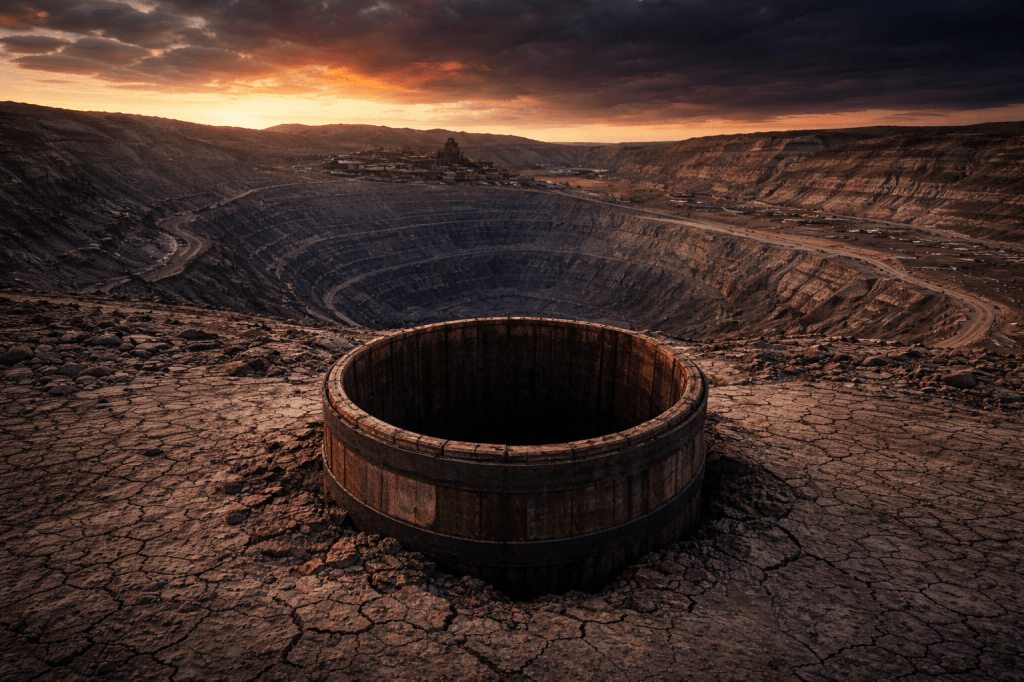
The mining industry is congratulating itself at precisely the wrong moment.
A recent headline carried by MINING.COM declares that global mining is now a brownfield industry, framing the claim around a new academic study from the University of Queensland’s Sustainable Minerals Institute, published in OneEarth. The data themselves are not controversial. Brownfield capital expenditure dominates. Copper leads expansion. New mine starts have declined while production continues to rise.
The problem isn’t the data.
The problem is the story being told about what it means.
Brownfield Dominance Is a Symptom, Not a Strategy
Calling modern mining a brownfield-dominant industry implies intent, maturity, even prudence. But brownfield dominance didn’t emerge because it is optimal.
It emerged because true greenfield, roll-the-dice exploration has been systematically starved.
Not replaced.
Not evolved past.
Starved.
What we are seeing is not strategic refinement—it is an industry retreating from discovery risk while continuing to consume discoveries made by prior generations.
We Are Mining the Past, Not the Future
The deposits being expanded today were not found by the system we have now. They were found by one we no longer tolerate.
Most brownfield expansions draw from deposits that were:
- Discovered two or three exploration generations ago
- Permitted under less adversarial regulatory regimes
- Financed by capital markets willing to accept discovery risk
- Advanced when failure was still an acceptable outcome
Brownfield mining is not proof that the system still works.
It is proof that it used to.
Rising Production Is a Lagging Indicator — and a Dangerous One
The study notes that new mine starts peaked years ago for copper, gold, iron ore, and nickel—yet production continues to rise. This is often framed as resilience.
It isn’t.
Production can increase long after discovery collapses by accepting:
- Lower grades
- Higher strip ratios
- Deeper pits and workings
- Longer mine lives
- Greater environmental and social intensity per unit of metal
This is not innovation.
This is drawdown.
Mining is beginning to resemble a farmer celebrating a strong harvest while quietly abandoning seed for the next planting.
Brownfields Are Politically Easier — Until They Aren’t
There is a reason operators favor brownfield expansion:
- Existing permits
- Existing infrastructure
- Existing workforces
- Incremental approvals that avoid holistic scrutiny
But brownfielding compounds impact over time. Longer mine lives, deeper footprints, intensified water and energy use, and growing social fatigue eventually turn “safe” expansions into the most contested projects on the landscape.
Incremental approval does not mean incremental impact.
It just delays the reckoning.
The Study Accidentally Proves the Opposite of Its Headline
One of the most revealing findings in the study is the global shift away from grassroots exploration toward mine-site work. This is presented descriptively, almost neutrally.
It shouldn’t be.
Exploration is not a discretionary expense.
It is the R&D engine of mining.
And right now, that engine is idling while the world demands acceleration.
We want electrification.
We want AI, data centers, grids, storage, and energy security.
We want domestic and allied supply chains.
But we are simultaneously underinvesting in the only activity that makes all of that physically possible.
That contradiction is the real story.
This Is the Exact Wrong Time to Pat Ourselves on the Back
We are entering the most mineral-intensive era in human history.
Brownfield dominance does not signal strength. It signals dependence—on past success, inherited discoveries, and a system no longer capable of replacing what it consumes.
Let’s be clear:
Brownfield expansion is not a future-proof solution.
It is a bridge built from yesterday’s discoveries, stretching toward a future that has yet to be found.
Calling that progress doesn’t make it so.
The Question We’re Avoiding
The real question isn’t why mining looks brownfield-heavy today.
It’s why:
- Exploration capital has been financialized out of existence
- Discovery risk is punished rather than rewarded
- Permitting systems optimize for delay instead of learning
- We celebrate production while ignoring discovery collapse
Until those issues are addressed, brownfield dominance isn’t a strategy.
It’s a confession.
 Mineral Exploration Geology - finding value in the world around us