
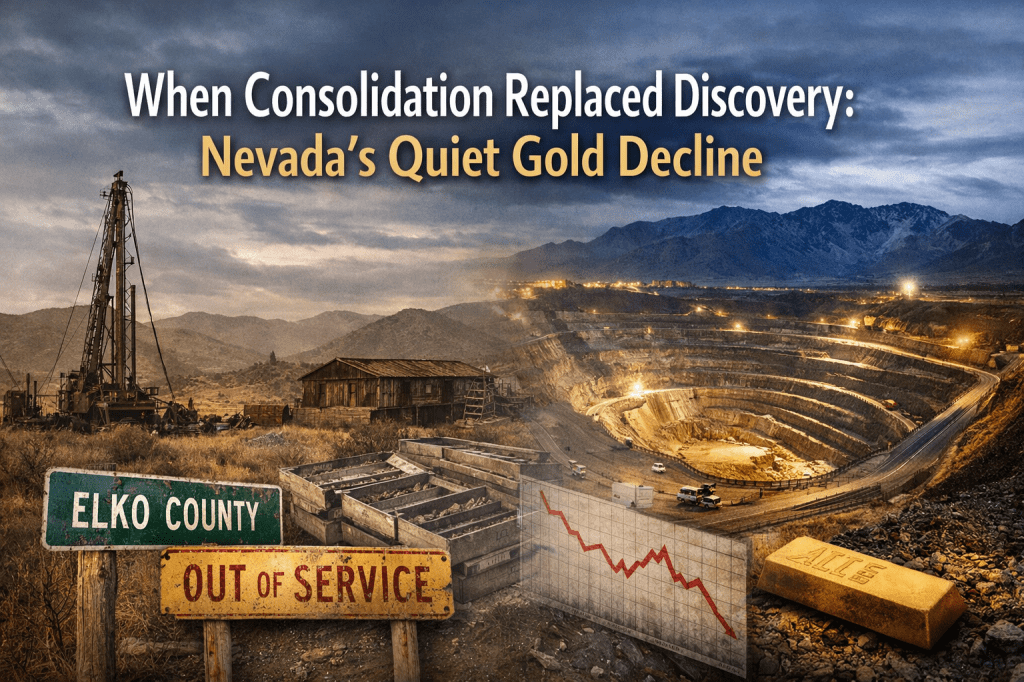
Nevada’s Gold Problem Isn’t the Rocks
There was a time in Elko, Nevada when you couldn’t find a spare hotel room—not because of tourism, but because exploration was booming. Drill rigs, geologists, and capital converged in a way few places on Earth could match. Discovery wasn’t an aspiration; it was an expectation.
Nevada didn’t lose that momentum because its geology failed. It lost it because consolidation quietly reshaped the incentives that once made discovery inevitable.
The creation of Nevada Gold Mines (NGM) was promoted as a logical efficiency play—combining assets, reducing redundancy, and maximizing output from one of the world’s richest gold districts. What followed instead was a slow erosion of competition, exploration appetite, and institutional depth, felt most acutely in the very heart of Nevada’s gold country.
This is not a story about personalities or short-term operational decisions. It is a story about structure, and how structural choices compound over time—often invisibly—until the consequences become impossible to ignore.
Before the Joint Venture: Competition as a Feature, Not a Bug
For decades, Nevada benefited from a rare alignment of factors that made it exceptional on the global stage. Multiple major operators—most notably Barrick and Newmont—ran independent mines, independent exploration teams, and independent geological models within the same district.
That competition mattered.
It created:
- Upward pressure on wages and benefits
- A deep and mobile talent pool
- Parallel interpretations of complex systems
- A continuous push to out-think, out-discover, and out-execute
Most importantly, exploration success belonged to the discoverer. That single incentive—clear ownership of upside—drove risk-taking, innovation, and sustained reinvestment in geology.
The result was not inefficiency. It was resilience.
The Structural Shift: Efficiency Without Renewal
The formation of NGM fundamentally altered this ecosystem. Under a single operating structure, the logic of decision-making changed:
- Exploration budgets were centralized and rationalized
- Redundant teams and roles were consolidated
- Geological work became more tightly tethered to near-mine needs
From a production standpoint, this appeared sensible. But production and discovery operate on different time horizons. When exploration is framed primarily as a support function—rather than a growth engine—its role inevitably narrows.
Over time, risk tolerance declines. Longer-dated ideas struggle to survive budget cycles. Geological creativity gives way to optimization.
None of this happens dramatically. It happens gradually, through attrition.
The Exploration Paradox: Capital Moved, Discovery Stalled
One of the most striking outcomes of the past several years is this paradox:
During a historic gold bull market, Nevada—particularly Elko County—became less exploratory.
Exploration capital did not disappear. It migrated.
Jurisdictions elsewhere in Nevada—Eureka, parts of Humboldt County near Winnemucca, and farther south toward Tonopah and Beatty—absorbed increasing shares of exploration spending. These areas shared a common trait: independent operators with clear discovery incentives.
Elko County, by contrast, entered a quiet lull. Despite hosting some of the most fertile gold systems on Earth, it experienced fewer greenfield programs, fewer independent drill campaigns, and fewer new geological ideas being tested.
This was not a failure of geology. It was a failure of incentive alignment.
Human Capital: The Slowest, Costliest Loss
Mining is capital-intensive, but it is equally knowledge-intensive. Geological understanding accumulates over decades, not quarters.
As consolidation progressed:
- Career pathways narrowed
- Turnover increased
- Generational knowledge transfer weakened
- Institutional memory thinned
Each departure carried more than a résumé—it carried context. Why a structure mattered. Where previous thinking had stalled. Which ideas were abandoned prematurely and which simply needed time.
Communities felt this erosion as well. Stable, high-quality technical employment supports local economies, schools, and public services. When that stability weakens, the effects ripple outward—often disconnected, at first glance, from mining itself.
Nevada’s Broader Underperformance
These dynamics were not confined to a single county. Across the state, Nevada has underperformed in true greenfield discovery relative to its geological endowment.
This reflects broader industry trends—shortened investment horizons, rising costs, and risk aversion—but consolidation at the top amplified those pressures. Large, centralized systems tend to favor incremental gains over foundational discovery, particularly when exploration upside is shared rather than earned.
The irony is difficult to ignore. Nevada should have entered this gold cycle with a pipeline of discoveries ready to advance. Instead, it entered with mature assets and limited organic growth visibility.
The IPO Moment: A Chance to Rebalance
Today, proposed restructuring and the potential IPO of North American assets has reopened a conversation that many in Nevada have been having quietly for years.
This moment is not about undoing the past. It is about deciding what comes next.
If the next phase:
- Restores independent exploration incentives
- Rebuilds technical depth and decision autonomy
- Encourages competition alongside scale
- Treats discovery as a responsibility, not a discretionary cost
Then Nevada may yet reclaim its role as the world’s premier gold discovery engine.
If not, the state risks formalizing a model that extracts efficiently—but renews poorly.
Conclusion: Discovery Is a Choice
Nevada has not lost its geology.
It has not lost its potential.
But discovery does not occur by default. It emerges from systems that reward curiosity, tolerate risk, and empower people to think beyond the next production quarter.
For much of its history, Nevada had those systems in place. The challenge now is whether it chooses to rebuild them.
Because in the end, consolidation did not replace discovery by accident.
It did so by design.
And what is designed can—if the will exists—be redesigned.
 Mineral Exploration Geology - finding value in the world around us