
Leadership appointments are rarely accidental.
When a global mining company elevates a seasoned litigator to oversee legal and policy functions and appoints a career diplomat to run global affairs — and does so while its most important North American asset sits inside a strained joint venture — the timing deserves attention.
Barrick Mining Corporation recently announced the appointments of James J. McGuire as Chief Legal and Policy Officer and Woo Lee as Chief Global Affairs Officer. On its face, it reads like a standard executive reshuffle. In context, however, it appears more deliberate.
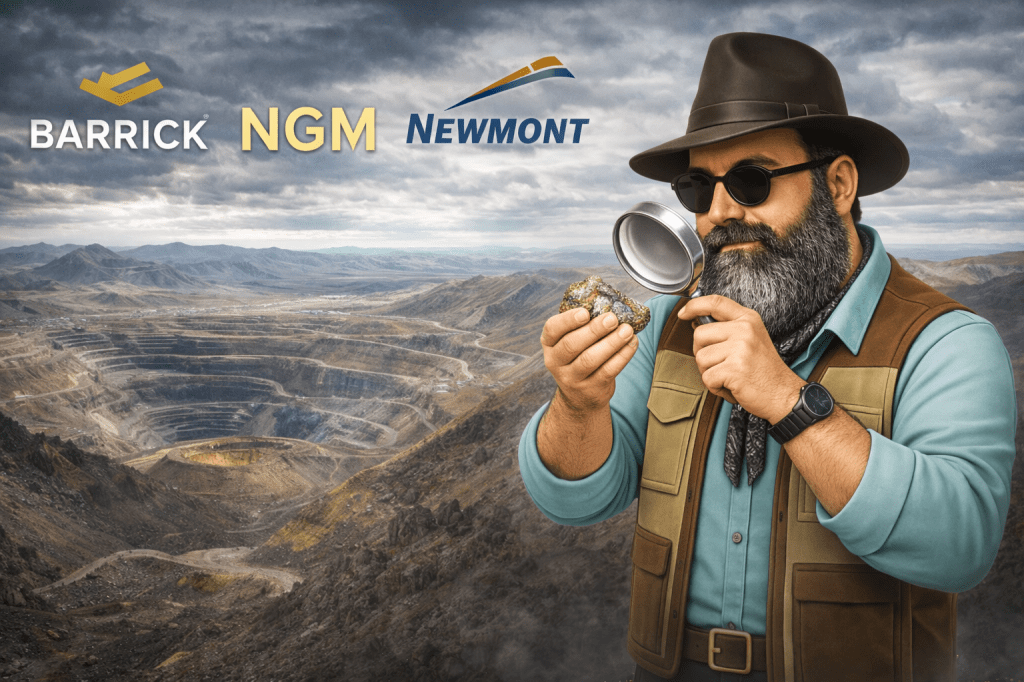
The backdrop is Nevada Gold Mines (NGM) — the world’s largest gold complex — operated by Barrick and owned roughly 61.5% by Barrick and 38.5% by Newmont. Public tensions between the partners, including a formal notice of default issued by Newmont, have introduced friction into what is arguably the most consequential gold joint venture in North America.
At the same time, Barrick has signaled interest in exploring a potential listing of certain North American assets. Whether or not that path ultimately materializes, the mere possibility elevates the importance of governance clarity, contractual precision, and regulatory stability.
When geology is stable but governance is stressed, the rocks are not the first thing to move. Contracts are.
The Legal Reinforcement
James McGuire steps into a role that is not merely administrative. A veteran litigator with federal prosecutorial experience, his background suggests comfort in high-stakes environments where precision matters and missteps compound.
In ordinary times, a Chief Legal Officer ensures compliance and manages risk. In moments of tension, that role becomes strategic.
Joint venture agreements are complex organisms. They define operational control, capital allocation, disclosure obligations, and dispute resolution pathways. When disagreements surface between major partners — particularly at the scale of NGM — legal architecture becomes the arena in which strategy unfolds.
Add the prospect of a North American IPO into that equation and the importance of legal clarity multiplies. Public markets demand transparency around governance structures, partner stability, and contingent risk exposure. Any ambiguity in JV alignment becomes a valuation variable.
Strengthening legal leadership in this environment is not dramatic. It is prudent.
When a mining company strengthens geology, it is preparing to drill.
When it strengthens legal leadership, it is preparing to negotiate.
The Diplomatic Layer
Woo Lee’s elevation to Chief Global Affairs Officer adds a second, equally telling dimension.
Lee brings a background in diplomacy and sovereign engagement — experience that extends beyond corporate communications into government relations and geopolitical fluency. In a sector where license to operate intersects with policy, trade, environmental regulation, and public perception, that skill set is not ornamental.
Joint venture disputes are not confined to boardrooms. They ripple outward — to regulators, to institutional investors, to host governments, and to the broader market narrative.
If Barrick intends to reposition or partially separate North American assets, the conversation extends beyond geology and ounces. It touches securities regulators, political stakeholders, and global capital allocators. Confidence in governance stability becomes essential.
Diplomacy, in this context, is not about optics. It is about continuity — ensuring that corporate transitions do not destabilize sovereign relationships or investor trust.
The pairing of legal fortification with diplomatic reinforcement suggests a company preparing for complexity, not merely reacting to headlines.
The Nevada Dimension
Nevada occupies a unique position in this story.
NGM is not a peripheral asset. It is a cornerstone of global gold supply and a central pillar of Nevada’s mining economy. Stability at NGM supports employment, capital investment, exploration momentum, and long-term planning across the state.
Competition between major operators can sharpen performance. Healthy tension can drive efficiency. But unresolved governance friction introduces uncertainty — and uncertainty slows capital.
For Nevada, the ideal outcome is not dominance by one operator over another. It is clarity. Clear roles. Clear incentives. Clear alignment around asset optimization and reinvestment.
If the partnership stabilizes, strengthened legal and global affairs leadership will appear prescient — a foundation laid before restructuring conversations matured.
If tensions deepen, Barrick has signaled that it intends to enter that arena prepared.
Either way, governance has moved to the foreground.
The Broader Signal
Modern mining is no longer just about discovery curves and recovery rates. It is about capital discipline, contractual architecture, regulatory navigation, and public trust.
Geology builds value.
Governance protects it.
In moments of structural tension, companies reveal their priorities not through press statements, but through personnel.
Barrick’s recent appointments suggest an understanding that the next phase of this story — whether it leads to reconciliation, restructuring, or strategic separation — will unfold as much in conference rooms and regulatory filings as in open pits and underground workings.
For observers of the Nevada Gold Mines saga, this is not noise.
It is a flank being fortified.
And in mining — as in strategy — preparation often tells you more than proclamation.
 Mineral Exploration Geology - finding value in the world around us