
We’re watching markets debate interest rates, inflation prints, and employment data with near-religious intensity.
Soft landing. Hard landing. No landing.
The dashboards glow. The indicators flicker. The commentary flows.
And yet, beneath all of it, something far more fundamental is being missed.
We are debating the controls of a machine…
without acknowledging that the machine itself is being rebuilt in real time.
The Illusion of Control
Modern financial systems are extraordinarily good at measuring motion.
They track liquidity, price signals, labor participation, consumer demand—metrics that describe how the economy behaves within a given structure.
But they are far less equipped to handle a more uncomfortable question:
What happens when the structure itself changes?
For decades, the global economic system operated on a set of assumptions that quietly underpinned everything:
- Supply chains were global, stable, and optimized for cost
- Inputs were available, fungible, and largely taken for granted
- Energy systems, while imperfect, were sufficient
- Capital efficiency mattered more than resilience
Those assumptions are no longer reliable.
What we are experiencing is not simply a cycle.
It is a restructuring.
Our Tastes Have Shifted (From Tea to Coffee)
The system hasn’t just slowed down or overheated—it has changed its preferences.
We’ve moved from a world that prioritized efficiency to one that increasingly demands resilience.
From:
- Just-in-time
to - Just-in-case
From:
- Global optimization
to - Strategic redundancy
From:
- Cost minimization
to - Security of supply
This shift didn’t happen overnight. It has been building quietly for years—through geopolitical friction, supply chain shocks, energy instability, and a growing recognition that dependency carries risk.
But capital is still behaving as if the old system remains intact.
It is analyzing signals within a framework that no longer fully applies.
The inputs have changed.
The expectations have changed.
But the models have not.
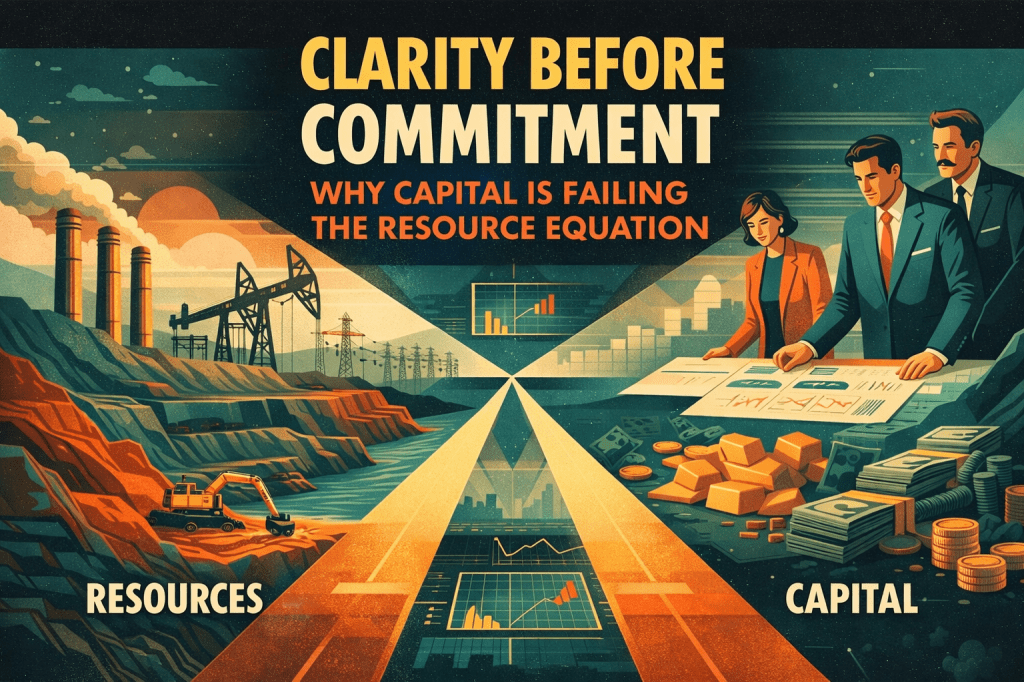
Capital Is a Claim, Not the Source
At the center of this disconnect lies a simple but often overlooked truth:
Capital does not create value. It claims it.
Value still originates in the physical world:
- In rock
- In ground
- In water
- In energy
- In systems that take time, labor, and expertise to develop
Capital can accelerate, organize, and scale these systems.
But it cannot replace them.
And yet, markets often behave as though capital itself is the primary driver—as if liquidity alone can summon the materials required to sustain growth.
This is where the misalignment begins.
Because capital is being deployed into a world that increasingly refuses to respond on financial timelines.
The Trillions Waiting on Reality
There is no shortage of capital.
Global institutions—JPMorgan Chase among them—have signaled trillions of dollars in potential investment toward energy transition, electrification, and infrastructure.
On paper, the resources exist.
But capital alone does not build systems.
Resources do.
Permitting does.
Processing capacity does.
Time does.
And these are precisely the areas that have been neglected.
We are attempting to deploy massive pools of capital into a system that has not been physically prepared to absorb it.
That is not a funding gap.
It is a capacity gap.
Energy Reality and the Cost of Delay
We continue to operate within a global energy framework heavily dependent on hydrocarbons.
And with that dependency comes the same geopolitical tensions and conflicts that have shaped the past century.
At the same time, viable alternatives exist:
- Uranium as a dense, scalable energy source
- Small Modular Reactors (SMRs) as a pathway to distributed, reliable baseload power
- Electrification systems that underpin everything from transportation to data infrastructure
These are not theoretical solutions.
They are real, proven, and increasingly necessary.
And yet, progress remains uneven.
Not because the ideas are lacking—but because the execution requires something far more difficult:
Materials, infrastructure, and time.
Silver and the Myth of Infinite Supply
Consider silver.
Unlike gold, which is largely stored, silver is consumed.
It is embedded in:
- Electronics
- Solar panels
- Defense systems
- Industrial applications
It is burned, dispersed, and often unrecoverable at scale.
Each year, more is used.
And each year, the pace of replacement struggles to keep up with consumption.
This is not a pricing anomaly.
It is a physical reality.
And it is emblematic of a broader truth:
Some resources do not cycle cleanly back into supply.
They disappear into progress.
The Lost Decades of Downstream Development
If we wanted to be competitive in this emerging landscape, we should have been building:
- Domestic processing capacity
- Refining infrastructure
- Integrated supply chains
Not recently.
Decades ago.
Instead, we optimized for cost.
We offshored complexity.
We deferred responsibility.
We built a system that functioned efficiently—so long as nothing went wrong.
Now, as conditions shift, we are left trying to reconstruct capabilities that were systematically dismantled.
And we are discovering that rebuilding them is neither quick nor simple.
Exploration: The Forgotten Foundation
Beneath all of this lies the most overlooked component of the entire system:
Exploration.
Exploration is the research and development arm of mining.
It is where future supply is discovered.
It is where optionality is created.
And it has been chronically underfunded.
We are, in many cases, still drawing from deposits discovered decades ago.
The pipeline of new discovery has not kept pace with rising demand.
And this is not a problem that can be solved overnight.
You cannot fast-track discovery.
You cannot shortcut geology.
You cannot will new deposits into existence through policy or capital allocation alone.
The Compression Problem
We now find ourselves attempting to compress:
- Decades of underinvestment
- Years of deferred infrastructure
- Generations of overlooked exploration
Into a single economic cycle.
It will not work.
Because time—the one input that underpins all resource development—is not compressible.
You can accelerate capital deployment.
You can streamline policy.
You can incentivize production.
But you cannot eliminate the time required to discover, permit, develop, and scale physical systems.
The Inversion: Capital Follows Reality
For much of the modern era, the prevailing assumption has been:
Capital leads. Development follows.
But in a world defined by physical constraints, that relationship inverts.
Reality leads. Capital follows.
Markets do not create supply.
They respond to its presence—or its absence.
And increasingly, they are beginning to encounter both.
Decision Infrastructure: Bridging the Gap
This is where the real work begins.
Because the gap between:
- capital that assumes
and - geology that decides
is widening.
Bridging that gap requires more than data.
It requires interpretation, context, and judgment.
It requires understanding not just what is possible—but what is real.
This is what I refer to as decision infrastructure:
The layer of insight that connects:
- physical reality
to - capital deployment
Before commitments are made.
Before systems are built.
Before value is assumed.
Clarity Before Commitment
We are entering a phase where physical constraints are reasserting themselves.
Where inputs matter.
Where access matters.
Where time matters.
And in that world, the cost of getting it wrong increases.
Significantly.
Because capital deployed without clarity does not just underperform.
It compounds error.
Where It All Begins
Before capital deploys…
Before infrastructure scales…
Before policy succeeds…
There has to be something real.
Mining does not start at the mine.
It starts at the decision to understand what is actually there.
And until that connection between capital and reality is restored—
We will continue to misprice, misallocate, and misunderstand the very foundation of the systems we depend on.
This is not a cycle.
It is a reckoning with reality.
And reality, as it always does, will set the terms.
 Mineral Exploration Geology - finding value in the world around us