The U.S. Nuclear Regulatory Commission is reorganizing.
On the surface, that sounds bureaucratic. Org charts. Reporting lines. Internal memos.
But don’t be fooled.
This may be one of the most consequential structural signals for nuclear energy — and uranium — in decades.
What’s Actually Happening?
The U.S. Nuclear Regulatory Commission is restructuring around three core business lines:
New Reactors
Operating Reactors
Nuclear Materials & Waste
Licensing and inspection functions will be integrated. Accountability will be centralized within each line. Decision velocity is the objective.
This is not deregulation.
This is reorganization for efficiency.
And efficiency, in nuclear, has historically been the missing variable.
From Fear to Function
There was a time when America built reactors.
Under the United States Atomic Energy Commission, nuclear power was both regulated and promoted — sometimes imperfectly, but with ambition.
Then came the era of public fear, media amplification, and institutional risk aversion. The China Syndrome premiered. Three Mile Island accident followed.
Permitting paradigms hardened. Timelines stretched. Capital retreated.
The industry didn’t die. It slowed.
This reorganization signals something different:
A regulator aligning itself with national deployment goals — without abandoning safety.
That distinction is everything.
The Elephant in the Room: Uranium
If the NRC becomes faster, clearer, and more accountable in licensing new reactors, the consequences ripple upstream immediately.
Amir Adnani, CEO of UEC, has floated the possibility of $1,000/lb U₃O₈ in a true supply squeeze (at a recent talk given in Vancouver (VRIC 2026)).
Is that the base case? No.
But the direction of travel matters more than the ceiling.
When regulatory friction decreases, capital confidence increases. When capital confidence increases, projects move. When projects move, supply tightens against accelerating demand.
This is how structural bull markets are born.
Unlocking the Upstream
For uranium producers and explorers, a credible acceleration in nuclear deployment does several things:
Unlocks equity financing for restarts and greenfields
Encourages long-term utility contracts
Justifies domestic enrichment and conversion build-out
De-risks jurisdictional narratives
But here’s the deeper layer:
Regulatory reform does not just unlock production.
It unlocks exploration.
And exploration is where the real asymmetry lives.
Humanity’s New Fire
Nuclear energy is not just another commodity cycle.
It is 3,000,000-to-1 energy density. It is grid stability in an AI-powered century. It is geopolitical leverage. It is decarbonization without fragility.
It is Prometheus without smoke.
If the NRC reorganization proves durable — if it translates into measurable timeline compression — then we are not witnessing a bureaucratic shuffle.
We are witnessing the quiet removal of a bottleneck.
And when bottlenecks disappear, abundance flows.
Where I Stand
In a world where regulatory velocity meets capital discipline, the most valuable role is not the driller or the promoter.
It is the translator.
The one who stands between geology, permitting, and capital and asks:
Is this technically real?
Is this jurisdictionally viable?
Is this capital-ready?
Is this timed correctly within the cycle?
That’s the lane I operate in.
Because when humanity reaches again for its new fire, someone must ensure the spark lands where it can actually burn.
This NRC reorganization may seem administrative.
But to those watching the full arc — from regulator to reactor to uranium to discovery —
Every so often, a question settles into the back of a geologist’s mind like a pebble in a boot. No matter how far you walk, you feel it.
For me, that pebble was this:
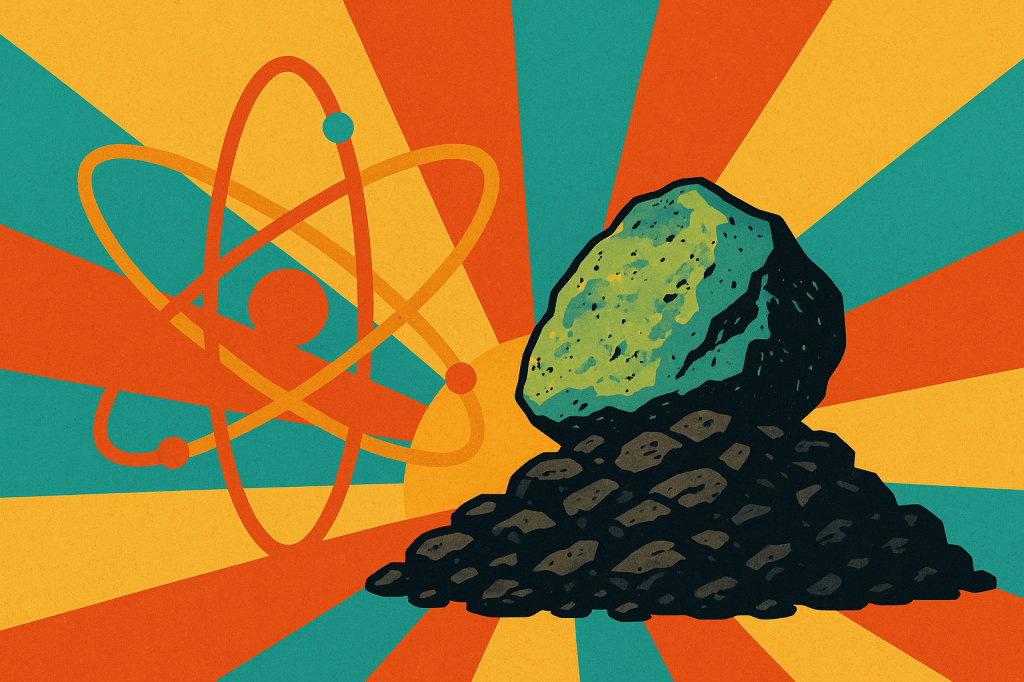
If one pound of uranium holds roughly three million times more energy than a pound of coal… why do they trade at the same order of magnitude in price?
Why is uranium an $80/lb commodity when, energetically, it behaves like bottled lightning?
I expected the answer to be complicated. The truth was deeper — and far more astonishing — than I imagined.
This essay is the story of following that question all the way down to the bedrock… and discovering a fault line in the global economy waiting to slip.
I. Uranium vs. Coal: A Tale of Two Fuels
Let’s start with the raw physics — no jargon, no reactor-speak, just simple energy content.
Coal:
About 10,000 BTU per pound.
Uranium (real-world reactor fuel):
About 1.6 billion BTU per pound.
Uranium (full-U235 fission theoretical):
About 37 billion BTU per pound.
To keep the math anchored:
👉 1 pound of uranium ≈ 3,000,000 pounds of coal 👉 or roughly 1,500 short tons
This is not a rounding error. It is the largest energy-density spread in the history of civilization.
Yet…
Coal trades at $50–$100 per ton. Uranium trades at ~$80 per pound.
The more I turned the numbers over, the more absurd the comparison became.
II. The First Shock: Uranium’s “Heat Parity” Price Isn’t $100 — It’s Thousands
To calculate uranium’s “true value,” let’s ask a simple, childlike question:
“If you priced uranium the same way you price coal — purely by heat content — what would it be worth?”
Answer:
In today’s reactors, uranium should be worth $3,000–$8,000 per pound.
In theoretical full-fission terms, it reaches $100,000–$500,000 per pound.
Those are not typos. Those aren’t dreams. Those are physics.
So how on Earth is uranium $80/lb?
Because markets don’t trade physics — they trade logistics, regulation, and psychology.
That realization led me to the second, even deeper shock.
III. The Second Shock: Even at $300–$1,000/lb, Nuclear Power Costs Stay Flat
This was the moment the ground shifted under my feet.
You can triple or quadruple the price of uranium…
…and the cost of nuclear electricity barely moves.
Why?
Because nuclear plants use so little fuel.
A single fuel pellet the size of your fingertip holds the same energy as a ton of coal. A single pound of uranium powers thousands of homes for a year. Fuel is a tiny slice of a reactor’s operating cost.
Raising uranium from $80 to $300 or even $1,000 moves the needle only from ½ cent per kWh to maybe 2 cents per kWh in fuel cost.
Let that sink in:
Nuclear energy is so potent that even a 10× or 20× rise in uranium price barely budges the electric bill.
This is not just an economic curiosity — it is a macroeconomic revelation.
IV. The Third Shock: A World Built on Cheap Nuclear Energy Floats, Not Sinks
If uranium rises to its real value — $300 fuel-parity or even $3,000 physics-parity — something extraordinary happens:
Energy becomes inexpensive, predictable, and abundant.
Imagine:
No volatility from gas pipelines.
No coal supply crunches.
No weather-dependent intermittency.
No geopolitical chokeholds.
No fragile grids.
No spiraling power costs.
Nuclear offers:
Ultra-cheap fuel
Ultra-long asset life
Ultra-stable output
When energy becomes cheap and constant, everything else in the economy becomes lighter:
Manufacturing costs drop
Mining costs drop
Transportation costs drop
Food production costs drop
Inflation pressure eases
Economic growth accelerates
It is the closest thing to a “cheat code” for civilization we have ever found.
Sometimes you have to read the tea leaves to see the deeper reality: Cheap uranium → cheap nuclear → cheap everything.
This isn’t geology anymore — this is political economy.
V. And Here’s the Punchline: The Mining World Isn’t Ready
This is where my geologist’s boots hit the dirt.
Because if uranium is this undervalued… if its true energy value is in the thousands per pound… if the world is going nuclear out of necessity… then we are standing on the threshold of a mining revolution.
At $300/lb:
Roll-fronts once considered “marginal” become prime targets.
At $500–$1,000/lb:
Low-grade sandstone horizons become company-makers. Old ISR fields get second and third lives.
At $1,000–$3,000/lb:
Lignites, shales, metasomatic systems, and granites — today written off as waste — become the Athabasca Basins of 2075.
What we call “low grade” today will be considered “bonanza” tomorrow.
We are in the early-early-early oil age of uranium. Rockefeller-level early. “Horse-drawn rigs in Pennsylvania” early.
The only reason the world isn’t acting like it is early? Because we are pricing uranium as if it is coal.
And it is not coal. It is energy compressed into a mineral soul.
VI. The New Frontier: Energy Abundance and Geologic Renaissance
What happens when:
reactors get smaller
regulations get smarter
fuel cycles get closed
enrichment expands
nations seek energy independence
grids bend under AI and electrification…
…and uranium prices finally catch up?
A renaissance.
A rebirth.
A new era where exploration geologists walk onto projects long dismissed as “uneconomic” — and suddenly see opportunity glowing like desert varnish at sunset.
We will re-drill old deposits. We will re-map old roll fronts. We will re-model old sandstone basins. We will re-evaluate “waste” with wiser eyes.
Because the future doesn’t belong to high-grade deposits.
The future belongs to scale.
VII. Conclusion: The Rock Is Mighty — The Market Just Forgot
Uranium is not an $80 commodity pretending to be a fuel.
It is a world-changing energy metal priced as if it were an afterthought.
Physics says it should be thousands per pound. Economics says it can easily support hundreds per pound. Civilization says we desperately need it. Geology says we are barely scratching the surface.
And the exploration frontier — the one that I and many others walk every day — is on the cusp of rediscovery.
The rock is mighty.
The world just hasn’t remembered it yet.
But it will.
And when it does, the next century of energy, mining, geopolitics, and human flourishing may well be written in the quiet glow of uranium’s still-untapped power.
For years, many of us in exploration, energy, and policy circles have been voicing the same refrain:
America must rediscover its backbone — the one forged in ore and energy, refined by industry, and animated by purpose.
We’ve written about it, spoken at conferences, and fought uphill battles in permitting offices. Now, a trillion and a half dollars later, that whisper from the pit, the drill pad, and the assay lab has finally reached the marble halls of finance.
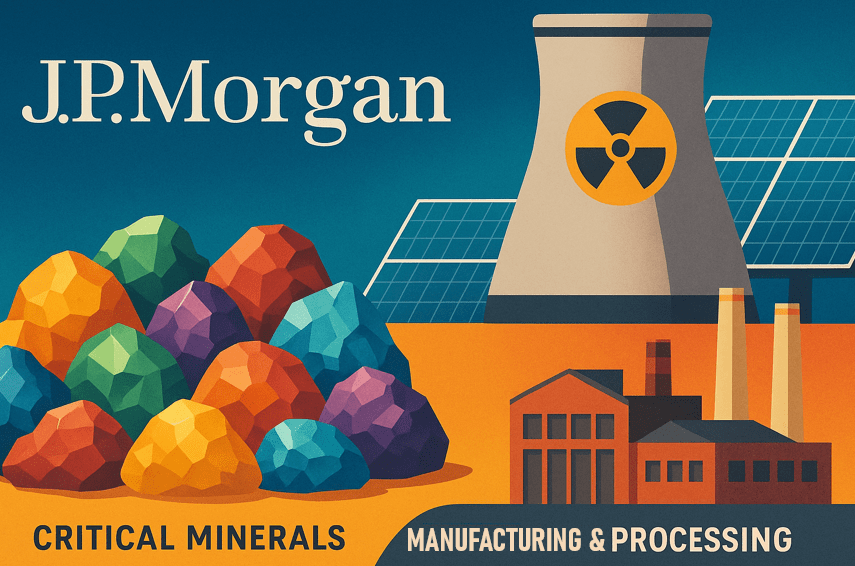
JPMorgan Chase’s new “Security & Resiliency Initiative” — a $1.5 trillion investment framework — reads like a checklist of every structural challenge we’ve named:
Supply chains fractured by foreign dependence
Permitting regimes tangled in red tape
Hollowed-out refining and manufacturing capacity
A cultural hesitation to act upon the Earth — to build, dig, and dare
And suddenly, the world’s largest bank says: We hear you.
II. From Policy Paralysis to Purposeful Action
This isn’t a boutique green fund or a PR stunt. It’s a re-industrialization mandate that explicitly includes:
Critical-mineral exploration and refining
Nuclear energy, solar power, and grid resilience
Advanced manufacturing and AI-enabled infrastructure
Policy advocacy to streamline permitting and remove regulatory friction
That last point stopped me cold. A global financial titan committing to advocate for permitting reform? That’s a tectonic shift.
For decades, investors have been content to fund consumption rather than creation. Now we’re seeing a return to first principles — to the idea that progress and stewardship can walk the same path. That responsible use of Earth’s materials is not desecration but devotion.
III. The Nuclear Note in the New Energy Symphony
Look closer and you’ll find nuclear listed among JPMorgan’s 27 “sub-areas of strategic investment.” This is no longer fringe. The same financiers that once fled uranium are now calling it resilient infrastructure.
As data centers bloom across the prairie and AI’s appetite for electrons deepens, the need for firm, clean, constant power grows existential. The atom — long maligned, long patient — is returning to the spotlight. And with it, the miners, geologists, and innovators who never stopped believing that the future still runs on fuel from the rocks beneath us.
IV. Refining the Future
JPMorgan’s plan isn’t just about what comes out of the ground — it’s about what we can build above it.
From copper smelters to rare-earth separation plants, from battery-metal recycling to magnet manufacturing, the initiative recognizes what explorers have always known: a resource has no power until it’s refined.
That’s not just metallurgy — that’s civilization in miniature. The same alchemy that turns rock into revenue also turns vision into reality.
V. The Political Ground Shifts
Equally seismic is the policy stance:
“The firm will advocate for research, development, permitting, procurement, and regulations conducive to growth.”
In other words: they’re joining the lobby to fix what’s broken. When Wall Street’s largest player begins echoing the same frustrations voiced by field geologists, operators, and regional coalitions, the ground has truly moved.
This could be the moment when private capital and public policy finally align — when we stop apologizing for production and start enabling it.
VI. A Renewal of Faith in Making
There’s a deeper current running through all this. For too long, the national conversation has treated use as something shameful — as if to touch the Earth is to harm it. But creation has always required contact.
Our machines, our reactors, our refineries — these are the hands of a species still learning how to shape wisely. To use with restraint. To build with reverence. That’s not exploitation — that’s participation in something vast, beautiful, and ongoing.
This new initiative, if it holds course, could mark the dawn of a renewed covenant between humanity and its home planet — one built on trust, purpose, and shared prosperity.
VII. The Road Ahead
There’s plenty left to prove. Capital can move mountains — or drown them in paperwork. But for now, this feels like the beginning of something worthy.
The miners, metallurgists, and mappers have always been the first to sense a change in the strata. And this feels like a fresh layer being laid down — one built of courage, collaboration, and the will to act.
Maybe the Earth has been whispering all along, and at last, the world’s largest bank stopped to listen.
“The age of apology must end. The age of awareness must begin.”
Civilization runs on minerals. Gold may glitter, but copper carries our current, uranium powers our grids, and rare earths anchor the very magnets that spin the world. Without them, the skyscrapers don’t rise, the phones don’t ring, and the servers that feed the cloud go dark. Mining is not just an industry; it is the bedrock upon which every other modern enterprise rests.
And yet, here we stand in 2025, after more than a decade of neglect. The global mining industry has starved its own “R&D department”—exploration. Budgets have been slashed, geologists retired without replacement, and entire districts left unmapped since the 1980s. Instead of planting seeds for the future, the sector has lived off old harvests, leaning on deposits discovered by the last great exploration wave of the 1960s–1990s.
It’s the equivalent of eating the seed corn to make it through winter. Yes, you may survive the lean season, but when spring arrives the fields are bare. The industry now faces a generational dilemma: demand is rising with electrification, AI-driven power consumption, and defense needs, but the pipeline of new discoveries is running dry.
The warning signs are already here. Grades are falling, permitting timelines stretch a decade or more, and the very talent pool of geologists—the human capital that finds ore before machines can mine it—is shrinking. The exploration torch is passing out, just as the world needs it most.
This is the seed corn problem: an industry that mistook austerity for efficiency, cost-cutting for strategy, and in doing so mortgaged its future.
Why Exploration Matters
Exploration is the ghost in the machine—the unseen force that keeps the gears of civilization turning. Mines are not infinite. Ore bodies deplete, grades decline, and production costs inevitably climb. Without a steady stream of new discoveries, the reserves that underpin our supply chains wither away.
When exploration falters, the ripple effects are immediate and profound:
Depletion at the source: Mature mines close or shift to lower-grade zones, requiring more energy, more water, and more waste rock for every ton of metal produced.
Fragile supply chains: Scarcity tightens the noose. Nations grow dependent on single suppliers or unstable jurisdictions, inviting shortages and geopolitical choke points.
Economic exposure: Industries that appear cutting-edge—AI, data centers, quantum computing, crypto, electric vehicles, wind turbines, solar panels—become castles built on sand, unsupported by the very raw materials that make them possible.
History proves the point. The U.S. uranium boom of the 1950s, the global porphyry copper discoveries of the 1960s and 1970s, and the Carlin Trend gold rush in Nevada all reshaped economies and societies. But each relied on bold, boots-on-the-ground exploration—and each took decades to bring from discovery to production. Without planting new seeds today, there will be no harvest tomorrow.
Exploration is not optional. It is the bedrock of resilience, the insurance policy against scarcity, and the quiet act of faith that there will still be metal in the mill when the world comes calling.
What Happened to the Juniors?
Once, junior explorers were the daring prospectors of capital markets. They were scrappy, nimble, and driven by geologists with calloused hands and big dreams—funded by retail investors and risk-tolerant funds who saw the outsized upside of a drill-bit discovery. They were the seed planters.
Today, they’re skeletal. The ecosystem that once sustained them has been hollowed out by a perfect storm of mistrust, market shifts, and changing appetites for risk.
Burned Trust (2011–2015): Billions vanished in the last gold cycle. Over-promises, bad geology, and outright scams poisoned the well. Investors fled, leaving legitimate juniors to starve alongside the frauds.
ETF Domination: Passive index funds became the new custodians of capital. They allocate by market cap, not by exploration potential. Drill holes don’t move the needle. The capital pool that once flowed freely into high-risk discovery stories has shrunk to a trickle.
Retail Drift: The everyday investor who once bought a thousand shares of a penny-stock explorer on a hunch now chases tech IPOs, cannabis booms, meme stocks, and crypto tokens. Rocks lost their shine in a world of instant returns and digital buzz.
Risk Aversion: Institutional capital demands cash flow, not speculation. Money flows to mid-tiers and majors who can produce quarterly results, not to juniors who burn cash in search of something that may not exist.
The result? An entire generation of junior companies reduced to husks—managing legacy properties, eking out survival on private placements, or vanishing altogether. Where once the TSX-Venture exchange was a bustling bazaar of discovery, it is now a thinly traded echo chamber.
The juniors are left begging for scraps. And without them, the pipeline of new discoveries—the very seed corn of the mining industry—runs dry.
Why the Majors Look Away
Big mining companies are not innocent bystanders in this drought of discovery. They’ve made a calculated choice—a choice that prioritizes quarterly comfort over generational security.
Dividends > Drills: Shareholders demand yield, not uncertainty. The likes of BHP, Rio Tinto, and Vale trumpet their dividend programs as proof of “discipline,” funneling billions back to investors instead of into the geologists who might find tomorrow’s ore bodies. The City of London and Bay Street cheer, but the exploration pipeline withers.
M&A Is Easier: Why risk the cost and uncertainty of greenfield exploration when you can let juniors shoulder the burden and then swoop in later? Barrick, Newmont, and Anglo American have built portfolios on acquisitions rather than discoveries, paying premiums for ounces once desperation sets in. This strategy works only as long as juniors exist—and today, even that seedbed is failing.
Permitting Pain: In the U.S., a new mine can take 10–15 years to permit. In Chile, Peru, and Argentina, political shifts and social unrest regularly derail development. Even Canada, once a paragon of mining stability, has bogged down in federal-provincial wrangling. To the majors, exploration feels like wasted effort if politics can veto production. Why drill if a discovery just becomes a stranded asset?
Artificial Scarcity: A tighter project pipeline props up higher commodity prices. For majors, scarcity is profitable—at least in the short run. Copper prices hold stronger when new supply is uncertain. Uranium equities rally when no new projects are breaking ground. But this “discipline” is short-sighted. Artificial scarcity enriches today’s balance sheets while mortgaging tomorrow’s grids.
The majors’ restraint looks like prudence, but in truth, it is systemic neglect. They have mistaken risk aversion for strategy. Instead of seeding the next generation of mines, they are cannibalizing the last generation’s discoveries, hoping someone else will do the dirty work of prospecting.
Yet “someone else” no longer exists. The juniors are starved, governments are paralyzed, and the majors have parked their drills. The system is eating itself.
The Timeline of Consequences
The story of exploration neglect is not abstract. It unfolds on a clock, with milestones as predictable as they are dire. Here’s what we will see in the coming year, 5 years, and 10 years if this pattern of neglect is allowed to continue:
📍 1 Year (2026): The Plateau(if this isn’t already the case)
Reserves continue to shrink across commodities—global copper reserves, for example, are already skewed toward lower-grade porphyries that cost twice as much to mine as their predecessors.
Senior geologists retire, taking with them decades of local knowledge about belts in Nevada, the Andes, and the African Copperbelt. Their field notebooks, often never digitized, gather dust in basements.
Once-vibrant districts—like northern Ontario’s greenstone belts or the Carlin Trend in Nevada—begin to lose their intellectual “muscle memory.” The living knowledge that connects old drill logs to new targets vanishes.
📍 5 Years (2030): The Gap
Project pipelines hollow out. The majors’ development schedules, already thin, collapse into a handful of advanced brownfield expansions.
Juniors consolidate into survival mergers or collapse outright, leaving only a skeletal handful of companies with active drills. The TSX-Venture—the historical cradle of global discovery—is reduced to a backwater of shell companies and recycled management teams.
Governments scramble to reverse decades of neglect: Washington floats “Critical Mineral Moonshots,” Brussels pushes exploration tax credits, Beijing doubles down on African offtake agreements. But the measures are too late. You cannot conjure ore bodies with subsidies once the drills have gone silent.
Supply deficits bite. Copper, lithium, and rare earths become the new oil shocks—triggering inflation, power rationing, and trade wars over who gets the last shipments.
📍10 Years (2035): The Ghost Tap
You cannot turn on a tap that isn’t connected to a pipeline. Mines take 10–20 years to permit and build. By 2035, the missing decade of exploration has come due.
Critical minerals are no longer market stories—they are national security flashpoints.
China leverages its dominance in rare earths to dictate terms in global trade.
The U.S. Defense Department stockpiles uranium and cobalt like Cold War-era oil.
Europe, unable to build batteries without imported lithium, faces rolling blackouts and stalled EV adoption.
Even record-high commodity prices won’t matter. A $15,000/t copper price or $200/lb uranium price won’t magically materialize new deposits. Discovery takes decades, and the decade has already been lost.
The result is a ghost system: idle smelters, shuttered gigafactories, and stalled wind and solar farms—technology stranded for want of the materials that should have been planted years before.
The Geopolitical Context
We are entering an era where geology is geopolitics. Control of the periodic table is now as decisive as control of sea lanes or satellite constellations.
China throttles rare earth exports, weaponizing its near-monopoly in magnets and battery materials. Its Belt and Road Initiative has already secured lithium and cobalt across Africa and South America.
Russia leans into resource nationalism, tying uranium exports and energy corridors to its foreign policy goals. Kazakhstan—producer of over 40% of the world’s uranium—sits in Moscow’s orbit.
India is no longer just a consumer but an aggressive competitor, racing to lock down lithium supplies in Argentina and rare earth projects in Australia.
The West risks becoming a permanent importer, dependent on rivals for the metals that power its grids, weapons, and economies.
This is not about abstract “market dynamics.” It is about whether democracies will control their own futures.
Without uranium, copper, lithium, and rare earth elements, there is no AI revolution, no data center backbone, no renewable transition, no electric vehicle fleet. Strip away the minerals, and the high-tech towers of modernity collapse like sandcastles in the tide.
And here lies the hard truth: exploration is the first act of sovereignty. Mines take 10–20 years to permit and build. If we do not plant seeds now, by the 2030s the United States and its allies will be paying whatever price Beijing or Moscow demands—or doing without altogether.
The call to action is clear:
Reinvest in exploration with the urgency of a Manhattan Project—geological surveys, public-private partnerships, and incentives that pull risk capital back into the field.
Build Western supply chains that can withstand geopolitical shocks, from Nevada lithium to Saskatchewan uranium to Australian rare earths.
Treat geology as strategy, not afterthought. The United States Geological Survey should be viewed with the same seriousness as the Pentagon, for both are guardians of national defense.
This is the rallying cry for the U.S. and its allies: sovereignty begins at the drill rig. Without exploration, there is no mining. Without mining, there is no economy. Without an economy built on secure foundations, there is no freedom to defend.
A Glimmer of Policy Reform
For all the gloom, there are sparks of recognition—early shoots that hint the field may not be barren forever.
FAST-41 Permitting Reform: Once a bureaucratic chokehold, permitting in the U.S. is showing signs of movement. The Federal Permitting Improvement Steering Council (FAST-41) is beginning to streamline timelines for “covered projects.” Uranium juniors like Anfield Energy with its Velvet-Wood mine in Utah, and EnCore Energy with Dewey-Burdock in South Dakota, have already secured wins under this process. What once looked like stranded assets are edging toward daylight.
Pentagon–MP Materials Partnership: The U.S. Department of Defense has invested directly in MP Materials’ Mountain Pass rare earth mine in California—hundreds of millions of dollars in contracts to secure separation and magnet manufacturing capacity on U.S. soil. This is no boutique project: MP Materials controls the only rare earth mine (of scale) in the U.S. and is ramping toward vertical integration that could anchor a Western supply chain.
Copper as a Keystone: Projects like Resolution Copper in Arizona—one of the largest undeveloped copper resources in the world—remain politically tangled, but their scale makes them unavoidable. If unlocked, Resolution alone could supply up to 25% of U.S. copper demand for decades.
Lithium Rising: The controversial but progressing Thacker Pass project in Nevada, and Ioneer’s Rhyolite Ridge, have secured federal loans and partnerships, positioning the U.S. as a serious player in lithium carbonate production. Thacker Pass, with more than $2 billion in projected investment, is not just a mine but a downstream refining hub in the making.
Downstream Momentum: Supply chains are finally catching political attention. From rare earth magnet plants in Texas to lithium hydroxide refineries in Nevada, the U.S. is beginning to invest not only in the rocks, but in the capacity to turn them into finished products. That is the true measure of sovereignty.
These reforms are encouraging, but they are still small strokes on a canvas that demands bold, sweeping lines. A handful of permitting wins and defense contracts are not a revolution. What’s needed is a scale-up—tenfold, a hundredfold. Only when the U.S. and its allies treat minerals with the same urgency once reserved for oil, or for the space race, can we say things have truly changed.
This glimmer is fragile, but it is real. If fanned, it could light the torch of a new exploration renaissance.
Conclusion: Choose Risk or Embrace Ruin
The mining industry thought it was playing it safe by pulling back on exploration. In truth, it was gambling the future—trading short-term stability for long-term scarcity. The result is hollow pipelines, fragile supply chains, and a generation of geological knowledge at risk of fading into silence.
Exploration is not a luxury. It is the R&D of civilization itself. Without it, there is no copper for wires, no lithium for batteries, no uranium for baseload power. Starve exploration, and we starve the future.
The real risk isn’t in drilling holes—it’s in failing to drill them. The world’s faucets are running, but the reservoir is dropping. The only question that remains is whether we have the vision and courage to dig the next well before the water stops.
For those still with me at the end of this essay, here’s the wry truth in one line:
“Exploration: the riskiest bet we can’t afford not to make.”
Sometimes, the invisible hand of the market needs a little nudge. Other times, it needs the full force of the Pentagon’s wallet—and apparently, that’s all it takes to wake the giants.
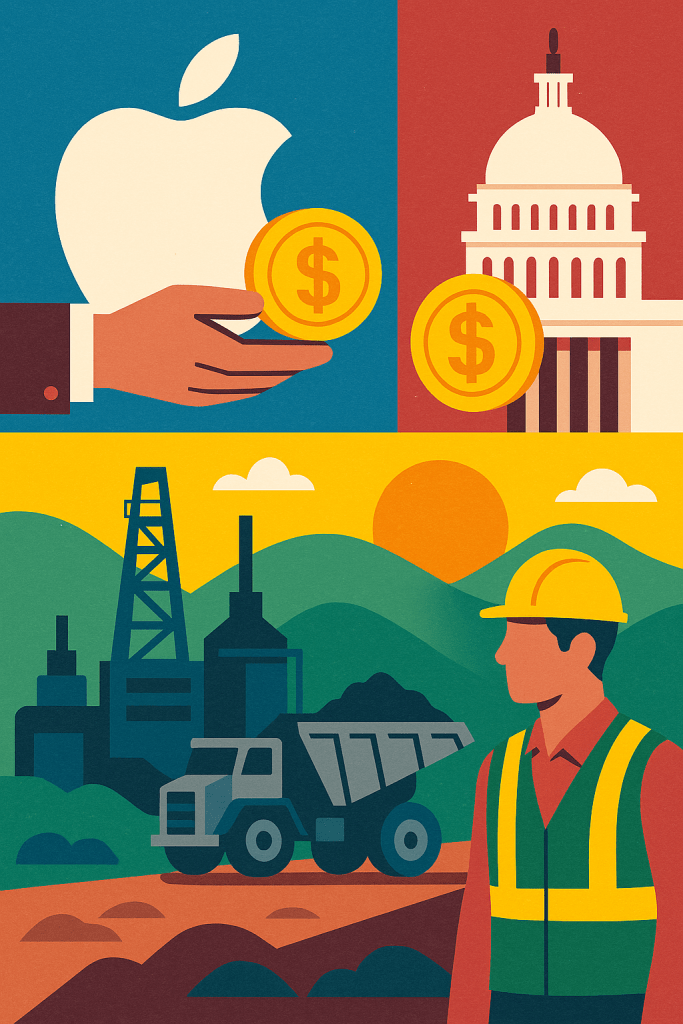
Just one week after MP Materials landed a $400 million deal with the U.S. Department of Defense, tech behemoth Apple swooped in with a stunning $500 million commitment to secure domestically sourced rare earth magnets. That’s not just validation—that’s velocity.
Together, these two powerhouse deals sent MP stock surging to all-time highs, but more importantly, they sent a thunderous signal to industry: this is where the future is being built.
Pentagon First, Apple Fast Follows
The sequence is telling.
The DoD’s investment was more than a show of support—it was a strategic move to anchor domestic supply chains for critical defense technologies, from fighter jets to satellites. It gave MP Materials the capital and credibility to move forward with large-scale production and magnet manufacturing out of Fort Worth, Texas and Mountain Pass, California.
Enter Apple. With an eye toward vertical integration and supply chain resilience, Apple’s deal includes co-developing neodymium magnet lines for its products, launching a rare earth recycling initiative, and helping fund the R&D needed to improve magnet performance—using U.S. materials, refined and manufactured on U.S. soil.
For a company that famously said “Designed in California,” this is now about “Sourced in America,” too.
What This Means for Exploration
Deals like this don’t just move markets—they reshape exploration narratives.
While Apple and MP Materials are focusing their initial efforts on established facilities, the next logical step is new discovery and development. And that brings us to the Bear Lodge carbonatite complex in northeast Wyoming—an underappreciated, world-class REE deposit in one of the most mining-friendly states in the U.S.
Long known by geologists and quietly held in industry circles, Bear Lodge has sat in a state of limbo due to market pricing, lack of offtake agreements, and, frankly, a lack of momentum. That changes now.
As capital floods into domestic rare earth supply chains, Bear Lodge looks like a near-term winner—especially with permitting pathways and community sentiment in Wyoming often far more supportive than coastal counterparts. Expect renewed attention, joint ventures, and perhaps a long-awaited move into production-ready territory.
And don’t sleep on Nevada. While known for lithium and gold, the state harbors critical mineral potential across a range of underexplored terrains—from bastnaesite showings to overlooked thorium-rich systems that could offer the same kind of radiometric pathfinding used at Mountain Pass.
The New ESG: Exploration, Sovereignty, and Guidance
It’s tempting to view these deals through a traditional ESG lens—jobs created, emissions reduced, supply chains localized. And that’s all true. But this isn’t your father’s ESG report.
This is ESG 2.0, where Exploration is prioritized, Sovereignty is defended, and Government plays a guiding hand—not by overregulating, but by strategically investing to de-risk the private sector’s next move.
Apple didn’t just show up with a half-billion dollars out of pure idealism. They responded to a roadmap set by the federal government. The Pentagon pointed, and Apple followed—not blindly, but confidently. This is what good governance looks like: coaxing industry in the right direction by reducing risk and increasing reward.
That’s not just smart policy. That’s nation-building—from the periodic table up.
Final Thoughts
In the wake of these historic deals, one thing is clear: the age of foreign rare earth dominance is over. America is not just responding—it’s repositioning.
Exploration geologists, developers, and entrepreneurs—take note. Whether you’re sampling carbonatite in Wyoming or chasing radiometric highs in Nevada, the tide has shifted. The question is no longer if domestic supply chains will grow, but where you want to stand when they do.
Now is the time to stake, explore, invest, and build—because the future of tech is being built from the bedrock up.
By Mark Travis, CPG | June 23, 2025 President, Arkenstone Exploration
“In every supply chain lies a seam. And when pressure builds, the whole system can slip.”
In March, the cobalt market trembled. In June, it roared.
What began as a localized export ban in the Democratic Republic of Congo (DRC)—the world’s undisputed cobalt kingpin—has now widened into a seven-month disruption with no clear end in sight. Prices have surged. IPOs have crumbled. Investors are watching from the edge of their seats. And somewhere in the hills of Idaho, Alaska, or northern Quebec… a junior explorer is unrolling a map and whispering: Now is the time.
Let’s step back and trace the arc—from instability to opportunity—and explore what it means for the U.S., for the mining sector, and for the future of secure, ethical critical minerals.
Part I: March Madness – When the Ban First Dropped
The story began in February 2025, when the DRC suspended cobalt concentrate exports. Officials cited oversupply and weak EV demand as justification—though insiders speculated on broader motivations, from domestic processing ambitions to geopolitical posturing.
By mid-March, chaos was rippling through the global cobalt chain:
Eurasian Resources Group declared force majeure at Metalkol.
Cobalt prices hit $12.25/lb in Europe, climbing nearly 12% in China.
Analysts buzzed about “structural fragility” in a market too dependent on one country’s copper byproduct stream.
I wrote then that this disruption was a “wake-up call” for domestic mining, a rare window where investors, policymakers, and industry leaders might finally align around the urgent need for U.S.-based production.
Part II: June Reverb – The Shock That Keeps On Shaking
Now, the DRC has extended the ban by another three months—pushing the total supply interruption to over half a year, and pulling an estimated 100,000 tonnes of cobalt off the global market.
The price reaction was swift and sharp:
Cobalt futures on China’s Wuxi Exchange surged 9% overnight to $35.34/kg.
Cobalt sulphate—critical to EV battery cathodes—has rebounded 80% from January lows.
Glencore, the world’s #2 cobalt producer, followed ERG in declaring force majeure.
Cobalt Holdings scrapped its anticipated $230M London IPO, spooked by instability.
While CMOC claims its Congo-based operations remain steady, the market at large is anything but.
Behind the headlines, a deeper current is pulling: the realization that this isn’t a one-time hiccup—it’s a systemic vulnerability. One that threatens the clean energy transition at its roots.
Part III: The U.S. Response – Still Waiting for the Drill to Turn
So here’s the paradox.
We know the problem: too much cobalt comes from too few jurisdictions. We know the stakes: EVs, grid storage, military tech, even aerospace all need cobalt. And we know the solution: develop domestic resources.
Yet exploration companies still face:
Multi-year permitting timelines
Inconsistent federal support
Lack of processing capacity
Skeptical capital markets burned by previous busts
The opportunity is clear, but the runway is short. If the U.S. wants to seize this moment, we need policy shifts, capital infusions, and a cultural reawakening that mining matters.
Part IV: From Fragility to Fortitude – What Comes Next
The cobalt crisis of 2025 is more than a spike in futures charts. It’s a stress test of global supply chains, and a preview of coming attractions for lithium, rare earths, and beyond.
This is the inflection point where:
Domestic juniors can shine with the right support and strategy
Investors can reposition toward hard assets with real leverage
Governments can double down on permitting reform and resilient infrastructure
Cobalt is the canary—but it’s singing a warning in a mine shaft lined with copper, nickel, lithium, and rare earths.
Final Thoughts: The Claim is Staked—Will We Act?
As a geologist, I’ve seen firsthand how resource trends bend history. As a project manager, I’ve wrestled with the real costs of getting a mine off the ground. And as someone who believes in the long arc of human progress, I see cobalt not as a crisis, but a catalyst.
A catalyst to return to the rock, to the root, to the real work of supplying a world in transition.
Let’s not miss this window. Let’s dig deeper—literally and figuratively—into our own potential.
Mark Travis is a Certified Professional Geologist and President of Arkenstone Exploration. He believes in building resource resilience from the ground up, and writes frequently on the intersection of exploration, policy, and the human spirit.
In a move that feels like the opening scene of a modern-day energy epic, the U.S. Department of the Interior has granted a swift green light to Anfield Energy’s Velvet-Wood uranium and vanadium project in Utah. This isn’t just another mining approval; it’s the first to benefit from a newly implemented 14-day environmental review process, a stark contrast to the years such assessments typically consume.
Why does this matter? Because it’s not just about one mine; it’s about setting a precedent. This expedited approval could be the catalyst that reignites domestic exploration and production of critical minerals, particularly uranium—a resource that’s poised to become the linchpin of our energy future.
The Velvet-Wood Project: A Glimpse into the Future
Anfield Energy’s Velvet-Wood project isn’t starting from scratch. It’s a revival of the historic Velvet mine, coupled with the development of the nearby Wood deposit. Together, they boast an estimated 4.6 million pounds of uranium oxide equivalent (eU₃O₈) in measured and indicated resources, with an additional 552,000 pounds in inferred resources. The vanadium-to-uranium ratio stands at an impressive 1.4:1, adding another layer of value to the operation.
But the real game-changer? The plan to reopen the Shootaring Canyon uranium mill, one of only three licensed, permitted, and constructed uranium mills in the U.S. This facility will process the ore into uranium concentrate, reducing our reliance on imports—a staggering 99% of the uranium used by U.S. nuclear power plants in 2023 came from countries like Russia, Kazakhstan, and Uzbekistan.
A New Frontier for Exploration
This fast-track approval doesn’t just benefit Anfield; it sends a clear signal to the entire industry. The message? The U.S. is serious about securing its mineral future. For geologists, explorers, and investors, this is a clarion call to action. The regulatory landscape is shifting, and with it, the opportunities for domestic exploration are expanding.
Imagine the untapped potential in regions like the Colorado Plateau or the Wyoming Basins. With streamlined permitting processes, these areas could see a surge in exploration activities, leading to new discoveries and a revitalized domestic mining sector.
Investing in Uranium: The Next Oil Boom?
Drawing parallels between uranium today and oil in the early 20th century isn’t just poetic—it’s prophetic. Back then, early investors in oil companies reaped astronomical returns as the world transitioned to petroleum-based energy. Today, as we pivot towards low-carbon and nuclear energy solutions, uranium stands at the cusp of a similar boom.
Consider this: the global oil and gas market recorded revenues of $5.95 trillion in 2024 . The U.S. oil and gas sector alone is valued at over $1.5 trillion. If uranium follows a similar trajectory, early investors could see returns that mirror those historic oil booms.
The Bigger Picture: Energy Security and Sustainability
Beyond the financial incentives, there’s a broader narrative at play. Fast-tracking projects like Velvet-Wood aligns with national interests—reducing dependence on foreign adversaries, bolstering energy security, and promoting sustainable, low-carbon energy sources.
As we navigate the complexities of the 21st-century energy landscape, uranium offers a bridge between our current fossil-fuel dependence and a future powered by clean, reliable nuclear energy.
In Conclusion
Anfield Energy’s Velvet-Wood project isn’t just a mining operation; it’s a symbol of what’s possible when policy, industry, and innovation converge. For those with the foresight to see the writing on the wall, the uranium sector offers not just a lucrative investment opportunity but a chance to be part of a transformative chapter in America’s energy story.
If you’ve been watching the metals markets lately—and let’s be honest, in this line of work, who isn’t—you might’ve caught the sharp glint of tungsten flashing across the headlines. Prices have just hit a 12-year high, and the story behind it reads like a geopolitical thriller with economic veins running straight through defense, tech, and green energy.
The Numbers Don’t Lie Let’s start with the basics: tungsten concentrate prices in China have surged 26% since January, reaching $20,400 per tonne, while ammonium paratungstate (APT) prices in Europe have climbed 18% since February. This isn’t a fluke—it’s a flare.
The core issue? Supply dominance meets strategic vulnerability. China controls over 80% of global tungsten production, and they’ve begun reining in exports with tightened quotas in response to U.S. tariffs and mounting international tensions. When the world’s tungsten tap gets turned down, the rest of us scramble for buckets.
The Critical Metal Nobody’s Talking About Tungsten doesn’t get the fanfare of lithium or rare earths, but it should. With the highest melting point of any metal and a density comparable to gold, tungsten is irreplaceable in a range of mission-critical applications:
Armor-piercing projectiles and aerospace components in defense
High-performance alloys in manufacturing and electronics
Heat-resistant electrodes and filaments in energy technologies
Oh, and if you’re building wind turbines, tungsten’s there too—making it quietly indispensable in the renewable revolution.
Meanwhile, in the U.S.… a familiar refrain Domestic tungsten mining ceased in 2015, and despite its designation as a critical mineral, the U.S. still leans heavily on imports—primarily from China and Russia. Sound familiar? It’s a play we’ve seen before in uranium, rare earths, and battery metals. Rinse, repeat, regret.
The U.S. is now signaling intentions to cut its dependence on adversarial suppliers, but that pivot takes time. Infrastructure must be rebuilt, permitting streamlined, and domestic production incentivized. Until then, we’re flying with foreign fuel in our tanks.
A Glimmer of Supply Security: Almonty Industries Enter Almonty Industries, a name suddenly in bright lights. The company has inked a key offtake agreement to supply tungsten oxide for U.S. defense applications, sending its stock soaring 140% this year with a current valuation of $709 million. It’s a big move—but not big enough to fix the global crunch.
Even with Almonty ramping up, the supply/demand imbalance remains stark. Strategic stockpiles are thin. New mines take years. And demand? It’s only growing—driven not just by bullets and blades, but by circuit boards and solar arrays.
What’s Next? Building Resilience, One Drill Hole at a Time This tungsten tale isn’t isolated—it’s part of a larger mineral awakening. As we push into the energy transition, shore up our defense base, and modernize infrastructure, we are being reintroduced—perhaps rudely—to the fact that you can’t digitize a drill rig.
We need to explore. We need to invest. And we need to rethink how and where our mineral lifelines begin.
For those of us on the ground floor of exploration and policy, this is a call to action. Let’s not wait for the next squeeze to tell us what should’ve been obvious all along: strategic metals deserve strategic attention.
💬 What’s your take? Have you been tracking tungsten’s rise or working with it in your own projects? What lessons can we draw from this for the broader critical minerals landscape? Let’s dig in—pun intended.
Where mining’s biggest buzzword meets its most overlooked foundation
ESG Starts at the Outcrop
Somewhere beyond the last graded road, a geologist shoulders their pack, boots grinding against fractured tuff, eyes tracing mineralized trends across the outcrop.
They’re not just following a drill target. They’re carrying the weight of a term that’s reshaping mining—ESG.
But here’s the reality: when most people hear “ESG,” they picture corporate reports, shareholder meetings, and polished sustainability disclosures. What they don’t see? The person logging core in an unheated shed, shaking hands at the local diner before an Environmental Impact Statement is ever drafted.
That’s us. Exploration geologists. And it’s time we talk about ESG where it really begins.
E is for Exploration (and Environment)
Exploration might have the lightest footprint in the mining lifecycle, but it’s still the first handshake between industry and landscape. And in an era where scrutiny moves faster than drill rigs, first impressions matter.
Modern geologists aren’t swinging pickaxes blindly. We’re integrating:
Drones to map terrain without cutting trails
Portable XRF analyzers to reduce waste in geochemical sampling
GIS-integrated apps that log digital footprints instead of physical ones
In high-regulation jurisdictions like Nevada and Saskatchewan, exploration teams conduct wildlife surveys, navigate seasonal migrations, and backfill trenches before assays even arrive. In Western Australia, drill programs now include indigenous monitors and cultural heritage agreements—an evolution decades in the making.
Yes, exploration still comes with dust, diesel, and impact. But increasingly, responsibility is the standard, not an afterthought.
S is for Stakeholders (and Storytelling)
Stakeholder engagement doesn’t begin with corporate affairs—it starts when a geologist’s pickup rolls into town.
We are the first face of the industry, answering questions like:
“Will this ruin my well water?”
“Is this going to bring jobs to the community?”
“Are you just another junior speculator passing through?”
And we answer with maps, honesty, and story.
Take northern Nevada in 2023: a lithium project stalled not because of permitting hurdles, but local mistrust. The exploration team hadn’t engaged early, leaving space for opposition to fill the gap. Meanwhile, explorers like First Quantum and Orla Mining invest in relationship-building from day one—and when development ramps up, their projects move forward, not sideways.
Exploration geologists aren’t just reading rock formations. We read the room.
G is for Ground Truth (and Governance)
Exploration governance isn’t about shareholder votes. It’s about:
Respecting land boundaries and indigenous access agreements
Maintaining clean data and transparent geological logs
Following every state, federal, and tribal permitting protocol—even when it slows you down
Weak governance at the early stage can sink an entire project.
Case in point: in 2022, a Canadian junior lost its lithium claims in the U.S.—not due to geology, but sloppy BLM filings and failure to engage with surface owners. By contrast, junior explorers in Arizona and Wyoming who partner with ranchers and tribal groups now hold stronger legal and social licenses than better-financed competitors.
A well-run exploration program isn’t just technical success—it’s a proof of competency, ethics, and long-term viability.
ESG as an Investment Filter: The Upstream Signals
Investors focused on ESG tend to fixate on production-stage mining. But savvy investors know where to look earlier.
Exploration practices—community engagement, transparency, permitting rigor—are early indicators of:
Management maturity
Project viability
Legal durability
Exit/acquisition potential
If an explorer is disorganized at the claim-staking phase, expect chaos at feasibility study stage. Conversely, juniors that log responsibly, hire locally, and engage proactively tend to attract the right attention—from majors, financiers, and governments alike.
Conclusion: We Are the Stewards Before the Shovels
ESG in mining doesn’t begin with production—it begins at the first stake in the ground, the first handshake, the first core logged.
It begins with us.
We stand at the frontlines of both discovery and stewardship, carrying not just science, but responsibility.
So next time ESG enters the conversation on mining, let’s remind people: “Mining doesn’t start with ESG. Exploration does.”
On National Geologist Day, it’s an opportune moment to reflect on the critical contributions of mineral exploration geologists and how their work reverberates throughout the entire mining lifecycle. Geologists are far more than rock enthusiasts; they are strategists, scientists, and innovators who lay the groundwork for an entire industry.
Let’s explore how mineral exploration geologists provide the original data that informs every stage of mining, turning raw potential into sustainable success.
Mineral Exploration: The Starting Point of Every Mining Journey
Every mining project begins with exploration, and this stage is guided by the expertise and intuition of mineral exploration geologists. These professionals are tasked with the challenging yet rewarding responsibility of uncovering mineral potential. Their work involves:
Data Collection: Gathering geological, geochemical, and geophysical data to pinpoint promising mineral deposits.
Mapping Potential: Creating detailed maps that serve as the first blueprint for understanding an area’s resource viability.
Hypothesis Testing: Using critical thinking to evaluate mineral theories and test the likelihood of a productive outcome.
Their discoveries represent the foundational data that powers the rest of the mining lifecycle. How can technology further enhance the precision and efficiency of exploration in the future?
Evaluation: Transforming Raw Data into Economic Insight
The evaluation stage is where geology meets business. Geologists analyze the data gathered during exploration to determine whether a site is economically viable. Their expertise helps mining companies navigate risks and make informed decisions. Key responsibilities include:
Resource Estimation: Calculating ore reserves and grades to assess the value of a deposit.
Feasibility Studies: Integrating geological findings with economic models to forecast profitability.
Risk Assessment: Identifying geological challenges and recommending mitigation strategies.
The balance between geological insight and economic practicality raises thought-provoking questions: Is sustainability always compatible with economic viability? What compromises are necessary?
Development and Production: Geologists as Operational Guides
During the development and production phases, geologists transition from strategists to operational guides. Their expertise ensures efficient and responsible extraction of resources while prioritizing safety. Here’s how they contribute:
Excavation Planning: Advising on mining methods based on rock mechanics and orebody characteristics.
Safety Protocols: Identifying hazards such as unstable ground conditions and designing preventive measures.
Waste Minimization: Collaborating with engineers to maximize ore recovery while reducing waste.
Given their role in production, geologists also help address an evolving challenge: How can mining operations further reduce environmental impact and energy consumption?
Closure and Rehabilitation: Designing Sustainable Futures
The impact of geologists extends well beyond production, as they play a pivotal role in closure and rehabilitation efforts. Their contributions include:
Stability Analysis: Assessing long-term geological stability of mine sites to prevent future risks.
Rehabilitation Plans: Using original exploration data to inform restoration efforts and return land to productive use.
Environmental Stewardship: Developing innovative approaches to minimize ecological footprints.
These efforts provoke deeper questions: What does true sustainability look like in mining? How can geologists advocate for stronger environmental policies in the industry?
The Ripple Effect of Original Data: From Start to Finish
The original data collected by mineral exploration geologists doesn’t fade into obscurity after exploration; it becomes a thread that connects every stage of the mining lifecycle. Here’s how it’s harnessed:
Adaptive Use: Exploration data evolves into resource models, operational plans, and closure strategies.
Technological Integration: Data collected by geologists fuels advancements in AI, remote sensing, and resource mapping.
The question then becomes: How can the industry better preserve and repurpose geological knowledge to improve long-term outcomes?
Celebrating Geologists: The Architects of Opportunity
Mineral exploration geologists embody innovation and resilience, turning possibility into reality. Their dedication enables mining to progress in smarter, safer, and more sustainable ways. On this National Geologist Day, let’s not only celebrate their achievements but also inspire conversations around their evolving role in the mining sector.
What stage of the mining lifecycle do you believe geologists have the greatest impact on? How can the industry elevate their contributions even further?











 Mineral Exploration Geology - finding value in the world around us