
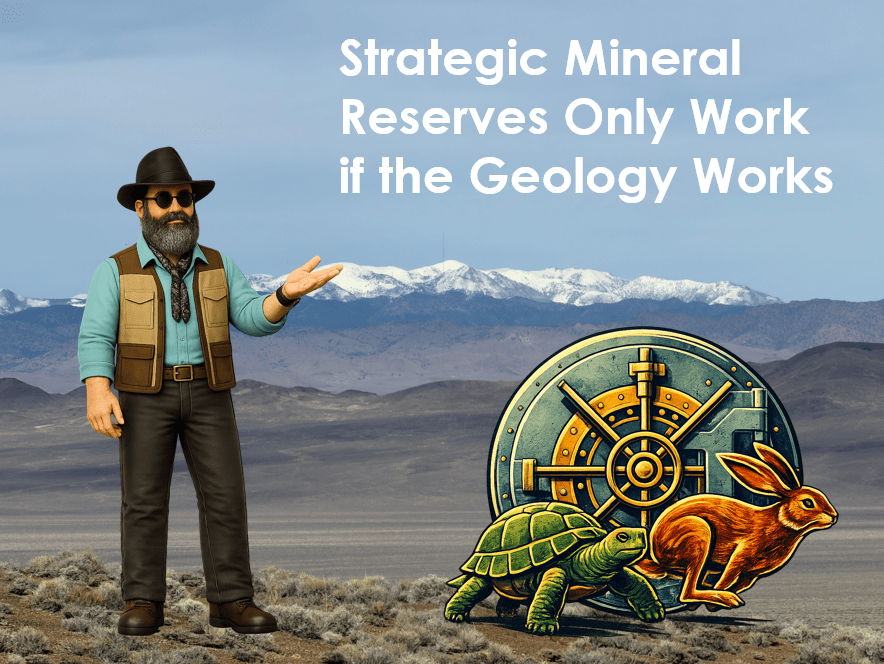
Why permitted mines are only the beginning of America’s critical mineral supply chain
Over the past year, a subtle shift has begun to ripple through Washington’s policy circles.
Minerals—once treated largely as commodities governed by global markets—are increasingly being discussed in the language of national resilience. Copper, cobalt, antimony, and other materials have entered the conversation not merely as inputs for industry, but as strategic resources tied to defense, energy systems, and advanced manufacturing.
Initiatives such as “Project Vault,” proposed with financing support through the Export-Import Bank of the United States, reflect this new thinking. The concept envisions a decentralized American reserve of critical minerals designed to buffer domestic industry from supply shocks, geopolitical leverage, or sudden disruptions in global supply chains.
The idea itself is simple and compelling: if certain minerals are strategically important, the United States should ensure reliable access to them.
Anyone who has spent time working on exploration and development projects knows that the journey from a mineral deposit to a producing mine is rarely simple.
But strategic reserves do not begin in vaults.
They begin in the rocks.
A Short List of “Ready” Projects
Recent policy discussions often point to a handful of U.S. mining projects described as “permitted and ready to deliver” the minerals needed for a resilient domestic supply chain.
One such list circulating in policy circles includes projects like:
- Perpetua Resources — Stibnite Project, Idaho (gold and antimony)
- Hudbay Minerals — Copper World Project, Arizona
- U.S. Gold Corp. — CK Gold Project, Wyoming
- Highland Copper Company — Copperwood Project, Michigan
- Arizona Sonoran Copper Company — Cactus Project, Arizona
- Bunker Hill Mining — Bunker Hill Mine, Idaho
- Gunnison Copper — Johnson Camp, Arizona
- Sandfire Resources America — Black Butte Copper, Montana
- Jervois Global — Idaho Cobalt Operations
- Florence Copper — Florence Copper Project, Arizona
Collectively, these projects represent billions of dollars in potential investment and a significant opportunity to expand domestic supply of metals essential to modern industry.
From a policy perspective, the logic is straightforward: these projects have permits, therefore they represent near-term production capacity.
From the perspective of someone who has worked inside exploration and development projects, the story is more nuanced.
The Long Distance Between Permit and Production
In public discussions about mining, permits are often treated as the final hurdle.
In reality, they are closer to the starting line.
Between a permitted project and an operating mine lies a long and uncertain stretch of road:
- additional drilling and resource refinement
- metallurgical testing and processing design
- detailed engineering and feasibility work
- capital financing
- infrastructure development
- construction timelines that often span years
Even well-advanced projects typically require several years—and substantial capital—to move from permit to production.
This is not a flaw in the system. It is simply the nature of building complex industrial operations around geological deposits that formed millions of years ago under conditions we are still working to understand.
The rocks may be known.
Turning those rocks into reliable supply takes time.
Every Deposit Is Its Own Geological Story
Another quiet reality rarely captured in policy lists is that no two mineral deposits behave exactly the same way.
Copper porphyry systems differ dramatically from sediment-hosted copper deposits. Cobalt mineralization presents different metallurgical challenges than gold. Underground operations carry different cost structures than open-pit mines or in-situ recovery systems.
Two deposits producing the same metal can require entirely different mining methods, processing technologies, infrastructure footprints, and capital investments.
A list of projects may appear interchangeable on paper.
In the field, each represents its own geological puzzle.
Understanding those differences—and how they influence timelines, risk, and scalability—is where geological interpretation becomes essential.
Strategic Mineral Policy Meets Geological Reality
The renewed focus on domestic mineral supply is both welcome and overdue.
For decades, the United States relied on global markets to deliver the materials needed for everything from electronics to defense systems. Recent geopolitical tensions and supply disruptions have exposed the fragility of that approach.
Programs like Project Vault reflect an emerging consensus: supply chains for critical minerals deserve strategic attention.
In policy circles this conversation is often framed in terms of supply chain resilience, industrial base security, and the need for friend-shoring or domestic sourcing of critical materials. These are important goals, and they reflect a growing recognition that minerals underpin modern manufacturing and defense systems alike. But achieving that resilience ultimately depends on something far more fundamental: understanding the deposits themselves—the geology, the metallurgy, and the practical realities that determine whether a mineral resource can truly become supply.
Strategic policy must ultimately intersect with geological reality.
Decision-makers in government agencies, manufacturing firms, and investment funds increasingly find themselves asking questions that sit squarely in the geological domain:
- How robust are these resources?
- How scalable are the deposits?
- What geological risks remain unresolved?
- How quickly could production realistically begin?
These questions cannot be answered through policy frameworks alone.
They require people who understand the ground beneath the proposals.
The Quiet Role of Geological Judgment
In mining, geology sits upstream of everything.
Before financing, before engineering, before construction, there must first be a deposit—one that can be mined economically, processed effectively, and developed responsibly.
Exploration geologists spend careers learning to read those signals in the Earth: the structure of the rock, the chemistry of the mineralization, the geometry of the orebody, and the countless clues hidden in drill core and outcrop.
Those interpretations rarely make headlines.
But they quietly determine whether a project becomes a mine—or remains a promising idea on paper.
As strategic mineral initiatives expand, the need for clear geological interpretation will only grow. Policymakers and investors alike must translate mineral resources into timelines, risk assessments, and development strategies.
In that process, geology becomes something more than an academic discipline.
It becomes a form of decision infrastructure.
The Opportunity Ahead
The United States is rediscovering a simple truth that earlier generations understood well: civilization runs on the materials of the Earth.
Copper wires carry electricity. Cobalt stabilizes batteries. Antimony strengthens alloys used in defense systems. Rare elements hidden in rock formations underpin technologies that define modern life.
Ensuring reliable access to those materials is a legitimate strategic goal.
But initiatives like Project Vault will succeed not because minerals are declared strategic in Washington.
They will succeed because exploration geologists find deposits, engineers design viable mines, investors commit capital, and communities support responsible development.
Strategic reserves may ultimately sit in warehouses, supply contracts, or financial instruments.
Yet their origins trace back to a much older place.
The outcrop.
The drill core.
The rocks beneath our feet.
Because in the end, strategic mineral reserves only work if the geology works.









 Mineral Exploration Geology - finding value in the world around us