
When Great Discoveries Meet the Fine Print
There are moments in mining where the story feels almost too clean.
A major discovery emerges. The grades are exceptional. The scale is undeniable. The infrastructure is already there. The timelines begin to take shape. The narrative writes itself—efficient, elegant, inevitable.
Fourmile, in Nevada, is one of those discoveries.
It is, without question, a significant discovery. High-grade, long-life, strategically located within one of the most productive gold belts on Earth. The kind of asset that doesn’t just move a needle—it redraws the chart.
And just as that story begins to crystallize…
Enter stage left: Teck.
With a quiet but very real reminder—
a 10–15% net profits interest over a meaningful portion of the ground.
Not a geological problem.
Not a technical flaw.
But something far more subtle—and far more powerful.
A reminder that in mining, the story is never just about the rock.
The Discovery Is Real—But So Is the Structure
Let’s be clear: Fourmile deserves the attention it’s getting.
Discoveries of this caliber don’t come around often. The grades, the continuity, the scale—these are the ingredients of a Tier 1 asset. In many ways, Fourmile represents the culmination of decades of understanding Nevada’s Carlin-type systems and the structural controls that govern them.
But Fourmile is also something else.
It is not a discovery made in isolation.
It exists within a mature, heavily explored, and deeply transacted district—one where land positions, agreements, royalties, and joint ventures have been layered over time like stratigraphy itself.
And that’s where the royalty comes in.
Teck’s net profits interest is not new. It wasn’t conjured out of thin air. It is the product of prior ownership, prior deals, prior visions of what this ground might one day become.
In other words:
The geology may be newly revealed—but the ownership history is not.
When the Ownership Stack Comes Due
A 10–15% net profits interest is not a rounding error.
It is a direct participation in the economic engine of the project. It touches cash flow. It influences valuation. It shapes how the asset is perceived—especially in the context of a broader corporate strategy like a spinout or IPO.
And timing matters.
As Barrick advances plans to carve out its North American assets into a new publicly listed entity, Fourmile sits prominently among them. It is a flagship. A cornerstone. A driver of future value.
But value, in mining, is never just about ounces in the ground.
It is about what portion of those ounces you actually control—and what portion has already been spoken for.
This is where the narrative shifts.
Not dramatically. Not catastrophically. But meaningfully.
Because:
Not all ounces are created equal.
And not all of them are fully yours.
The Quiet Reality: Discovery vs. Ownership
This is where we step out of the headline and into the deeper layer—the one that often doesn’t get the same airtime.
Fourmile is a significant discovery.
But it is not, strictly speaking, true greenfield exploration.
And that distinction matters.
Fourmile exists within the broader Nevada Gold Mines ecosystem—a region with decades of drilling, data, reinterpretation, and evolving geological models. The discovery is the result of refinement, persistence, and deeper understanding, not the first recognition of a system in untouched ground.
That’s not a critique. In fact, it’s a testament to how world-class districts continue to give—if you know how to listen.
But it does come with a trade-off.
Because mature districts carry history.
And history, in mining, comes with:
- Royalties
- Legacy agreements
- Joint venture structures
- Fragmented ownership layers
Each one subtle on its own.
But together, forming an ownership stack that can materially shape the outcome.
The Greenfield Contrast — The Purity of First Position
This is where the conversation turns—and where the lesson sharpens.
There is a reason that greenfield exploration still holds a special place in the hierarchy of opportunity.
Not because it is easier. Quite the opposite.
Greenfield exploration carries the highest geological risk. You are stepping into uncertainty. You are testing ideas against silence. You are, quite literally, asking the Earth a question and waiting for an answer.
But if that answer comes back positive…
You hold something rare:
Clarity of ownership.
No legacy royalties.
No historical encumbrances.
No prior claims on future value.
Just you, the ground, and whatever you discover.
That is the purest form of exploration.
One risks the drill bit.
The other risks the cap table.
In brownfield environments like Nevada, the geological risk may be lower—but the structural complexity is higher. The discovery may be exceptional, but the value must flow through a pre-existing framework of agreements that were never designed with this exact outcome in mind.
And when those agreements surface—like Teck’s royalty has—they don’t diminish the discovery.
But they do redefine it.
Geology Is Only One Part of the Equation
This is the heart of it—and it sits squarely within the NGM lens.
Mining is not just a story of rocks.
It is a story of decisions layered over time.
Geology.
Land tenure.
Agreements.
Capital structure.
Each one interacting with the others.
Each one shaping what a discovery ultimately becomes—not just in technical terms, but in economic reality.
Fourmile is a powerful reminder of this.
It shows us that even the best discoveries in the world are not immune to the past. That ownership, once defined, has a way of echoing forward into the future—sometimes quietly, sometimes all at once.
The Takeaway
Fourmile remains one of the most compelling gold discoveries in recent memory.
That hasn’t changed.
But the emergence of a meaningful royalty over the project reframes the conversation—not by diminishing the asset, but by adding dimension to it.
Because in mining, the win condition is not simply to discover.
It is to discover and control.
And when those two things diverge—even slightly—the market takes notice.
As it should.
NGM — Nevada Gold Mines, and the lessons beneath them.
Because the rock was never the only story.

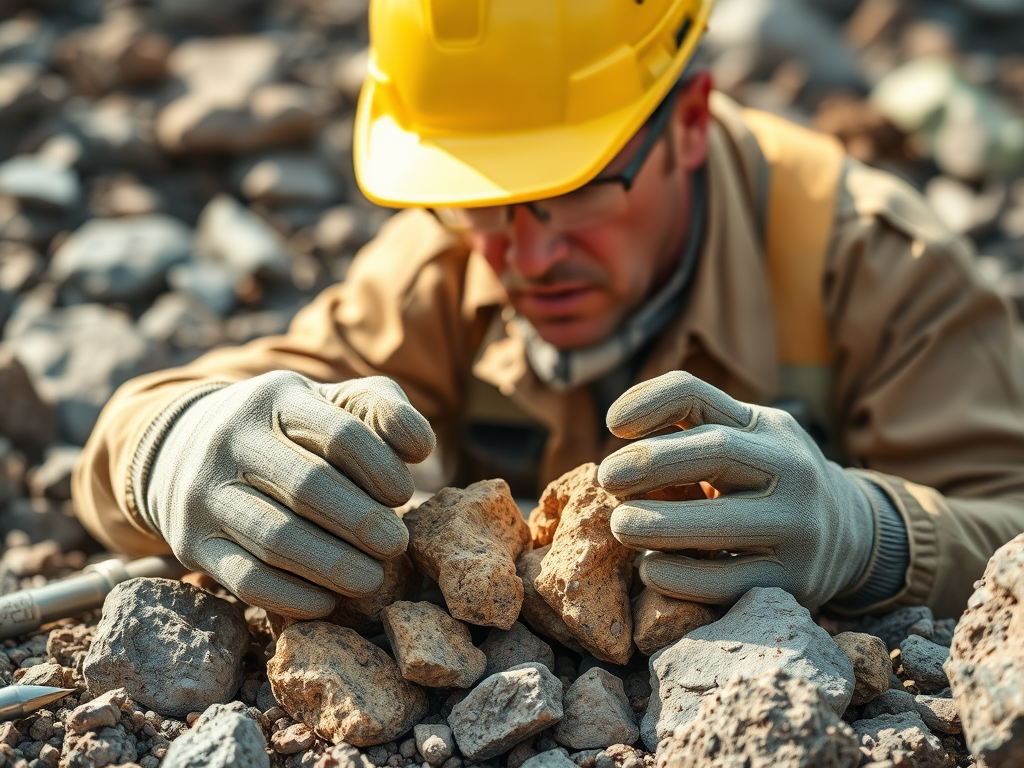




 Mineral Exploration Geology - finding value in the world around us