
By Mark W. Travis, CPG | Arkenstone Exploration
I. The Echo of a Vision
Sometimes the mountain answers.
For years, many of us in exploration, energy, and policy circles have been voicing the same refrain:
America must rediscover its backbone — the one forged in ore and energy, refined by industry, and animated by purpose.
We’ve written about it, spoken at conferences, and fought uphill battles in permitting offices.
Now, a trillion and a half dollars later, that whisper from the pit, the drill pad, and the assay lab has finally reached the marble halls of finance.
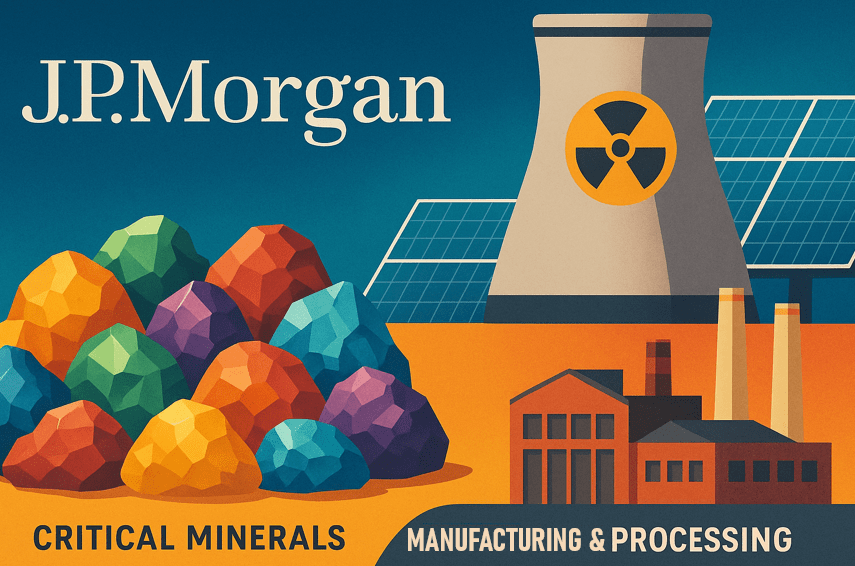
JPMorgan Chase’s new “Security & Resiliency Initiative” — a $1.5 trillion investment framework — reads like a checklist of every structural challenge we’ve named:
- Supply chains fractured by foreign dependence
- Permitting regimes tangled in red tape
- Hollowed-out refining and manufacturing capacity
- A cultural hesitation to act upon the Earth — to build, dig, and dare
And suddenly, the world’s largest bank says: We hear you.
II. From Policy Paralysis to Purposeful Action
This isn’t a boutique green fund or a PR stunt. It’s a re-industrialization mandate that explicitly includes:
- Critical-mineral exploration and refining
- Nuclear energy, solar power, and grid resilience
- Advanced manufacturing and AI-enabled infrastructure
- Policy advocacy to streamline permitting and remove regulatory friction
That last point stopped me cold.
A global financial titan committing to advocate for permitting reform? That’s a tectonic shift.
For decades, investors have been content to fund consumption rather than creation.
Now we’re seeing a return to first principles — to the idea that progress and stewardship can walk the same path.
That responsible use of Earth’s materials is not desecration but devotion.
III. The Nuclear Note in the New Energy Symphony
Look closer and you’ll find nuclear listed among JPMorgan’s 27 “sub-areas of strategic investment.”
This is no longer fringe. The same financiers that once fled uranium are now calling it resilient infrastructure.
As data centers bloom across the prairie and AI’s appetite for electrons deepens, the need for firm, clean, constant power grows existential.
The atom — long maligned, long patient — is returning to the spotlight.
And with it, the miners, geologists, and innovators who never stopped believing that the future still runs on fuel from the rocks beneath us.
IV. Refining the Future
JPMorgan’s plan isn’t just about what comes out of the ground — it’s about what we can build above it.
From copper smelters to rare-earth separation plants, from battery-metal recycling to magnet manufacturing, the initiative recognizes what explorers have always known: a resource has no power until it’s refined.
That’s not just metallurgy — that’s civilization in miniature.
The same alchemy that turns rock into revenue also turns vision into reality.
V. The Political Ground Shifts
Equally seismic is the policy stance:
“The firm will advocate for research, development, permitting, procurement, and regulations conducive to growth.”
In other words: they’re joining the lobby to fix what’s broken.
When Wall Street’s largest player begins echoing the same frustrations voiced by field geologists, operators, and regional coalitions, the ground has truly moved.
This could be the moment when private capital and public policy finally align — when we stop apologizing for production and start enabling it.
VI. A Renewal of Faith in Making
There’s a deeper current running through all this.
For too long, the national conversation has treated use as something shameful — as if to touch the Earth is to harm it.
But creation has always required contact.
Our machines, our reactors, our refineries — these are the hands of a species still learning how to shape wisely.
To use with restraint. To build with reverence.
That’s not exploitation — that’s participation in something vast, beautiful, and ongoing.
This new initiative, if it holds course, could mark the dawn of a renewed covenant between humanity and its home planet — one built on trust, purpose, and shared prosperity.
VII. The Road Ahead
There’s plenty left to prove.
Capital can move mountains — or drown them in paperwork.
But for now, this feels like the beginning of something worthy.
The miners, metallurgists, and mappers have always been the first to sense a change in the strata.
And this feels like a fresh layer being laid down — one built of courage, collaboration, and the will to act.
Maybe the Earth has been whispering all along,
and at last, the world’s largest bank stopped to listen.
 Mineral Exploration Geology - finding value in the world around us