The U.S. Nuclear Regulatory Commission is reorganizing.
On the surface, that sounds bureaucratic. Org charts. Reporting lines. Internal memos.
But don’t be fooled.
This may be one of the most consequential structural signals for nuclear energy — and uranium — in decades.
What’s Actually Happening?
The U.S. Nuclear Regulatory Commission is restructuring around three core business lines:
New Reactors
Operating Reactors
Nuclear Materials & Waste
Licensing and inspection functions will be integrated. Accountability will be centralized within each line. Decision velocity is the objective.
This is not deregulation.
This is reorganization for efficiency.
And efficiency, in nuclear, has historically been the missing variable.
From Fear to Function
There was a time when America built reactors.
Under the United States Atomic Energy Commission, nuclear power was both regulated and promoted — sometimes imperfectly, but with ambition.
Then came the era of public fear, media amplification, and institutional risk aversion. The China Syndrome premiered. Three Mile Island accident followed.
Permitting paradigms hardened. Timelines stretched. Capital retreated.
The industry didn’t die. It slowed.
This reorganization signals something different:
A regulator aligning itself with national deployment goals — without abandoning safety.
That distinction is everything.
The Elephant in the Room: Uranium
If the NRC becomes faster, clearer, and more accountable in licensing new reactors, the consequences ripple upstream immediately.
Amir Adnani, CEO of UEC, has floated the possibility of $1,000/lb U₃O₈ in a true supply squeeze (at a recent talk given in Vancouver (VRIC 2026)).
Is that the base case? No.
But the direction of travel matters more than the ceiling.
When regulatory friction decreases, capital confidence increases. When capital confidence increases, projects move. When projects move, supply tightens against accelerating demand.
This is how structural bull markets are born.
Unlocking the Upstream
For uranium producers and explorers, a credible acceleration in nuclear deployment does several things:
Unlocks equity financing for restarts and greenfields
Encourages long-term utility contracts
Justifies domestic enrichment and conversion build-out
De-risks jurisdictional narratives
But here’s the deeper layer:
Regulatory reform does not just unlock production.
It unlocks exploration.
And exploration is where the real asymmetry lives.
Humanity’s New Fire
Nuclear energy is not just another commodity cycle.
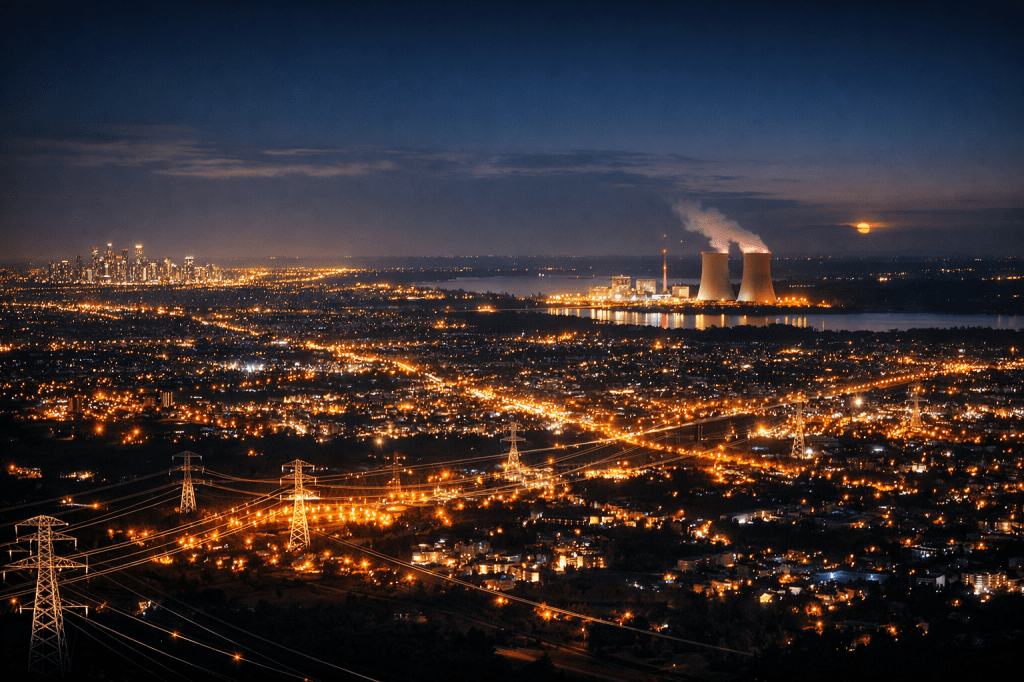
It is 3,000,000-to-1 energy density. It is grid stability in an AI-powered century. It is geopolitical leverage. It is decarbonization without fragility.
It is Prometheus without smoke.
If the NRC reorganization proves durable — if it translates into measurable timeline compression — then we are not witnessing a bureaucratic shuffle.
We are witnessing the quiet removal of a bottleneck.
And when bottlenecks disappear, abundance flows.
Where I Stand
In a world where regulatory velocity meets capital discipline, the most valuable role is not the driller or the promoter.
It is the translator.
The one who stands between geology, permitting, and capital and asks:
Is this technically real?
Is this jurisdictionally viable?
Is this capital-ready?
Is this timed correctly within the cycle?
That’s the lane I operate in.
Because when humanity reaches again for its new fire, someone must ensure the spark lands where it can actually burn.
This NRC reorganization may seem administrative.
But to those watching the full arc — from regulator to reactor to uranium to discovery —
Three years ago, I wrote about uranium as humanity’s new fire—a phrase meant to reframe the atom not as a weapon or a controversy, but as a fundamental leap in how civilization accesses energy. At the time, it felt like a contrarian stance. Nuclear was tolerated, debated, sometimes defended—but rarely embraced.
That hesitation is gone.
Not because minds were changed in op-eds or hearings, but because reality arrived carrying a power bill.
Artificial intelligence has done what decades of climate arguments, geopolitical warnings, and grid stress tests could not: it has made nuclear energy unavoidable.
The Load That Ended the Debate
When Meta signed agreements to secure up to 6.6 gigawatts of nuclear power—enough electricity to supply millions of homes—it wasn’t a branding exercise or a political statement. It was load planning.
Those agreements, spanning utilities and advanced reactor developers, were designed to power data centers and AI infrastructure, including Meta’s Prometheus supercluster in Ohio. This followed an earlier 20-year nuclear power purchase agreement with Constellation Energy, reinforcing the message: this is not speculative demand. It is contracted, long-term, and mission-critical.
Six gigawatts is not ideology. It is physics, written in ink.
AI Doesn’t Run on Vibes
Artificial intelligence is different from every prior wave of electrification. It is not flexible. It does not pause politely when the sun sets or the wind calms. It requires:
Continuous, 24/7 power
Tight voltage and frequency control
Massive energy density in a small footprint
Zero tolerance for unplanned downtime
In other words, baseload.
Wind and solar play important roles in modern grids—but at scale, AI exposes their limits. The storage required to smooth intermittency at data-center magnitude is staggering, costly, and still bounded by materials, land use, and physics.
AI doesn’t run on vibes. It runs on electrons—and electrons don’t care about politics.
Why Nuclear Won This Time
This is not nuclear’s first comeback attempt. The industry’s past is littered with projects that ran late, over budget, or both. The cautionary tale most often cited is NuScale, whose flagship SMR project collapsed under rising costs and withdrawn power-purchase commitments.
So what changed?
Two things—both decisive.
First, the customer. Today’s nuclear buyers are not utilities hoping regulators approve future rate recovery. They are technology companies with fortress balance sheets, global competition breathing down their necks, and no patience for unreliable power.
Second, the urgency. AI infrastructure is not optional. It is strategic. As Goldman Sachs Research has noted, data-center electricity demand is projected to surge dramatically this decade. This demand is not hypothetical—it is already being built.
Nuclear did not win because it became cheaper overnight. It won because it became necessary.
The Uranium Signal
When downstream demand hardens, upstream signals follow—and nowhere is that clearer than in uranium markets.
The Sprott Physical Uranium Trust has continued accumulating physical uranium, pushing holdings to historic levels and reinforcing price stability well above long-term averages. These purchases are often dismissed as “financial flows,” but that misses the point.
Physical uranium inventory tightens the market precisely when utilities and developers are locking in future supply. The result is not hype—it is structural support.
For explorers and developers, the message is plain: future reactors require present-day pounds.
Energy Density Is Destiny
At its core, this moment is not about AI, climate policy, or even uranium prices. It is about energy density—the quiet variable that governs everything from industrial growth to geopolitical stability.
Every major leap in civilization has been powered by denser energy:
Wood to coal
Coal to oil
Oil to uranium
Each transition unlocked more capability with less material, less land, and fewer constraints. Nuclear sits at the top of that ladder—not because it is perfect, but because nothing else delivers so much energy in so small a space, so reliably, for so long.
AI has simply forced us to admit it.
The Return of the Atom
The nuclear debate did not end in a courtroom or a legislature. It ended in server halls, where engineers stared at uptime requirements and crossed everything else off the list.
This is not a revival driven by nostalgia or ideology. It is a return driven by necessity—by grids that must work, by data that must flow, and by a civilization that has once again reached the limits of its current fire.
Humanity’s new fire was never extinguished. It was waiting—for the moment when nothing else would do.
There are moments in history when humanity stumbles into a discovery so profound that the old world simply cannot continue. We split the atom less than a century ago, and for a long stretch, our species barely knew what to make of it. We feared it, mythologized it, and stuffed it into a box labeled too powerful, too political, too much.
But now—finally—something is shifting. The timing, the physics, the policy winds, and the relentless hunger of the digital age are converging into an unmistakable truth: we are stepping out of the era of chemical fire and into the era of nuclear fire.
This is not a cycle story. It’s a civilizational pivot.
And uranium—quiet, dense, misunderstood uranium—is at the heart of it.
I. The New Fire: Humanity’s Leap Beyond Combustion
For fifty thousand years, every spark that powered our lives came from the same narrow miracle: electrons jumping between bonds. Campfires, coal plants, gas turbines—they’re all variations on the same ancient theme.
Then came nuclear fission. A new fire. A different fire. A fire born not from electrons, but from the nucleus itself—where the strong force holds court as the most powerful force nature has ever revealed to us.
One pound of uranium equals the energy of three million pounds of coal. Energy density so extreme it defies intuition. So compact it reshapes civilization the moment we accept its implications.
We’ve spent decades treating this fuel as though it were just another commodity. But uranium is not the next step in the combustion story—it is the first step beyond it.
II. Three Industrial Revolutions at Once
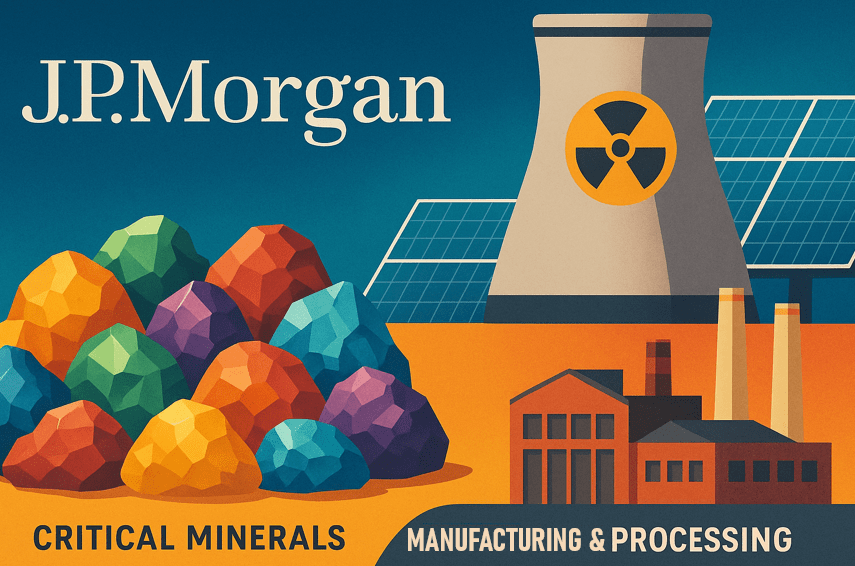
In October, JPMorgan dropped a quiet thunderbolt: a $1.5 trillion Security & Resiliency Initiative, aimed at reinforcing the strategic backbone of the U.S. economy. The pillars were unmistakable:
AI and frontier technologies
Energy independence and grid resiliency
Critical minerals and advanced manufacturing
And there, placed unapologetically among the must-have infrastructure of the 21st century, was nuclear energy.
When institutions of this scale shift their worldview, they aren’t betting on a fad. They’re acknowledging an inevitability.
Artificial intelligence, automation, domestic supply chains, data… these things are not trends. They are the architecture of a new industrial order. And that order requires a stable, abundant, high-density energy substrate.
It requires the new fire.
III. The Market Awakens
For years, uranium wandered in the desert—underpriced, misunderstood, dismissed as yesterday’s fuel. Yet even in the lean decade, the physics remained unchanged. And eventually, reality comes calling.
Today, every part of the fuel cycle is tightening:
Spot and term prices rising
Enrichment swinging from underfeeding to overfeeding
Inventories thinning
Utilities returning to long-term contracts after a decade asleep
And what was once a niche corner of commodity finance now has a shadow giant: the Sprott Physical Uranium Trust, pulling pounds off the market with the force of pure price signal.
This is not speculative froth. This is structural tightening.
We burned through our cushion. We failed to invest in new supply. We forgot that no reactor, no matter how modern, can run on sentiment.
And now the market is rediscovering what the physics always told us: uranium has been undervalued for an entire generation.
IV. Policy Tailwinds: Fast-41 and Federal Momentum
For decades, permitting has been the slow-turning wheel that discouraged developers and exhausted investors. But the federal landscape is changing—quietly, steadily, and now unmistakably.
Fast-41, once a framework reserved for highways and pipelines, now explicitly includes: ISR uranium, Mills, Conversion, Enrichment, & HALEU production
In parallel, the 2025 Budget Bill and executive directives have recognized nuclear as essential to national security, supply-chain strength, and decarbonization. Washington isn’t simply approving nuclear. It is prioritizing it.
The bureaucracy is beginning to match the physics. And that alone is enough to shift the trajectory of an industry.
V. The World Starts Building Again
While the West spent years debating nuclear’s identity crisis, the rest of the world kept building: China. India. South Korea. The UAE. Eastern Europe.
Dozens of reactors under construction. More in planning. And the U.S., once stagnant, is quietly transforming its own fleet with 80-year life extensions—the kind of decision that locks in long-term uranium demand for generations.
Meanwhile, SMRs and microreactors are not science projects anymore. Their first deployments aim where the grid falters: Remote towns, Industrial loads, Military installations, Microgrids, & Data centers
The next generation of reactors will not look like the last. Their scale will be smaller, their roles more varied, and their potential enormous.
VI. AI and the Electrification Surge
Artificial intelligence is no longer just a computational discipline—it is an energy consumer of mythic proportions. Model training. Inference. Hyperscale data centers. 24/7 loads with zero tolerance for downtime.
We are building digital cathedrals that run day and night, learning, predicting, dreaming, building. They demand electricity not in peaking cycles, but in ceaseless baseload.
Intermittency cannot carry this burden. Batteries cannot shoulder it. Gas cannot scale cleanly enough for it.
Only nuclear operates with the quiet consistency that AI requires: 90%+ capacity factors. Multi-year refueling cycles. Carbon-free baseload.
AI is the new industrial furnace. And the only fuel that can support it at scale is uranium.
VII. The Price Is Wrong — and Physics Says So
The greatest misunderstanding in the entire uranium market is a simple one: we price uranium like a commodity, but it behaves like a physical miracle.
Whether uranium is $70/lb or $300/lb barely moves the cost of nuclear power. Fuel is a single-digit portion of reactor economics. Meanwhile, the energy density of U-235—nuclear strong-force energy—puts it in a cost-equivalence range orders of magnitude above today’s pricing.
A physics-based valuation framework places uranium somewhere between:
$300/lb (conservative cost parity)
$1000–3000/lb (pure energy-density equivalence)
This is not a price forecast. It is a statement of mismatch—between what uranium is and what the market pretends it is.
This gap is the opportunity of a generation.
VIII. When Prices Move, Entire Districts Wake Up
A true price breakout doesn’t just lift a few producers. It resurrects forgotten districts, reopens dormant mines, and redraws the map of viable exploration.
At higher uranium prices:
ISR isn’t the only game in town
Open pits and underground operations return
Marginal belts transform into real contenders
Drilling accelerates
Staking wars reopen
The exploration pipeline finally breathes again
Meanwhile, modern tools—AI, machine learning, 3D geologic modeling—unlock layers of subsurface intelligence never before accessible. Roll-front discovery becomes a data-driven pursuit rather than a needle-in-a-basin exercise.
The work becomes smarter. Faster. More predictive. More efficient.
We’re not just inheriting new fire. We’re learning how to aim it.
IX. Waste: The Myth, the Reality, and the Future Fuel
Nuclear waste is one of the great optical illusions of modern society. The entire spent-fuel footprint of the United States fits on a single football field stacked 30 feet high. It is solid. Contained. Tracked. Managed with a flawless safety record spanning seven decades.
And—this is the part almost no one realizes—95% of its energy remains unused.
Tomorrow’s reactors and recycling technologies will turn much of what we now store into multi-century fuel. Even the isotopes considered “waste” today are becoming strategic assets—powering nuclear batteries, satellites, sensors, and remote systems for centuries.
In a world obsessed with circularity, nuclear is quietly revealing the most circular energy cycle of all.
X. What This Means for Us
The horizon in front of us is not abstract. It is real, rising, and demanding talent, courage, stewardship, and scientific clarity.
As uranium prices rise and the world’s appetite for electrons becomes insatiable, opportunity expands across every corner of the sector:
Geologists
Engineers
Hydrologists
Nuclear fuel specialists
Data scientists
Permitting professionals
AI-driven subsurface modelers
This is not a renaissance to watch. It is a renaissance to shape.
We have inherited a fire more powerful than any our species has ever wielded—and with it, a responsibility to use it wisely, transparently, ethically, and with a long memory for the land and communities that support our work.
We are building the energy architecture of 2050, 2080, 2100 and beyond. The choices we make now echo into a century that will run on electrons drawn from the nucleus.
Every so often, a question settles into the back of a geologist’s mind like a pebble in a boot. No matter how far you walk, you feel it.
For me, that pebble was this:
If one pound of uranium holds roughly three million times more energy than a pound of coal… why do they trade at the same order of magnitude in price?
Why is uranium an $80/lb commodity when, energetically, it behaves like bottled lightning?
I expected the answer to be complicated. The truth was deeper — and far more astonishing — than I imagined.
This essay is the story of following that question all the way down to the bedrock… and discovering a fault line in the global economy waiting to slip.
I. Uranium vs. Coal: A Tale of Two Fuels
Let’s start with the raw physics — no jargon, no reactor-speak, just simple energy content.
Coal:
About 10,000 BTU per pound.
Uranium (real-world reactor fuel):
About 1.6 billion BTU per pound.
Uranium (full-U235 fission theoretical):
About 37 billion BTU per pound.
To keep the math anchored:
👉 1 pound of uranium ≈ 3,000,000 pounds of coal 👉 or roughly 1,500 short tons
This is not a rounding error. It is the largest energy-density spread in the history of civilization.
Yet…
Coal trades at $50–$100 per ton. Uranium trades at ~$80 per pound.
The more I turned the numbers over, the more absurd the comparison became.
II. The First Shock: Uranium’s “Heat Parity” Price Isn’t $100 — It’s Thousands
To calculate uranium’s “true value,” let’s ask a simple, childlike question:
“If you priced uranium the same way you price coal — purely by heat content — what would it be worth?”
Answer:
In today’s reactors, uranium should be worth $3,000–$8,000 per pound.
In theoretical full-fission terms, it reaches $100,000–$500,000 per pound.
Those are not typos. Those aren’t dreams. Those are physics.
So how on Earth is uranium $80/lb?
Because markets don’t trade physics — they trade logistics, regulation, and psychology.
That realization led me to the second, even deeper shock.
III. The Second Shock: Even at $300–$1,000/lb, Nuclear Power Costs Stay Flat
This was the moment the ground shifted under my feet.
You can triple or quadruple the price of uranium…
…and the cost of nuclear electricity barely moves.
Why?
Because nuclear plants use so little fuel.
A single fuel pellet the size of your fingertip holds the same energy as a ton of coal. A single pound of uranium powers thousands of homes for a year. Fuel is a tiny slice of a reactor’s operating cost.
Raising uranium from $80 to $300 or even $1,000 moves the needle only from ½ cent per kWh to maybe 2 cents per kWh in fuel cost.
Let that sink in:
Nuclear energy is so potent that even a 10× or 20× rise in uranium price barely budges the electric bill.
This is not just an economic curiosity — it is a macroeconomic revelation.
IV. The Third Shock: A World Built on Cheap Nuclear Energy Floats, Not Sinks
If uranium rises to its real value — $300 fuel-parity or even $3,000 physics-parity — something extraordinary happens:
Energy becomes inexpensive, predictable, and abundant.
Imagine:
No volatility from gas pipelines.
No coal supply crunches.
No weather-dependent intermittency.
No geopolitical chokeholds.
No fragile grids.
No spiraling power costs.
Nuclear offers:
Ultra-cheap fuel
Ultra-long asset life
Ultra-stable output
When energy becomes cheap and constant, everything else in the economy becomes lighter:
Manufacturing costs drop
Mining costs drop
Transportation costs drop
Food production costs drop
Inflation pressure eases
Economic growth accelerates
It is the closest thing to a “cheat code” for civilization we have ever found.
Sometimes you have to read the tea leaves to see the deeper reality: Cheap uranium → cheap nuclear → cheap everything.
This isn’t geology anymore — this is political economy.
V. And Here’s the Punchline: The Mining World Isn’t Ready
This is where my geologist’s boots hit the dirt.
Because if uranium is this undervalued… if its true energy value is in the thousands per pound… if the world is going nuclear out of necessity… then we are standing on the threshold of a mining revolution.
At $300/lb:
Roll-fronts once considered “marginal” become prime targets.
At $500–$1,000/lb:
Low-grade sandstone horizons become company-makers. Old ISR fields get second and third lives.
At $1,000–$3,000/lb:
Lignites, shales, metasomatic systems, and granites — today written off as waste — become the Athabasca Basins of 2075.
What we call “low grade” today will be considered “bonanza” tomorrow.
We are in the early-early-early oil age of uranium. Rockefeller-level early. “Horse-drawn rigs in Pennsylvania” early.
The only reason the world isn’t acting like it is early? Because we are pricing uranium as if it is coal.
And it is not coal. It is energy compressed into a mineral soul.
VI. The New Frontier: Energy Abundance and Geologic Renaissance
What happens when:
reactors get smaller
regulations get smarter
fuel cycles get closed
enrichment expands
nations seek energy independence
grids bend under AI and electrification…
…and uranium prices finally catch up?
A renaissance.
A rebirth.
A new era where exploration geologists walk onto projects long dismissed as “uneconomic” — and suddenly see opportunity glowing like desert varnish at sunset.
We will re-drill old deposits. We will re-map old roll fronts. We will re-model old sandstone basins. We will re-evaluate “waste” with wiser eyes.
Because the future doesn’t belong to high-grade deposits.
The future belongs to scale.
VII. Conclusion: The Rock Is Mighty — The Market Just Forgot
Uranium is not an $80 commodity pretending to be a fuel.
It is a world-changing energy metal priced as if it were an afterthought.
Physics says it should be thousands per pound. Economics says it can easily support hundreds per pound. Civilization says we desperately need it. Geology says we are barely scratching the surface.
And the exploration frontier — the one that I and many others walk every day — is on the cusp of rediscovery.
The rock is mighty.
The world just hasn’t remembered it yet.
But it will.
And when it does, the next century of energy, mining, geopolitics, and human flourishing may well be written in the quiet glow of uranium’s still-untapped power.
For years, many of us in exploration, energy, and policy circles have been voicing the same refrain:
America must rediscover its backbone — the one forged in ore and energy, refined by industry, and animated by purpose.
We’ve written about it, spoken at conferences, and fought uphill battles in permitting offices. Now, a trillion and a half dollars later, that whisper from the pit, the drill pad, and the assay lab has finally reached the marble halls of finance.
JPMorgan Chase’s new “Security & Resiliency Initiative” — a $1.5 trillion investment framework — reads like a checklist of every structural challenge we’ve named:
Supply chains fractured by foreign dependence
Permitting regimes tangled in red tape
Hollowed-out refining and manufacturing capacity
A cultural hesitation to act upon the Earth — to build, dig, and dare
And suddenly, the world’s largest bank says: We hear you.
II. From Policy Paralysis to Purposeful Action
This isn’t a boutique green fund or a PR stunt. It’s a re-industrialization mandate that explicitly includes:
Critical-mineral exploration and refining
Nuclear energy, solar power, and grid resilience
Advanced manufacturing and AI-enabled infrastructure
Policy advocacy to streamline permitting and remove regulatory friction
That last point stopped me cold. A global financial titan committing to advocate for permitting reform? That’s a tectonic shift.
For decades, investors have been content to fund consumption rather than creation. Now we’re seeing a return to first principles — to the idea that progress and stewardship can walk the same path. That responsible use of Earth’s materials is not desecration but devotion.
III. The Nuclear Note in the New Energy Symphony
Look closer and you’ll find nuclear listed among JPMorgan’s 27 “sub-areas of strategic investment.” This is no longer fringe. The same financiers that once fled uranium are now calling it resilient infrastructure.
As data centers bloom across the prairie and AI’s appetite for electrons deepens, the need for firm, clean, constant power grows existential. The atom — long maligned, long patient — is returning to the spotlight. And with it, the miners, geologists, and innovators who never stopped believing that the future still runs on fuel from the rocks beneath us.
IV. Refining the Future
JPMorgan’s plan isn’t just about what comes out of the ground — it’s about what we can build above it.
From copper smelters to rare-earth separation plants, from battery-metal recycling to magnet manufacturing, the initiative recognizes what explorers have always known: a resource has no power until it’s refined.
That’s not just metallurgy — that’s civilization in miniature. The same alchemy that turns rock into revenue also turns vision into reality.
V. The Political Ground Shifts
Equally seismic is the policy stance:
“The firm will advocate for research, development, permitting, procurement, and regulations conducive to growth.”
In other words: they’re joining the lobby to fix what’s broken. When Wall Street’s largest player begins echoing the same frustrations voiced by field geologists, operators, and regional coalitions, the ground has truly moved.
This could be the moment when private capital and public policy finally align — when we stop apologizing for production and start enabling it.
VI. A Renewal of Faith in Making
There’s a deeper current running through all this. For too long, the national conversation has treated use as something shameful — as if to touch the Earth is to harm it. But creation has always required contact.
Our machines, our reactors, our refineries — these are the hands of a species still learning how to shape wisely. To use with restraint. To build with reverence. That’s not exploitation — that’s participation in something vast, beautiful, and ongoing.
This new initiative, if it holds course, could mark the dawn of a renewed covenant between humanity and its home planet — one built on trust, purpose, and shared prosperity.
VII. The Road Ahead
There’s plenty left to prove. Capital can move mountains — or drown them in paperwork. But for now, this feels like the beginning of something worthy.
The miners, metallurgists, and mappers have always been the first to sense a change in the strata. And this feels like a fresh layer being laid down — one built of courage, collaboration, and the will to act.
Maybe the Earth has been whispering all along, and at last, the world’s largest bank stopped to listen.
“The age of apology must end. The age of awareness must begin.”
“There are decades where nothing happens; and there are weeks where decades happen.” – Vladimir Lenin (and, let’s be honest, every energy sector analyst this month)
For years, the phrase “American uranium renaissance” has lingered in industry headlines like the smell of a diesel rig that never quite fired up. Promising starts faded. Policy support came in fits and starts. And those of us in the trenches—operators, geologists, engineers—held on to a vision of domestic nuclear revival that never quite made it out of committee.
Until now.
The last few weeks have delivered something different: not just press releases, but permits, production, and political will—aligned, accelerating, and actively reshaping the landscape of uranium in the United States. From Wyoming to Utah to Texas, major players are pushing forward with restarts, expansions, and acquisitions, emboldened by a rare trifecta: market fundamentals, government policy, and infrastructure readiness.
Let’s take a tour of the sector’s seismic shifts.
🚨 Policy First: Washington Opens the Gates
It started at the top.
In April and May, the Trump administration rolled out a flurry of Executive Orders aimed at reviving the nuclear fuel cycle. These included:
Emergency Declarations identifying uranium as a strategic national asset
A ban on Russian uranium imports (signed into law in May 2024)
Federal directives to streamline permitting for domestic uranium and vanadium projects
The creation of the National Energy Dominance Council brought policy coordination to a new level, explicitly calling out uranium as an “amazing energy asset.” That might sound like political theater, but in an industry as permit-constrained as ours, it’s hard to overstate what a signal like this does to capital flows and operational confidence.
And the results? Almost immediate.
⛏️ Anfield Energy: Permitted at the Speed of Policy
On May 27, Anfield’s Velvet-Wood Project in San Juan County, Utah, became the first uranium mine approved under the new emergency declaration. The U.S. Department of the Interior wrapped environmental review in just 14 days—a process that once took years. This was not a pilot or demonstration; this was the green light to go.
Anfield’s position is even stronger when you consider their Shootaring Canyon Mill, one of only three licensed conventional uranium mills in the U.S. With mill capacity in place and a $238 million pre-tax NPV (PEA combined with Slick Rock), Anfield’s production pipeline is now a strategic national asset.
In June, Uranium Energy Corp (UEC) doubled down, acquiring 170 million Anfield shares and boosting its stake to over 37% (partially diluted). In doing so, UEC is anchoring itself not just as a producer, but as a portfolio architect of the American fuel cycle.
🛠️ IsoEnergy: Restart Plans with a Permit-First Strategy
Also on May 27, IsoEnergy Ltd. announced it had kicked off technical optimization programs at its fully permitted Tony M Mine in Utah. These included:
Ore sorting with Steinert’s sensor-based technology
High-Pressure Slurry Ablation (HPSA) for improved uranium recovery
Enhanced evaporation to speed up dewatering and reduce pond buildout costs
All of IsoEnergy’s mines in Utah—Tony M, Daneros, and Rim—are fully permitted. With a toll milling agreement already in place with Energy Fuels’ White Mesa Mill, IsoEnergy is poised to become a low-capex, near-term producer with minimal regulatory hurdles.
A restart decision is anticipated by the end of 2025. From where I sit, that’s not just likely—it’s inevitable.
🧭 Ur-Energy: Expansion Secured, Basin Rising
In early May, Ur-Energy received final approval from both Wyoming DEQ and the EPA to expand its Lost Creek ISR project by six additional mine units. While production in those areas is several years out, the regulatory legwork is now done—a rare luxury in our industry.
More immediately, Ur-Energy’s focus is on the Shirley Basin Project, with construction underway and startup expected in early 2026. When combined with Lost Creek, Shirley Basin increases Ur-Energy’s licensed production capacity by 83%.
And just in case you missed it: according to EIA data, Ur-Energy was the top U.S. uranium producer in 2024.
🧮 Production Reawakens: The Data Don’t Lie
Fourth-quarter 2024 U.S. uranium production reached 375,401 pounds U₃O₈—the highest since 2018. Here’s how the key players stacked up:
Company
Q4 2024 U₃O₈ Output
Notables
Energy Fuels
157,525 lbs
White Mesa Mill + Pinyon Plain (AZ)
EnCore Energy
127,293 lbs
Alta Mesa ISR (TX)
Ur-Energy
74,006 lbs
Lost Creek ISR (WY)
UEC
Restarted 2024
Christensen Ranch ISR + Irigaray processing
Peninsula Energy
2,669 lbs
Lance ISR (WY), full output expected mid-2025
UEC also added Rio Tinto’s Sweetwater Mill to its portfolio—a massive 4.1 million lb/year licensed facility. Plans are underway to retrofit it for resin-based recovery from ISR feedstock, creating a centralized processing solution for Wyoming’s next chapter.
🔮 What It All Means
We’ve crossed a threshold. These aren’t speculative PEA-stage juniors poking around the desert. These are licensed facilities, operational mines, and full-cycle infrastructure moving into motion under the influence of:
Strong uranium prices
A domestic supply crisis
And now—at last—unified federal support
The combination of ISR assets (UEC, EnCore, Ur-Energy) and conventional mine-mill pairs (Anfield, IsoEnergy, Energy Fuels) represents a diversified, scalable, and increasingly de-risked supply base.
More importantly, this isn’t a rerun of 2010s false starts. The Russian ban is real. The mills are licensed. The ore is moving. The politics are aligned.
✍️ Final Thoughts: The Clock Is Ticking—and We’re Finally Ticking With It
For years, the U.S. uranium industry has been a paradox—essential, but ignored; strategic, but unsupported. Today, that paradox is breaking.
What’s emerging is not just a domestic comeback. It’s a structural reawakening—where geology, capital, and policy are syncing into rhythm. As a geologist and project manager in this space, I’ve never seen the lines on the map feel so alive.
From drill rigs in Wyoming to boardrooms in Toronto, the message is clear:
The uranium engine is no longer idling. It’s revving. And this time, we’re going somewhere.
Mark Travis, CPG is a consulting geologist, writer, and uranium exploration advocate based in Nevada and Wyoming. He is President of Arkenstone Exploration and serves as Acting Vice President of the Nevada Mineral Exploration Coalition.
There’s a strange poetry in the digital dreams of Silicon Valley being powered by the dense, invisible force forged in the heart of an Illinois cornfield.
Meta—the same company that gave us Facebook and our collective descent into the algorithmic abyss—is now hitching its AI ambitions to the atom. In a headline that’s as surreal as it is inevitable, Meta just inked a 20-year power purchase agreement (PPA) with Constellation Energy, locking in nuclear energy from the Clinton Clean Energy Center to help feed its growing fleet of data centers.
And no, this isn’t just another “we’re buying some credits and planting trees” PR stunt. This is baseload. This is carbon-free. This is nuclear—and it’s a signal flare in the night sky of America’s energy future.
When Data Demands a Dynamo
AI is hungry. Really hungry. Think: city-scale electricity loads to run the silicon minds dreaming up everything from deepfake movie scripts to how your toaster should talk to your car. With natural gas still king and renewables playing catch-up, Big Tech is suddenly realizing that if you want round-the-clock, carbon-free electrons—you need to cozy up to uranium.
Meta’s move doesn’t pull power off the grid. Instead, it’s a financial handshake: a promise to pay for the clean attributes of nuclear generation, offsetting their less-green draw elsewhere. It’s not about plugging servers straight into a reactor. It’s about giving that reactor a new lease on life—and making sure those precious electrons stay in the game.
And here’s the kicker: the Clinton plant was already facing the ticking clock of a 2027 relicensing deadline. This deal doesn’t just keep the lights on—it funds relicensing, system upgrades, and possibly even paves the way for a second reactor on site. The term “lifeline” doesn’t do it justice. This is strategic resuscitation.
From Meltdown to Momentum
Meta’s deal follows a similar PPA struck between Microsoft and Constellation to restart the undamaged reactor at Three Mile Island. Yes, that Three Mile Island—the ghost of nuclear nightmares past, now being resurrected not by government fiat, but by the insatiable need for clean, scalable power.
We’re witnessing something remarkable: the pivot of private capital into nuclear stability. It’s not ideology. It’s not politics. It’s demand pressure meeting supply crunch and realizing that the atom still has something to say.
A New Playbook for Clean Energy
Here’s why this matters far beyond Meta’s data closets:
It validates nuclear’s role in the clean energy mix. Not just in theory—but in dollars and contracts.
It provides a replicable model for other plants facing closure or uncertainty in competitive markets.
It opens the door to expanding capacity—whether that’s uprating existing plants, building second units, or finally bringing small modular reactors (SMRs) off the whiteboard and into the dirt.
Constellation’s CEO, Joe Dominguez, called it what it is: billions in capital risk, made bankable only through long-term certainty. And that’s exactly what these PPAs provide. We may not get new nuclear without solving our permitting and political paralysis—but we can shore up what we already have. And that’s no small feat.
Why It Matters to the Rocks and Wires Crowd
For those of us in the mining, exploration, and energy-adjacent world—this is music to our ears. It means demand for uranium is no longer just a function of geopolitical saber-rattling or reactor restarts elsewhere in the world. It’s increasingly being driven by the business case for domestic, carbon-free power.
And let’s be honest—this gives us something new to say when we’re cornered at the barbecue by someone asking, “But isn’t nuclear dangerous?” You can now reply, “Dangerous to ignore, maybe. Even Facebook thinks so.”
Closing Thoughts: AI’s Atomic Appetite
Meta’s deal isn’t just about electrons. It’s about narratives shifting. It’s about legacy infrastructure finding new relevance. It’s about the atom rising again—not as the ghost of Cold War terror, but as the workhorse of our digital future.
The AI age won’t be solar-only. It won’t run on vibes and wishful thinking. It’ll need something denser. More consistent. More resolute.
And nuclear, once cast aside, might just be the steel backbone beneath our silicon dreams.
Something big just moved beneath the surface—and not just geologically.
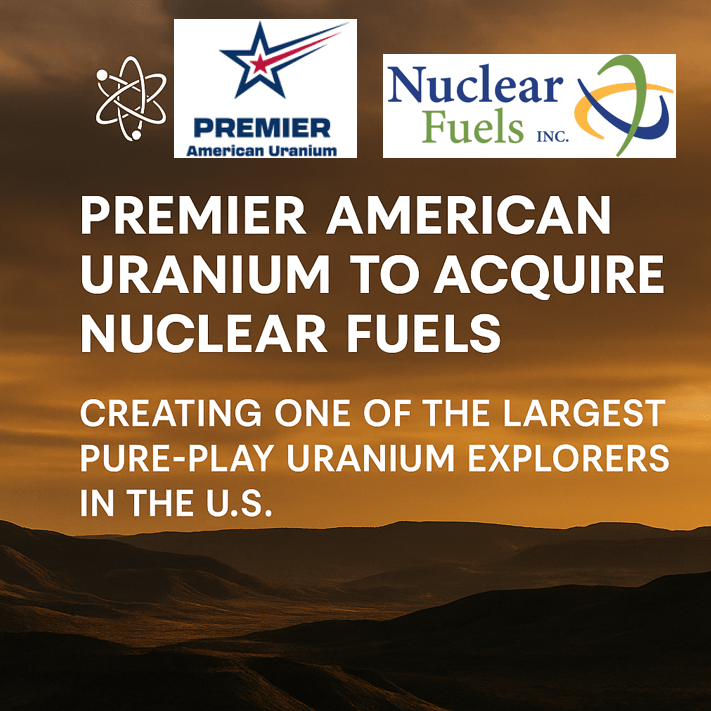
On June 5th, it was announced that Premier American Uranium Inc. (PUR) will acquire Nuclear Fuels Inc. (NF), creating one of the largest pure-play uranium explorers in the United States. As someone who’s had the privilege of serving as Project Manager for Nuclear Fuels, I’m proud to share that this is not the end of a chapter—it’s the doubling down of a mission. And I’ll continue to be actively involved in this newly merged entity as we push forward across the map, the drill deck, and the development pipeline.
What This Means: Consolidation with Purpose
The new company brings together:
12 exploration and development-stage projects across Wyoming, New Mexico, Utah, Arizona, and Colorado;
A land position totaling over 104,000 acres;
Historic and modern datasets from more than 4,200+ drill holes in Wyoming alone;
And a rare emphasis on ISR-focused uranium exploration, an area often overlooked but critically needed for the U.S. energy transition.
This isn’t consolidation for consolidation’s sake. It’s strategic integration—combining NF’s flagship Kaycee Project in Wyoming’s Powder River Basin with PUR’s Cyclone Project in the Great Divide Basin, both sitting squarely within America’s most prolific ISR districts.
Why Now? Because Timing is Everything
We’re in a moment.
In the last few months alone:
Uranium projects in the U.S. are being fast-tracked.
The Grants Mineral Belt in New Mexico—home to PUR’s Cebolleta Project—has received federal attention via the FAST-41 permitting program.
And domestic supply security has become more than a talking point—it’s a mandate.
This merger lands at exactly the right time, with exactly the right assets, and exactly the right team.
Kaycee: A Keystone Asset
Let me take a moment to highlight what makes Kaycee so special—because I’ve walked it, mapped it, and logged more than a few of those holes myself.
Kaycee spans a 35-mile roll-front system with over 430 miles of mapped trends, supported by historic drilling and modern work that proves uranium mineralization in all three major sand units: Wasatch, Fort Union, and Lance. That’s a rarity in ISR uranium, and it’s a big part of why this deal makes so much sense.
Our 2023 and 2024 drill campaigns were among the largest ISR exploration programs in the U.S., and the trend is just beginning to heat up. With C$14M in combined cash on hand, the new company is poised to aggressively advance Kaycee and our other high-potential assets in the months to come.
The People Behind the Rocks
This isn’t just about drill footage and roll fronts.
The combined company will be backed by some of the strongest strategic players in the space—Sachem Cove, enCore Energy, IsoEnergy, and Mega Uranium—and led by Colin Healey as CEO, with representation from both the PUR and NF boards. I’m honored to remain involved post-merger, contributing to the continued growth of the project portfolio and the technical strategy that guides it.
Exploration geologists don’t often get to see their work reach critical mass. This is one of those rare and exciting exceptions.
Looking Ahead
U.S. uranium isn’t just coming back. It’s growing smarter. Sharper. More deliberate.
With the Premier-Nuclear Fuels merger, we’re not just stitching together acreage. We’re assembling the kind of exploration-first, production-ready platform that’s been missing from the domestic uranium narrative. A platform with the data, the drilling history, the land, the resources—and the team—to make something enduring.
This is about more than uranium. It’s about how we meet the energy future with boldness, science, and a little bit of grit.
🔗 If you’re following the uranium sector, the time to pay attention is now. If you’re already invested—in industry, interest, or curiosity—this is a story worth tracking.
And if you’re a geologist like me?
You know what this really means: we’ve still got plenty of ground to cover—and we’re just getting started.
In a move that feels like the opening scene of a modern-day energy epic, the U.S. Department of the Interior has granted a swift green light to Anfield Energy’s Velvet-Wood uranium and vanadium project in Utah. This isn’t just another mining approval; it’s the first to benefit from a newly implemented 14-day environmental review process, a stark contrast to the years such assessments typically consume.
Why does this matter? Because it’s not just about one mine; it’s about setting a precedent. This expedited approval could be the catalyst that reignites domestic exploration and production of critical minerals, particularly uranium—a resource that’s poised to become the linchpin of our energy future.
The Velvet-Wood Project: A Glimpse into the Future
Anfield Energy’s Velvet-Wood project isn’t starting from scratch. It’s a revival of the historic Velvet mine, coupled with the development of the nearby Wood deposit. Together, they boast an estimated 4.6 million pounds of uranium oxide equivalent (eU₃O₈) in measured and indicated resources, with an additional 552,000 pounds in inferred resources. The vanadium-to-uranium ratio stands at an impressive 1.4:1, adding another layer of value to the operation.
But the real game-changer? The plan to reopen the Shootaring Canyon uranium mill, one of only three licensed, permitted, and constructed uranium mills in the U.S. This facility will process the ore into uranium concentrate, reducing our reliance on imports—a staggering 99% of the uranium used by U.S. nuclear power plants in 2023 came from countries like Russia, Kazakhstan, and Uzbekistan.
A New Frontier for Exploration
This fast-track approval doesn’t just benefit Anfield; it sends a clear signal to the entire industry. The message? The U.S. is serious about securing its mineral future. For geologists, explorers, and investors, this is a clarion call to action. The regulatory landscape is shifting, and with it, the opportunities for domestic exploration are expanding.
Imagine the untapped potential in regions like the Colorado Plateau or the Wyoming Basins. With streamlined permitting processes, these areas could see a surge in exploration activities, leading to new discoveries and a revitalized domestic mining sector.
Investing in Uranium: The Next Oil Boom?
Drawing parallels between uranium today and oil in the early 20th century isn’t just poetic—it’s prophetic. Back then, early investors in oil companies reaped astronomical returns as the world transitioned to petroleum-based energy. Today, as we pivot towards low-carbon and nuclear energy solutions, uranium stands at the cusp of a similar boom.
Consider this: the global oil and gas market recorded revenues of $5.95 trillion in 2024 . The U.S. oil and gas sector alone is valued at over $1.5 trillion. If uranium follows a similar trajectory, early investors could see returns that mirror those historic oil booms.
The Bigger Picture: Energy Security and Sustainability
Beyond the financial incentives, there’s a broader narrative at play. Fast-tracking projects like Velvet-Wood aligns with national interests—reducing dependence on foreign adversaries, bolstering energy security, and promoting sustainable, low-carbon energy sources.
As we navigate the complexities of the 21st-century energy landscape, uranium offers a bridge between our current fossil-fuel dependence and a future powered by clean, reliable nuclear energy.
In Conclusion
Anfield Energy’s Velvet-Wood project isn’t just a mining operation; it’s a symbol of what’s possible when policy, industry, and innovation converge. For those with the foresight to see the writing on the wall, the uranium sector offers not just a lucrative investment opportunity but a chance to be part of a transformative chapter in America’s energy story.
The winds of energy policy are shifting, and they’re carrying a whiff of enriched uranium. President Trump is poised to sign a series of executive orders that could set the U.S. nuclear power industry ablaze—not with radiation, but with opportunity.
From streamlined reactor approvals to Cold War-style fuel independence and rumors of a massive domestic uranium procurement program, it’s starting to look a lot like the 1950s again… only with more AI, and (hopefully) less fallout propaganda.
A National Emergency? Nuclear Declared Critical
The heart of Trump’s upcoming orders is a declaration of national emergency under the Defense Production Act—an old-school move with new-age implications. Why? Because we’re too dependent on foreign sources (read: Russia and China) for enriched uranium, advanced reactor components, and nuclear fuel processing.
In a twist of Cold War déjà vu, the orders direct the Departments of Energy and Defense to identify federal lands for nuclear development and fast-track permitting. We’re talking serious logistical streamlining—enough to make the NRC blush.
AI, the New Atom Smasher
Driving this urgency is the massive power demand boom from Artificial Intelligence and data centers. Energy Secretary Chris Wright compared it to a “Manhattan Project 2”—an apt analogy, as the race is on to power a future built on silicon and servers.
AI doesn’t sleep, and it sure doesn’t like blackouts. That makes carbon-free, always-on nuclear power one of the few realistic contenders for the throne.
Loan Guarantees, Federal Land, and Red Tape Cutters
This isn’t just rhetoric. The orders encourage the DOE to dust off the Loan Programs Office and firehose funding into the sector through guarantees and direct loans—something underutilized in Trump’s first term but now brimming with cash thanks to legislation from the prior administration.
Combine that with potential reform of the Nuclear Regulatory Commission, and the game may soon be played on a whole new field. A friendlier, faster, more results-driven one.
Back to the Future: AEC Vibes & the 200 Million Pound Bombshell
Perhaps the most exciting chatter? The rumored government plan to purchase 200 million pounds of U₃O₈ annually for a new U.S. strategic reserve.
Yes, you read that right. This would harken back to the golden days of the Atomic Energy Commission, when the government was the uranium market. Back then, exploration companies scrambled like claim-staking cowboys across the Western U.S., from the Colorado Plateau to Wyoming’s Wind River Basin.
If even a fraction of this deal materializes, it could supercharge domestic uranium exploration and development. Companies already holding past-producing assets or with NI 43-101 pounds in the ground could see unprecedented upside.
Opportunity for the Ready
This moment will favor the prepared, the proven, and the patient. If you’ve got:
Historic data and proven pounds in the ground,
Permitted projects or past-producing mines,
Geologists who know how to follow yellowcake trails…
Then you’re not just in the game—you’re on the edge of the next energy boom.
A Bipartisan Bridge?
Nuclear’s newfound spotlight is notable for crossing political lines. Democrats love it for its carbon-free reliability. Republicans champion it as a baseload powerhouse immune to cloud cover or calm winds. With AI and grid resilience uniting technocrats and climate hawks, nuclear just might be the great reconciling reactor in the room.
Final Thought: The Market Moves Faster Than Policy
Executive orders are one thing. Implementation takes time. But markets don’t wait. If this news sparks action—and it will—investors, developers, and explorers should already be positioning themselves. The reactor of opportunity is online. The rods are loaded. The only question is: are you ready to flip the switch?







 Mineral Exploration Geology - finding value in the world around us