
The current 2022 USGS list of Critical Minerals includes 50 minerals (updated from the 2018 list to exclude some curious selections, for sure) that have some implications on exploration efforts within the US. Inclusion or exclusion from the list is variably important to actual exploration efforts as many ore systems include a number of elements found on the list irregardless of inclusion. One example of this is a silver-dominant district (and most likely many others too) found in Central Nevada.
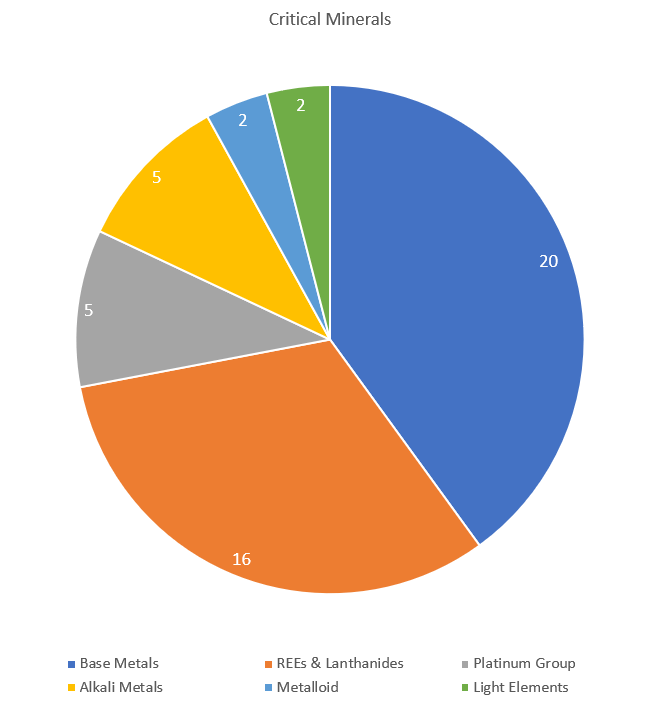
The critical mineral pie chart above puts all fifty elements into six categories for simpler evaluation. Chief among these categories is the base metal group where one can find such critical minerals as aluminum, antimony, cobalt, manganese, nickel, and zinc (to name a few). Second, the rare-earth and lathanides (seemingly a co-mingled designation with many overlapping elements therein) make up sixteen critical minerals. Third, the platinum group contains five critical minerals. Alkali and alkali earth metals includes evermore important lithium. Lastly there are a handful of metalloids (arsenic & tellurium) and light elements (fluorspar & graphite (Fluorine & Carbon in specfic forms)).
Silver-dominant ore systems here in Nevada (aka the “Silver State”) can be defined as a precious metal system where the silver to gold ratio is at least 20:1, but more often 100:1, such as Tonopah, Belmont, Austin, Eureka, or the Comstock of Virginia City silver camps. All of these camps date to the 1860’s or thereafter and hearken both to the first days of Nevada statehood as well as Nevada’s historic silver rush. Since this era many of these systems have been overlooked, ruled out, or re-worked as gold systems even though the orginal silver-dominant designation still fits best.
Geologically, these silver-dominant ore systems are found within volcanic or sediment hosted systems. The style of emplacement can vary between low-sulfidation to high-sulfidation epithermal systems and can also very between inclusion or exclusion of base metals as part of their overall geochemistry. But there seems to be a trend towards base metal inclusion within the sediment-hosted silver-dominant ore systems. These type of ore systems found typically within Paleozoic carbonate sequences across Nevada tend to either epithermal veins, carbonate replacement, or skarnoid.
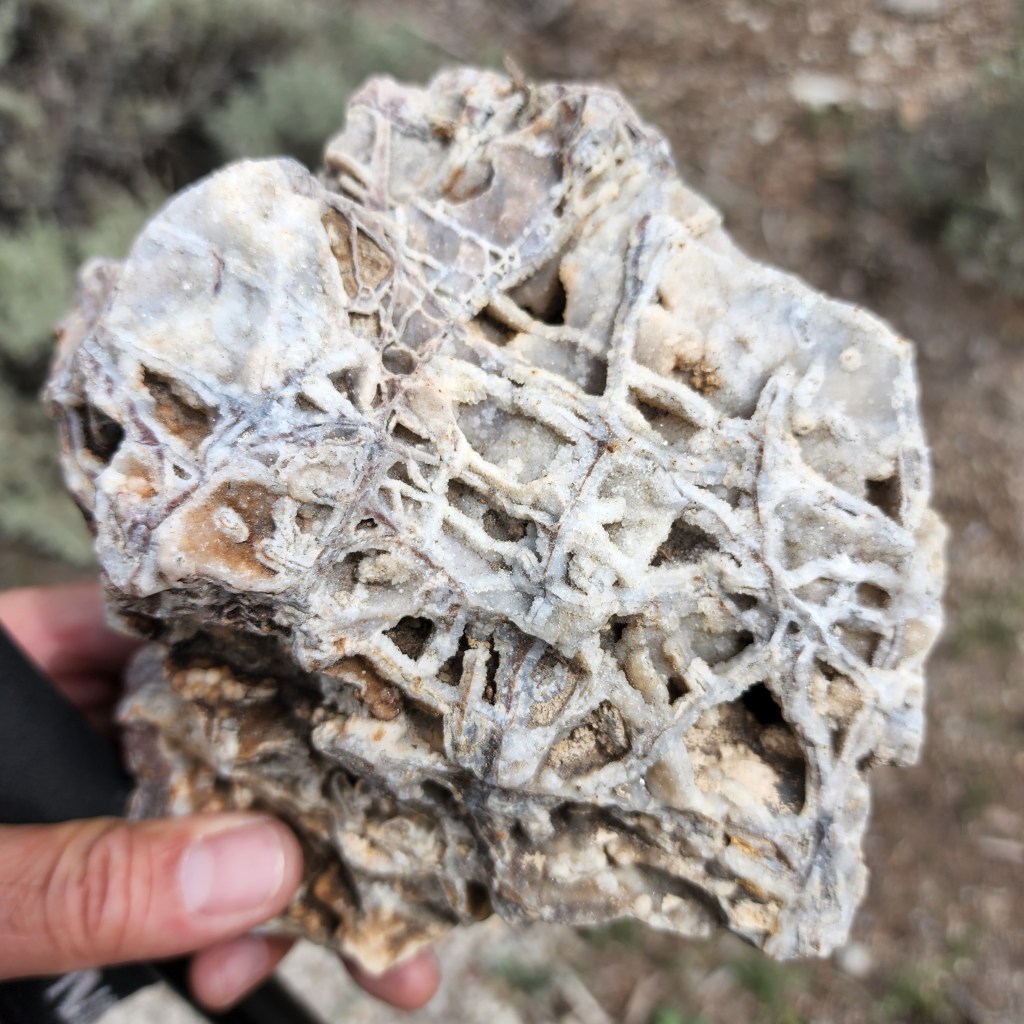
The above image was taken while prospecting in one of these silver-dominant carbonate replacement ore systems with inclusion of base metals. Eight critical minerals foudn within this silver-dominant system are included in the current critical mineral list from the USGS. The above picture is a “quartz after calcite” vein texture common in these ore systems. The drusy quartz texture is infilled quartz-bearing fluids that came along after earlier calcite veining within the host carbonate rocks. In this case the host carbonate is actually a dolomite, suggesting a much longer history of alteration of the Paleozoic units.
More commonly these systems have been called silver-lead-zinc deposits. This is due to the relative importance historically for this smaller list of historically critical minerals, especially arising in need during war time. In conjunction with these periodically significant eras, there is more broadly a cyclical nature to these metal markets. The ‘boom/bust’ cycle of precious metals leaves its mark upon the landscape and it mosttly to blame for the fragmentary development of these historic camps across the Western US.
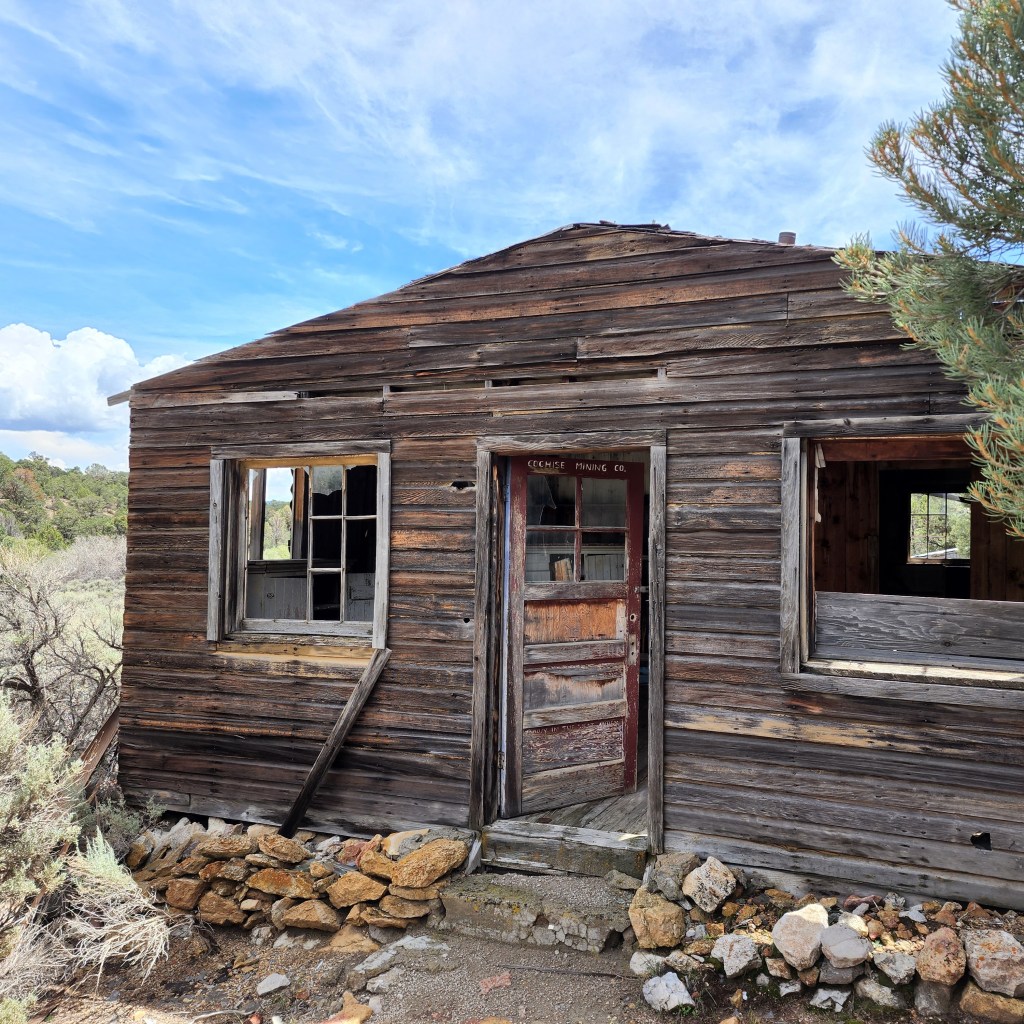
While prospecting within the un-named silver-dominant ore system in Central Nevada there were found numerous critical minerals either directly associated or adjacent to the silver endowment. One assayed sample came back with a stunning 19.5% aluminum kick. Within this same sample was found manganese, copper, arsenic, nickel, barium, cobalt, zinc, and antimony in anomalous to higher grade values. This could in turn be considered a polymetallic system or even a poly-critical systems (if there is such a term).
This begs the question of whether or not many (if any) of these systems have ever truly been looked at in this context. From unrealized value within historic districts, to the processing challenges for polymetallic ores, to revitalized exploration for new value chains found within similar to adjacent systems; these aspects of the search for critical minerals within the US open up endless possibilities for the mineral exploration geology field.
The “new eyes on old rocks” idiom is again reinforced. Many of these legacy districts could benefit from simple re-processing of old tails and dumps, though realistcially such re-processing would only be worthwhile if new mining were to occur in tandum. However, this discussion for me has more to do with a larger picture of mineral development in the US. There needs to be a more predictable path for these mineral endowments to achieve production. Minerals need the support and backing of the US government regardless of politics or cyclical economics. Our competitors, such as China and Russia, are playing the long game. They see the need for and fund a project that might lose money for decades before realizing the long-term gains. Without this level of support it will be difficult to impossible to realize the critical mineral endoment found under our own feet. Until regulations and the NEPA process become streamlined, these ore systems will continue to be overlooked and under-funded.
These silver-dominant ore deposits can be pathfinders for the critical mineral endowments that the US need at this moment. The only question is whether or not a simple list will turn into an inventory of value for us all.
 Mineral Exploration Geology - finding value in the world around us