

Every project begins with a judgment call.
This rock — or not this rock.
Before the models.
Before the drilling.
Before the press release.
Before the financing.
A geologist stands at an outcrop and makes a decision: does this matter?
That first instinct is not trivial. It is not romantic. It is not even particularly visible. But it is foundational. It is the first load-bearing element in a structure that may one day carry capital, communities, careers, and in some cases, national strategy.
We tend to treat geology as a technical discipline. In reality, it is decision infrastructure.
From Observation to Interpretation
Exploration begins with observation.
Lithology.
Structure.
Alteration.
Mineral assemblages.
Geochemistry.
Geophysics.
Layer by layer, uncertainty narrows. Patterns emerge. Hypotheses form.
At some point, interpretation crystallizes. A system is named:
Carlin-type.
CRD.
Epithermal.
Porphyry.
Intrusion-related.
VMS.
Or something new that doesn’t fit neatly into a box.
Before that naming, a project often has maximum optionality. It could be several things. It could evolve. It could surprise.
After that naming, gravity sets in.
Capital begins to align around a narrative.
Drill spacing reflects the model.
Metallurgy assumptions follow the model.
Permitting pathways assume the model.
Investor decks tell the story of the model.
Naming is powerful. It focuses effort. It clarifies direction. It attracts interest.
But it also constrains.
And from that moment forward, changing course becomes progressively more expensive — not just technically, but psychologically and financially.
That is where geology stops being a backdrop and becomes infrastructure.
Where Risk Actually Accumulates
It’s tempting to believe that projects fail because the geology was wrong.
In my experience, that’s rarely the case.
More often, technically correct work was asked to answer the wrong question.
The drill program wasn’t mismanaged — it was misframed.
The data wasn’t poor — it was mis-sequenced.
The interpretation wasn’t incompetent — it was prematurely hardened.
Risk accumulates when:
- Capital is committed before uncertainty is clearly framed.
- Success criteria are implied but never named.
- Stopping rules do not exist.
- Permitting timelines are assumed rather than tested.
- Metallurgical complexity is discounted.
- Jurisdictional or access constraints are treated as “later problems.”
Once a narrative aligns with capital, correcting course feels like weakness. Even when it is simply refinement. Even when it is the responsible thing to do.
At that stage, geology often becomes the scapegoat.
But the issue was rarely the rocks themselves. It was the sequencing of decisions.
Infrastructure Is Invisible — Until It Isn’t
We understand infrastructure in other contexts.
Bridges.
Highways.
Power grids.
They are load-bearing. Foundational. Often unnoticed when functioning. Catastrophic when ignored.
Geology functions the same way.
It is not a department.
It is not a phase.
It is not a box to check before engineering begins.
It is the substrate upon which:
- Engineering feasibility is built.
- Permitting strategies are justified.
- Capital is allocated.
- Governance decisions are defended.
- Community conversations are anchored.
If geology is misframed early, every discipline downstream inherits that distortion.
And once money, time, and reputation are committed, the tolerance for revisiting foundational assumptions narrows quickly.
That is not a technical flaw. It is a human one.
Which is precisely why geology must be treated as decision infrastructure rather than technical output.
Permitting, Access, and the “Oblique” Layer
Geology’s influence is not limited to ore models and grade shells.
It shapes:
- Groundwater flow and ISR suitability.
- Waste rock characterization.
- Acid-generating potential.
- Structural complexity affecting slope design.
- Footprint decisions.
- Closure planning.
- Long-term reclamation outcomes.
Permitting risk is often geological risk wearing a different hat.
If hydrogeology is misunderstood early, regulatory friction follows.
If structural complexity is underestimated, slope stability questions arise later.
If alteration or mineralogy is poorly characterized, environmental liabilities compound.
None of this is dramatic. It is simply cumulative.
Geology done well reduces friction.
Geology rushed or subordinated to momentum multiplies it.
And by the time those pressures surface in permitting or stakeholder engagement, the opportunity for quiet correction has often passed.
The Lifecycle Arc
From outcrop to closure, geology remains present.
Outcrop.
Model.
Drill.
Resource.
Study.
Financing.
Construction.
Production.
Concentrate.
Doré.
Infrastructure.
Modern civilization.
Reclamation.
Even at closure, original geological understanding governs water behavior, long-term stability, and reclamation integrity.
Geology is not just the first word in the life of a mine.
It is the last one.
The Industry Pattern We Rarely Name
There is a pattern in the industry that deserves acknowledgment.
Geology has increasingly become the silent backdrop across which other disciplines paint their scenery.
Engineering advances.
Finance structures deals.
Marketing shapes narrative.
Permitting teams navigate complexity.
And geology is expected to support — quietly, competently, and without friction.
When everything goes well, geology is invisible.
When outcomes disappoint, geology is questioned.
But geology was never meant to be reactive.
It was meant to frame the question.
Before drilling accelerates.
Before financing windows compress.
Before stories harden.
Before decisions become immovable.
In a higher-cost environment, in tighter capital markets, and under increasing governance scrutiny, the cost of misframed geology compounds faster than ever.
Clarity Before Commitment
None of this is an argument for paralysis.
Exploration requires risk. Development requires conviction. Capital requires movement.
But movement without clarity is not bold. It is brittle.
Geology, when done properly, is not merely technical. It is ethical. It is economic. It is civic.
It asks:
What actually needs to be proven next?
What uncertainty matters now?
What can wait?
What would cause us to stop?
Those are not just geological questions.
They are governance questions. Capital questions. Stewardship questions.
If we begin to treat geology as decision infrastructure — not just data generation — projects move forward with fewer regrets, cleaner outcomes, and greater durability.
Geology should not be the silent backdrop.
It should be the load-bearing structure.
Because when geology is framed clearly and sequenced intelligently, it becomes more than interpretation.
It becomes stewardship — of capital, of credibility, and of the Earth itself.
Clarity before commitment.



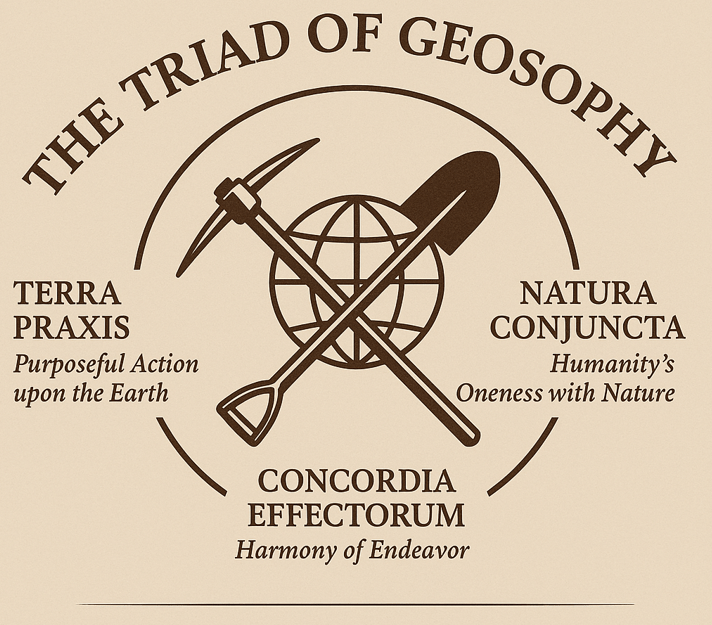

 Mineral Exploration Geology - finding value in the world around us