
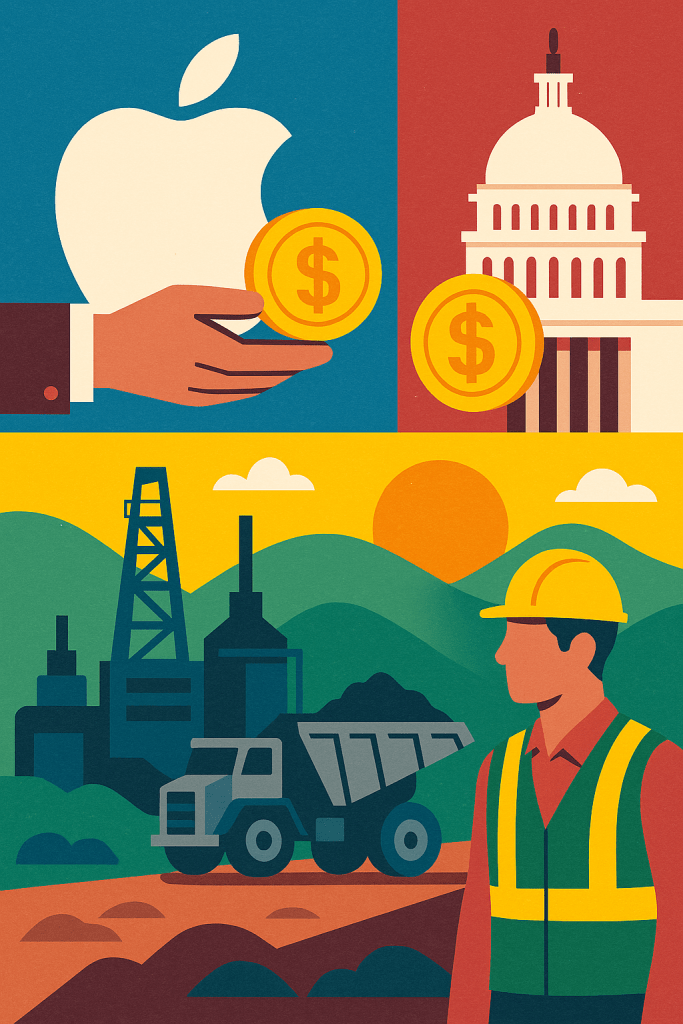
Sometimes, the invisible hand of the market needs a little nudge. Other times, it needs the full force of the Pentagon’s wallet—and apparently, that’s all it takes to wake the giants.
Just one week after MP Materials landed a $400 million deal with the U.S. Department of Defense, tech behemoth Apple swooped in with a stunning $500 million commitment to secure domestically sourced rare earth magnets. That’s not just validation—that’s velocity.
Together, these two powerhouse deals sent MP stock surging to all-time highs, but more importantly, they sent a thunderous signal to industry: this is where the future is being built.
Pentagon First, Apple Fast Follows
The sequence is telling.
The DoD’s investment was more than a show of support—it was a strategic move to anchor domestic supply chains for critical defense technologies, from fighter jets to satellites. It gave MP Materials the capital and credibility to move forward with large-scale production and magnet manufacturing out of Fort Worth, Texas and Mountain Pass, California.
Enter Apple. With an eye toward vertical integration and supply chain resilience, Apple’s deal includes co-developing neodymium magnet lines for its products, launching a rare earth recycling initiative, and helping fund the R&D needed to improve magnet performance—using U.S. materials, refined and manufactured on U.S. soil.
For a company that famously said “Designed in California,” this is now about “Sourced in America,” too.
What This Means for Exploration
Deals like this don’t just move markets—they reshape exploration narratives.
While Apple and MP Materials are focusing their initial efforts on established facilities, the next logical step is new discovery and development. And that brings us to the Bear Lodge carbonatite complex in northeast Wyoming—an underappreciated, world-class REE deposit in one of the most mining-friendly states in the U.S.
Long known by geologists and quietly held in industry circles, Bear Lodge has sat in a state of limbo due to market pricing, lack of offtake agreements, and, frankly, a lack of momentum. That changes now.
As capital floods into domestic rare earth supply chains, Bear Lodge looks like a near-term winner—especially with permitting pathways and community sentiment in Wyoming often far more supportive than coastal counterparts. Expect renewed attention, joint ventures, and perhaps a long-awaited move into production-ready territory.
And don’t sleep on Nevada. While known for lithium and gold, the state harbors critical mineral potential across a range of underexplored terrains—from bastnaesite showings to overlooked thorium-rich systems that could offer the same kind of radiometric pathfinding used at Mountain Pass.
The New ESG: Exploration, Sovereignty, and Guidance
It’s tempting to view these deals through a traditional ESG lens—jobs created, emissions reduced, supply chains localized. And that’s all true. But this isn’t your father’s ESG report.
This is ESG 2.0, where Exploration is prioritized, Sovereignty is defended, and Government plays a guiding hand—not by overregulating, but by strategically investing to de-risk the private sector’s next move.
Apple didn’t just show up with a half-billion dollars out of pure idealism. They responded to a roadmap set by the federal government. The Pentagon pointed, and Apple followed—not blindly, but confidently. This is what good governance looks like: coaxing industry in the right direction by reducing risk and increasing reward.
That’s not just smart policy. That’s nation-building—from the periodic table up.
Final Thoughts
In the wake of these historic deals, one thing is clear: the age of foreign rare earth dominance is over. America is not just responding—it’s repositioning.
Exploration geologists, developers, and entrepreneurs—take note. Whether you’re sampling carbonatite in Wyoming or chasing radiometric highs in Nevada, the tide has shifted. The question is no longer if domestic supply chains will grow, but where you want to stand when they do.
Now is the time to stake, explore, invest, and build—because the future of tech is being built from the bedrock up.
 Mineral Exploration Geology - finding value in the world around us