Why permitted mines are only the beginning of America’s critical mineral supply chain
Over the past year, a subtle shift has begun to ripple through Washington’s policy circles.
Minerals—once treated largely as commodities governed by global markets—are increasingly being discussed in the language of national resilience. Copper, cobalt, antimony, and other materials have entered the conversation not merely as inputs for industry, but as strategic resources tied to defense, energy systems, and advanced manufacturing.
Initiatives such as “Project Vault,” proposed with financing support through the Export-Import Bank of the United States, reflect this new thinking. The concept envisions a decentralized American reserve of critical minerals designed to buffer domestic industry from supply shocks, geopolitical leverage, or sudden disruptions in global supply chains.
The idea itself is simple and compelling: if certain minerals are strategically important, the United States should ensure reliable access to them.
Anyone who has spent time working on exploration and development projects knows that the journey from a mineral deposit to a producing mine is rarely simple.
But strategic reserves do not begin in vaults.
They begin in the rocks.
A Short List of “Ready” Projects
Recent policy discussions often point to a handful of U.S. mining projects described as “permitted and ready to deliver” the minerals needed for a resilient domestic supply chain.
One such list circulating in policy circles includes projects like:
Perpetua Resources — Stibnite Project, Idaho (gold and antimony)
Hudbay Minerals — Copper World Project, Arizona
U.S. Gold Corp. — CK Gold Project, Wyoming
Highland Copper Company — Copperwood Project, Michigan
Arizona Sonoran Copper Company — Cactus Project, Arizona
Bunker Hill Mining — Bunker Hill Mine, Idaho
Gunnison Copper — Johnson Camp, Arizona
Sandfire Resources America — Black Butte Copper, Montana
Collectively, these projects represent billions of dollars in potential investment and a significant opportunity to expand domestic supply of metals essential to modern industry.
From a policy perspective, the logic is straightforward: these projects have permits, therefore they represent near-term production capacity.
From the perspective of someone who has worked inside exploration and development projects, the story is more nuanced.
The Long Distance Between Permit and Production
In public discussions about mining, permits are often treated as the final hurdle.
In reality, they are closer to the starting line.
Between a permitted project and an operating mine lies a long and uncertain stretch of road:
additional drilling and resource refinement
metallurgical testing and processing design
detailed engineering and feasibility work
capital financing
infrastructure development
construction timelines that often span years
Even well-advanced projects typically require several years—and substantial capital—to move from permit to production.
This is not a flaw in the system. It is simply the nature of building complex industrial operations around geological deposits that formed millions of years ago under conditions we are still working to understand.
The rocks may be known.
Turning those rocks into reliable supply takes time.
Every Deposit Is Its Own Geological Story
Another quiet reality rarely captured in policy lists is that no two mineral deposits behave exactly the same way.
Copper porphyry systems differ dramatically from sediment-hosted copper deposits. Cobalt mineralization presents different metallurgical challenges than gold. Underground operations carry different cost structures than open-pit mines or in-situ recovery systems.
Two deposits producing the same metal can require entirely different mining methods, processing technologies, infrastructure footprints, and capital investments.
A list of projects may appear interchangeable on paper.
In the field, each represents its own geological puzzle.
Understanding those differences—and how they influence timelines, risk, and scalability—is where geological interpretation becomes essential.
Strategic Mineral Policy Meets Geological Reality
The renewed focus on domestic mineral supply is both welcome and overdue.
For decades, the United States relied on global markets to deliver the materials needed for everything from electronics to defense systems. Recent geopolitical tensions and supply disruptions have exposed the fragility of that approach.
Programs like Project Vault reflect an emerging consensus: supply chains for critical minerals deserve strategic attention.
In policy circles this conversation is often framed in terms of supply chain resilience, industrial base security, and the need for friend-shoring or domestic sourcing of critical materials. These are important goals, and they reflect a growing recognition that minerals underpin modern manufacturing and defense systems alike. But achieving that resilience ultimately depends on something far more fundamental: understanding the deposits themselves—the geology, the metallurgy, and the practical realities that determine whether a mineral resource can truly become supply.
Strategic policy must ultimately intersect with geological reality.
Decision-makers in government agencies, manufacturing firms, and investment funds increasingly find themselves asking questions that sit squarely in the geological domain:
How robust are these resources?
How scalable are the deposits?
What geological risks remain unresolved?
How quickly could production realistically begin?
These questions cannot be answered through policy frameworks alone.
They require people who understand the ground beneath the proposals.
The Quiet Role of Geological Judgment
In mining, geology sits upstream of everything.
Before financing, before engineering, before construction, there must first be a deposit—one that can be mined economically, processed effectively, and developed responsibly.
Exploration geologists spend careers learning to read those signals in the Earth: the structure of the rock, the chemistry of the mineralization, the geometry of the orebody, and the countless clues hidden in drill core and outcrop.
Those interpretations rarely make headlines.
But they quietly determine whether a project becomes a mine—or remains a promising idea on paper.
As strategic mineral initiatives expand, the need for clear geological interpretation will only grow. Policymakers and investors alike must translate mineral resources into timelines, risk assessments, and development strategies.
In that process, geology becomes something more than an academic discipline.
It becomes a form of decision infrastructure.
The Opportunity Ahead
The United States is rediscovering a simple truth that earlier generations understood well: civilization runs on the materials of the Earth.
Copper wires carry electricity. Cobalt stabilizes batteries. Antimony strengthens alloys used in defense systems. Rare elements hidden in rock formations underpin technologies that define modern life.
Ensuring reliable access to those materials is a legitimate strategic goal.
But initiatives like Project Vault will succeed not because minerals are declared strategic in Washington.
They will succeed because exploration geologists find deposits, engineers design viable mines, investors commit capital, and communities support responsible development.
Strategic reserves may ultimately sit in warehouses, supply contracts, or financial instruments.
Yet their origins trace back to a much older place.
The outcrop. The drill core. The rocks beneath our feet.
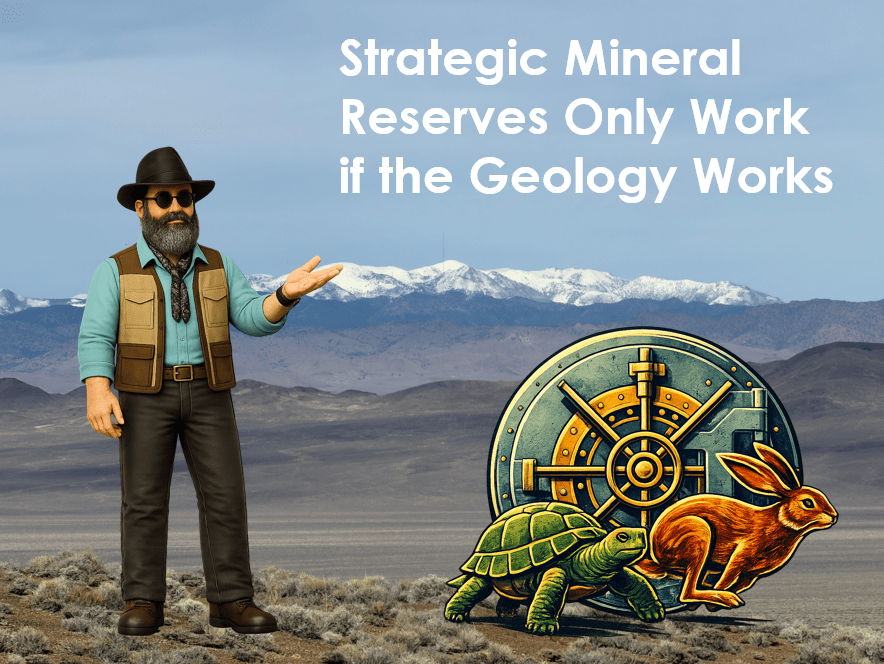
Because in the end, strategic mineral reserves only work if the geology works.
How Modular Processing Is Rewriting the Economics of Complex Ore Systems
Something fundamental has shifted in how the United States is thinking about minerals—and it didn’t start with a mining company.
It started with the U.S. Army.
In December, Reuters reported that the U.S. military is actively developing small, modular refineries for critical minerals, beginning with antimony and potentially expanding to other strategically essential elements. These are not conceptual studies or policy white papers. They are physical facilities—designed to be compact, deployable, resilient, and secure.
Let that reality settle in.
The U.S. military is no longer assuming that global processing markets will be there when it needs them. It is no longer content to rely on foreign refining capacity for materials essential to defense, technology, and national security. Instead, it is moving processing closer to home—and deliberately shrinking the scale at which it must occur.
That single decision quietly rearranges the board.
Because once processing can be modular, localized, and purpose-built, a whole class of deposits long written off as “too hard” suddenly demands a second look.
Why Antimony Matters—and Why It’s Just the Beginning
The choice of antimony as the starting point is not accidental. Antimony is critical for ammunition, alloys, flame retardants, and a range of defense applications. Yet the United States is almost entirely dependent on foreign refining capacity, with China dominating global processing.
At nearly the same moment, Perpetua Resources announced a partnership with Idaho National Laboratory to build a domestic antimony processing facility tied to the Stibnite project—explicitly framing metallurgical capacity as a matter of national security rather than just mining economics.
Taken together, these moves signal something deeper than a single metal or project. They represent a recognition that processing itself—not just mining—has become strategic infrastructure.
These are not isolated developments. They are load-bearing beams.
The Quiet Inversion of Value
For decades, mineral exploration carried a quiet graveyard of ideas.
Districts left behind. Deposits labeled uneconomic. Projects shelved not because the geology failed—but because the metallurgy did.
They were too polymetallic. Too complex. Too awkward for clean flowsheets and tidy concentrates. Penalty elements loomed. Recoveries weren’t elegant. And by the standards of their time, the economics never quite cleared the bar.
But geology, like history, has a way of reworking old material under new conditions.
What we are witnessing now—almost beneath the noise of quarterly earnings calls and policy press releases—is a structural inversion of value. The very attributes that once doomed complex ore systems are becoming the reasons they matter.
This is the critical minerals framework at work.
Criticality isn’t about elegance. It’s about vulnerability.
When Processing Stops Being a Liability
For much of modern mining history, success meant fitting neatly into an existing industrial mold: single-commodity recovery, conventional flotation, and concentrates that slid smoothly into global smelter networks.
Anything outside that template was discounted, deferred, or abandoned.
But once processing becomes localized, modular, and strategic, the logic flips.
Polymetallic systems—especially carbonate replacement deposits (CRDs) across Nevada and the broader Great Basin—often host exactly the element suites now appearing on critical minerals lists: antimony, zinc, lead, copper, silver, bismuth, arsenic pathfinders, and more.
What used to be metallurgical “noise” becomes strategic signal.
Complexity no longer disqualifies a deposit. In some cases, it enhances it.
Nevada’s Second Act
Consider historic silver or strategic-metals districts in the Great Basin and other polymetallic systems scattered across Nevada.
Historically, they faced familiar headwinds: multiple metals complicating recovery, elements that triggered smelter penalties, and project scales that struggled to justify bespoke processing solutions. In previous cycles, that complexity pushed them to the margins.
Under today’s conditions, those same attributes begin to look different.
Multiple metals become optionality rather than burden. Complex metallurgy becomes leverage rather than liability. Domestic processing capacity becomes a priority rather than an afterthought.
The emergence of small-scale, modular refining—whether military-led, government-assisted, or public–private—reshapes the economic calculus. Not every district reopens overnight. Not every deposit becomes viable. But the door that was once bolted shut is now undeniably open.
Mining as Remediation, Not Relic
There is an uncomfortable truth the broader conversation often avoids: the best way to clean up legacy mine sites is to mine them again—properly.
Modern mining is not the mining of the past. Today’s operations rely on precision drilling, advanced modeling, closed-loop water systems, electrified fleets, and far tighter environmental controls.
Abandoned sites do not heal themselves. They oxidize, leach, erode, and persist.
Responsible redevelopment isn’t regression. It’s reclamation with intent—and with a business plan.
The System Assembles
Step back far enough and the pieces begin to interlock.
Mining produces the metals that feed battery supply chains. Batteries electrify mining fleets and industrial equipment. Nuclear power delivers dense, reliable, carbon-free energy. Critical minerals underpin AI, defense systems, and grid resilience. Domestic processing closes the loop.
This isn’t contradiction. It’s recursion.
Mining metals to build batteries that power mining equipment, fueled by nuclear energy, to produce the materials that sustain a low-carbon, high-technology civilization.
Yes, it means more mining. But it also means smarter, cleaner, more intentional mining—guided by geology, enabled by technology, and reinforced by national strategy.
The Real Keystone
The lynchpin isn’t a single policy, deposit, or refinery.
It’s the recognition that complexity is no longer a flaw.
What was once “too hard” is now too important to ignore.
And in that realization lies the reopening of forgotten districts, the revival of overlooked systems, and perhaps the foundation of the next industrial era—one where geology, technology, and security finally pull in the same direction.
For years, many of us in exploration, energy, and policy circles have been voicing the same refrain:
America must rediscover its backbone — the one forged in ore and energy, refined by industry, and animated by purpose.
We’ve written about it, spoken at conferences, and fought uphill battles in permitting offices. Now, a trillion and a half dollars later, that whisper from the pit, the drill pad, and the assay lab has finally reached the marble halls of finance.
JPMorgan Chase’s new “Security & Resiliency Initiative” — a $1.5 trillion investment framework — reads like a checklist of every structural challenge we’ve named:
Supply chains fractured by foreign dependence
Permitting regimes tangled in red tape
Hollowed-out refining and manufacturing capacity
A cultural hesitation to act upon the Earth — to build, dig, and dare
And suddenly, the world’s largest bank says: We hear you.
II. From Policy Paralysis to Purposeful Action
This isn’t a boutique green fund or a PR stunt. It’s a re-industrialization mandate that explicitly includes:
Critical-mineral exploration and refining
Nuclear energy, solar power, and grid resilience
Advanced manufacturing and AI-enabled infrastructure
Policy advocacy to streamline permitting and remove regulatory friction
That last point stopped me cold. A global financial titan committing to advocate for permitting reform? That’s a tectonic shift.
For decades, investors have been content to fund consumption rather than creation. Now we’re seeing a return to first principles — to the idea that progress and stewardship can walk the same path. That responsible use of Earth’s materials is not desecration but devotion.
III. The Nuclear Note in the New Energy Symphony
Look closer and you’ll find nuclear listed among JPMorgan’s 27 “sub-areas of strategic investment.” This is no longer fringe. The same financiers that once fled uranium are now calling it resilient infrastructure.
As data centers bloom across the prairie and AI’s appetite for electrons deepens, the need for firm, clean, constant power grows existential. The atom — long maligned, long patient — is returning to the spotlight. And with it, the miners, geologists, and innovators who never stopped believing that the future still runs on fuel from the rocks beneath us.
IV. Refining the Future
JPMorgan’s plan isn’t just about what comes out of the ground — it’s about what we can build above it.
From copper smelters to rare-earth separation plants, from battery-metal recycling to magnet manufacturing, the initiative recognizes what explorers have always known: a resource has no power until it’s refined.
That’s not just metallurgy — that’s civilization in miniature. The same alchemy that turns rock into revenue also turns vision into reality.
V. The Political Ground Shifts
Equally seismic is the policy stance:
“The firm will advocate for research, development, permitting, procurement, and regulations conducive to growth.”
In other words: they’re joining the lobby to fix what’s broken. When Wall Street’s largest player begins echoing the same frustrations voiced by field geologists, operators, and regional coalitions, the ground has truly moved.
This could be the moment when private capital and public policy finally align — when we stop apologizing for production and start enabling it.
VI. A Renewal of Faith in Making
There’s a deeper current running through all this. For too long, the national conversation has treated use as something shameful — as if to touch the Earth is to harm it. But creation has always required contact.
Our machines, our reactors, our refineries — these are the hands of a species still learning how to shape wisely. To use with restraint. To build with reverence. That’s not exploitation — that’s participation in something vast, beautiful, and ongoing.
This new initiative, if it holds course, could mark the dawn of a renewed covenant between humanity and its home planet — one built on trust, purpose, and shared prosperity.
VII. The Road Ahead
There’s plenty left to prove. Capital can move mountains — or drown them in paperwork. But for now, this feels like the beginning of something worthy.
The miners, metallurgists, and mappers have always been the first to sense a change in the strata. And this feels like a fresh layer being laid down — one built of courage, collaboration, and the will to act.
Maybe the Earth has been whispering all along, and at last, the world’s largest bank stopped to listen.
“The age of apology must end. The age of awareness must begin.”
Civilization runs on minerals. Gold may glitter, but copper carries our current, uranium powers our grids, and rare earths anchor the very magnets that spin the world. Without them, the skyscrapers don’t rise, the phones don’t ring, and the servers that feed the cloud go dark. Mining is not just an industry; it is the bedrock upon which every other modern enterprise rests.
And yet, here we stand in 2025, after more than a decade of neglect. The global mining industry has starved its own “R&D department”—exploration. Budgets have been slashed, geologists retired without replacement, and entire districts left unmapped since the 1980s. Instead of planting seeds for the future, the sector has lived off old harvests, leaning on deposits discovered by the last great exploration wave of the 1960s–1990s.
It’s the equivalent of eating the seed corn to make it through winter. Yes, you may survive the lean season, but when spring arrives the fields are bare. The industry now faces a generational dilemma: demand is rising with electrification, AI-driven power consumption, and defense needs, but the pipeline of new discoveries is running dry.
The warning signs are already here. Grades are falling, permitting timelines stretch a decade or more, and the very talent pool of geologists—the human capital that finds ore before machines can mine it—is shrinking. The exploration torch is passing out, just as the world needs it most.
This is the seed corn problem: an industry that mistook austerity for efficiency, cost-cutting for strategy, and in doing so mortgaged its future.
Why Exploration Matters
Exploration is the ghost in the machine—the unseen force that keeps the gears of civilization turning. Mines are not infinite. Ore bodies deplete, grades decline, and production costs inevitably climb. Without a steady stream of new discoveries, the reserves that underpin our supply chains wither away.
When exploration falters, the ripple effects are immediate and profound:
Depletion at the source: Mature mines close or shift to lower-grade zones, requiring more energy, more water, and more waste rock for every ton of metal produced.
Fragile supply chains: Scarcity tightens the noose. Nations grow dependent on single suppliers or unstable jurisdictions, inviting shortages and geopolitical choke points.
Economic exposure: Industries that appear cutting-edge—AI, data centers, quantum computing, crypto, electric vehicles, wind turbines, solar panels—become castles built on sand, unsupported by the very raw materials that make them possible.
History proves the point. The U.S. uranium boom of the 1950s, the global porphyry copper discoveries of the 1960s and 1970s, and the Carlin Trend gold rush in Nevada all reshaped economies and societies. But each relied on bold, boots-on-the-ground exploration—and each took decades to bring from discovery to production. Without planting new seeds today, there will be no harvest tomorrow.
Exploration is not optional. It is the bedrock of resilience, the insurance policy against scarcity, and the quiet act of faith that there will still be metal in the mill when the world comes calling.
What Happened to the Juniors?
Once, junior explorers were the daring prospectors of capital markets. They were scrappy, nimble, and driven by geologists with calloused hands and big dreams—funded by retail investors and risk-tolerant funds who saw the outsized upside of a drill-bit discovery. They were the seed planters.
Today, they’re skeletal. The ecosystem that once sustained them has been hollowed out by a perfect storm of mistrust, market shifts, and changing appetites for risk.
Burned Trust (2011–2015): Billions vanished in the last gold cycle. Over-promises, bad geology, and outright scams poisoned the well. Investors fled, leaving legitimate juniors to starve alongside the frauds.
ETF Domination: Passive index funds became the new custodians of capital. They allocate by market cap, not by exploration potential. Drill holes don’t move the needle. The capital pool that once flowed freely into high-risk discovery stories has shrunk to a trickle.
Retail Drift: The everyday investor who once bought a thousand shares of a penny-stock explorer on a hunch now chases tech IPOs, cannabis booms, meme stocks, and crypto tokens. Rocks lost their shine in a world of instant returns and digital buzz.
Risk Aversion: Institutional capital demands cash flow, not speculation. Money flows to mid-tiers and majors who can produce quarterly results, not to juniors who burn cash in search of something that may not exist.
The result? An entire generation of junior companies reduced to husks—managing legacy properties, eking out survival on private placements, or vanishing altogether. Where once the TSX-Venture exchange was a bustling bazaar of discovery, it is now a thinly traded echo chamber.
The juniors are left begging for scraps. And without them, the pipeline of new discoveries—the very seed corn of the mining industry—runs dry.
Why the Majors Look Away
Big mining companies are not innocent bystanders in this drought of discovery. They’ve made a calculated choice—a choice that prioritizes quarterly comfort over generational security.
Dividends > Drills: Shareholders demand yield, not uncertainty. The likes of BHP, Rio Tinto, and Vale trumpet their dividend programs as proof of “discipline,” funneling billions back to investors instead of into the geologists who might find tomorrow’s ore bodies. The City of London and Bay Street cheer, but the exploration pipeline withers.
M&A Is Easier: Why risk the cost and uncertainty of greenfield exploration when you can let juniors shoulder the burden and then swoop in later? Barrick, Newmont, and Anglo American have built portfolios on acquisitions rather than discoveries, paying premiums for ounces once desperation sets in. This strategy works only as long as juniors exist—and today, even that seedbed is failing.
Permitting Pain: In the U.S., a new mine can take 10–15 years to permit. In Chile, Peru, and Argentina, political shifts and social unrest regularly derail development. Even Canada, once a paragon of mining stability, has bogged down in federal-provincial wrangling. To the majors, exploration feels like wasted effort if politics can veto production. Why drill if a discovery just becomes a stranded asset?
Artificial Scarcity: A tighter project pipeline props up higher commodity prices. For majors, scarcity is profitable—at least in the short run. Copper prices hold stronger when new supply is uncertain. Uranium equities rally when no new projects are breaking ground. But this “discipline” is short-sighted. Artificial scarcity enriches today’s balance sheets while mortgaging tomorrow’s grids.
The majors’ restraint looks like prudence, but in truth, it is systemic neglect. They have mistaken risk aversion for strategy. Instead of seeding the next generation of mines, they are cannibalizing the last generation’s discoveries, hoping someone else will do the dirty work of prospecting.
Yet “someone else” no longer exists. The juniors are starved, governments are paralyzed, and the majors have parked their drills. The system is eating itself.
The Timeline of Consequences
The story of exploration neglect is not abstract. It unfolds on a clock, with milestones as predictable as they are dire. Here’s what we will see in the coming year, 5 years, and 10 years if this pattern of neglect is allowed to continue:
📍 1 Year (2026): The Plateau(if this isn’t already the case)
Reserves continue to shrink across commodities—global copper reserves, for example, are already skewed toward lower-grade porphyries that cost twice as much to mine as their predecessors.
Senior geologists retire, taking with them decades of local knowledge about belts in Nevada, the Andes, and the African Copperbelt. Their field notebooks, often never digitized, gather dust in basements.
Once-vibrant districts—like northern Ontario’s greenstone belts or the Carlin Trend in Nevada—begin to lose their intellectual “muscle memory.” The living knowledge that connects old drill logs to new targets vanishes.
📍 5 Years (2030): The Gap
Project pipelines hollow out. The majors’ development schedules, already thin, collapse into a handful of advanced brownfield expansions.
Juniors consolidate into survival mergers or collapse outright, leaving only a skeletal handful of companies with active drills. The TSX-Venture—the historical cradle of global discovery—is reduced to a backwater of shell companies and recycled management teams.
Governments scramble to reverse decades of neglect: Washington floats “Critical Mineral Moonshots,” Brussels pushes exploration tax credits, Beijing doubles down on African offtake agreements. But the measures are too late. You cannot conjure ore bodies with subsidies once the drills have gone silent.
Supply deficits bite. Copper, lithium, and rare earths become the new oil shocks—triggering inflation, power rationing, and trade wars over who gets the last shipments.
📍10 Years (2035): The Ghost Tap
You cannot turn on a tap that isn’t connected to a pipeline. Mines take 10–20 years to permit and build. By 2035, the missing decade of exploration has come due.
Critical minerals are no longer market stories—they are national security flashpoints.
China leverages its dominance in rare earths to dictate terms in global trade.
The U.S. Defense Department stockpiles uranium and cobalt like Cold War-era oil.
Europe, unable to build batteries without imported lithium, faces rolling blackouts and stalled EV adoption.
Even record-high commodity prices won’t matter. A $15,000/t copper price or $200/lb uranium price won’t magically materialize new deposits. Discovery takes decades, and the decade has already been lost.
The result is a ghost system: idle smelters, shuttered gigafactories, and stalled wind and solar farms—technology stranded for want of the materials that should have been planted years before.
The Geopolitical Context
We are entering an era where geology is geopolitics. Control of the periodic table is now as decisive as control of sea lanes or satellite constellations.
China throttles rare earth exports, weaponizing its near-monopoly in magnets and battery materials. Its Belt and Road Initiative has already secured lithium and cobalt across Africa and South America.
Russia leans into resource nationalism, tying uranium exports and energy corridors to its foreign policy goals. Kazakhstan—producer of over 40% of the world’s uranium—sits in Moscow’s orbit.
India is no longer just a consumer but an aggressive competitor, racing to lock down lithium supplies in Argentina and rare earth projects in Australia.
The West risks becoming a permanent importer, dependent on rivals for the metals that power its grids, weapons, and economies.
This is not about abstract “market dynamics.” It is about whether democracies will control their own futures.
Without uranium, copper, lithium, and rare earth elements, there is no AI revolution, no data center backbone, no renewable transition, no electric vehicle fleet. Strip away the minerals, and the high-tech towers of modernity collapse like sandcastles in the tide.
And here lies the hard truth: exploration is the first act of sovereignty. Mines take 10–20 years to permit and build. If we do not plant seeds now, by the 2030s the United States and its allies will be paying whatever price Beijing or Moscow demands—or doing without altogether.
The call to action is clear:
Reinvest in exploration with the urgency of a Manhattan Project—geological surveys, public-private partnerships, and incentives that pull risk capital back into the field.
Build Western supply chains that can withstand geopolitical shocks, from Nevada lithium to Saskatchewan uranium to Australian rare earths.
Treat geology as strategy, not afterthought. The United States Geological Survey should be viewed with the same seriousness as the Pentagon, for both are guardians of national defense.
This is the rallying cry for the U.S. and its allies: sovereignty begins at the drill rig. Without exploration, there is no mining. Without mining, there is no economy. Without an economy built on secure foundations, there is no freedom to defend.
A Glimmer of Policy Reform
For all the gloom, there are sparks of recognition—early shoots that hint the field may not be barren forever.
FAST-41 Permitting Reform: Once a bureaucratic chokehold, permitting in the U.S. is showing signs of movement. The Federal Permitting Improvement Steering Council (FAST-41) is beginning to streamline timelines for “covered projects.” Uranium juniors like Anfield Energy with its Velvet-Wood mine in Utah, and EnCore Energy with Dewey-Burdock in South Dakota, have already secured wins under this process. What once looked like stranded assets are edging toward daylight.
Pentagon–MP Materials Partnership: The U.S. Department of Defense has invested directly in MP Materials’ Mountain Pass rare earth mine in California—hundreds of millions of dollars in contracts to secure separation and magnet manufacturing capacity on U.S. soil. This is no boutique project: MP Materials controls the only rare earth mine (of scale) in the U.S. and is ramping toward vertical integration that could anchor a Western supply chain.
Copper as a Keystone: Projects like Resolution Copper in Arizona—one of the largest undeveloped copper resources in the world—remain politically tangled, but their scale makes them unavoidable. If unlocked, Resolution alone could supply up to 25% of U.S. copper demand for decades.
Lithium Rising: The controversial but progressing Thacker Pass project in Nevada, and Ioneer’s Rhyolite Ridge, have secured federal loans and partnerships, positioning the U.S. as a serious player in lithium carbonate production. Thacker Pass, with more than $2 billion in projected investment, is not just a mine but a downstream refining hub in the making.
Downstream Momentum: Supply chains are finally catching political attention. From rare earth magnet plants in Texas to lithium hydroxide refineries in Nevada, the U.S. is beginning to invest not only in the rocks, but in the capacity to turn them into finished products. That is the true measure of sovereignty.
These reforms are encouraging, but they are still small strokes on a canvas that demands bold, sweeping lines. A handful of permitting wins and defense contracts are not a revolution. What’s needed is a scale-up—tenfold, a hundredfold. Only when the U.S. and its allies treat minerals with the same urgency once reserved for oil, or for the space race, can we say things have truly changed.
This glimmer is fragile, but it is real. If fanned, it could light the torch of a new exploration renaissance.
Conclusion: Choose Risk or Embrace Ruin
The mining industry thought it was playing it safe by pulling back on exploration. In truth, it was gambling the future—trading short-term stability for long-term scarcity. The result is hollow pipelines, fragile supply chains, and a generation of geological knowledge at risk of fading into silence.
Exploration is not a luxury. It is the R&D of civilization itself. Without it, there is no copper for wires, no lithium for batteries, no uranium for baseload power. Starve exploration, and we starve the future.
The real risk isn’t in drilling holes—it’s in failing to drill them. The world’s faucets are running, but the reservoir is dropping. The only question that remains is whether we have the vision and courage to dig the next well before the water stops.
For those still with me at the end of this essay, here’s the wry truth in one line:
“Exploration: the riskiest bet we can’t afford not to make.”
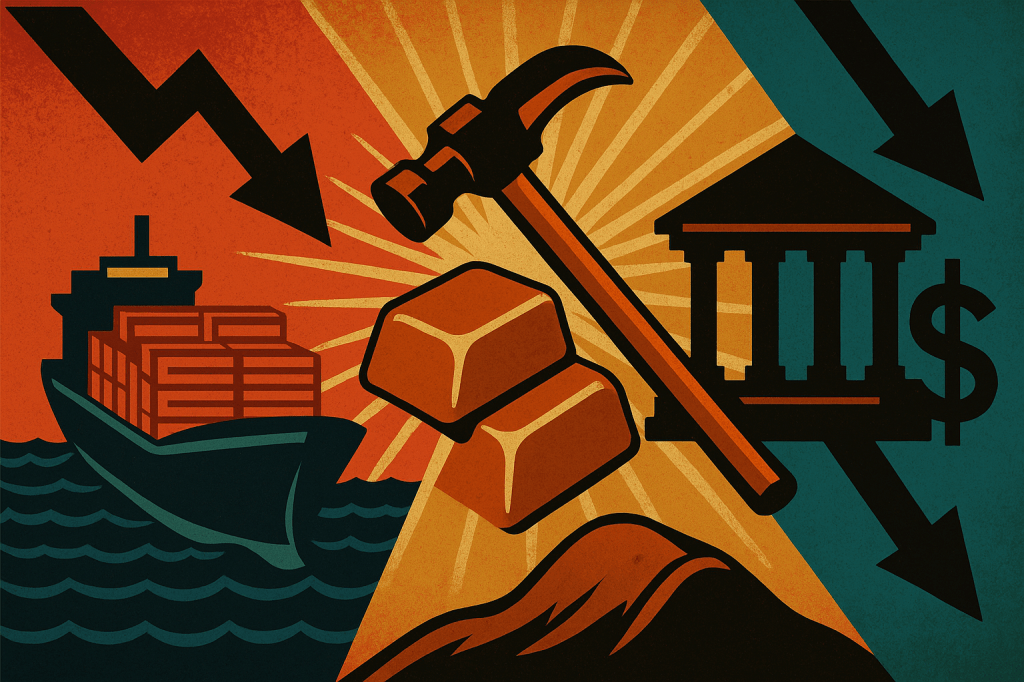
Just days ahead of what should’ve been a bullish bonanza — the looming August 1 implementation of a 50% U.S. tariff on imported copper — prices fell sharply. COMEX futures dropped nearly 3%, pulling back from last week’s near-$6/lb. euphoria, while the London Metal Exchange saw a similar retreat.
Now, if you’re scratching your head wondering why copper’s pulling back when tariffs typically restrict supply and boost prices, you’re not alone. But this is no anomaly — it’s classic commodity market psychology. And as we all know in exploration and resource markets: expectations drive the drill, but uncertainty drills the nerves.
Let’s unpack what’s really going on here, rock hammer in hand.
📉 The Market Moved Before the Tariff Did
Prices already surged earlier this month in anticipation of the tariff. Traders, speculators, and procurement teams raced to get their metal booked, shipped, and landed before the August deadline. It’s the age-old adage in the markets: buy the rumor, sell the news — or, in this case, sell the uncertainty.
That run-up pushed U.S. copper prices well above global benchmarks. But when the details of the tariff still weren’t confirmed by late July — no clarity on origin exemptions, product classes, or how incoming shipments would be treated — many market participants decided they’d rather not play roulette with that kind of policy fog.
⛴️ A Glut Before the Gate
In the scramble to beat the tariff clock, global traders sent a wave of copper across the seas to U.S. ports. Warehouses are fuller than usual. End users and suppliers alike stocked up while they could, which means…
Short-term supply is high, and immediate demand is low. The buyers already bought. And the sellers? They’re now looking for the next cue — and a price correction was inevitable once that panic buying wave receded.
So while the long-term logic of tariffs suggests upward pressure on prices, the short-term reality is a copper pile-up, not a copper pinch.
📉 Dislocation and Arbitrage: LME vs. COMEX
The difference between U.S. and global copper prices widened during the July run. Smart money — and quick hands — are now playing that gap, selling into the higher-priced U.S. contracts, or waiting for post-tariff clarity before betting on further upside.
We’re seeing a market pause, not a policy reversal. Call it a breath before the next sprint.
🪙 Enter the Fed: When Macroeconomics Muddy the Metal
Layer on top of all this the Federal Reserve’s upcoming policy meeting. Rates are expected to stay flat, but every trader knows the real action is in the tone of the Fed’s language. If they lean hawkish, the dollar strengthens — and a stronger dollar makes commodities more expensive for the rest of the world, cooling demand.
That macro undertow adds to copper’s momentary slip, even with tariffs looming like a guillotine over future imports.
🎯 The Takeaway for Exploration Geologists and Critical Mineral Investors
This is a perfect case study in why price volatility doesn’t always follow supply logic. Emotion, expectation, and market structure shape the narrative — and short-term jitters often misrepresent long-term fundamentals.
For those of us in the rocks-and-rebar world of copper exploration and development, this moment is a gift in disguise:
If you’re advancing a domestic copper project, this tariff cycle could set the stage for future premiums.
If you’re investing, this dip might be your window before tariffs create sustained dislocation.
If you’re lobbying, point to this disjointed response as more reason to shore up North American supply chains.
The ground may be stable under our boots, but the market’s a tightrope — and it pays to read the wind.
Let me know what you’re seeing out there — from porphyry prospects to policy posturing. The copper game isn’t cooling off; it’s just shifting gears.
Sometimes, the invisible hand of the market needs a little nudge. Other times, it needs the full force of the Pentagon’s wallet—and apparently, that’s all it takes to wake the giants.
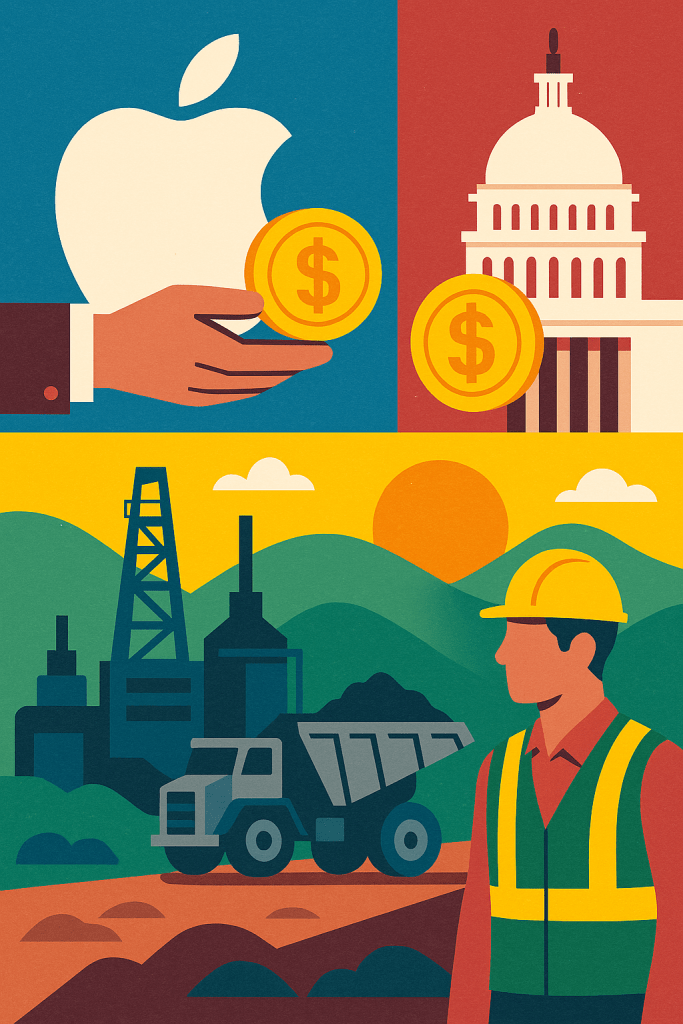
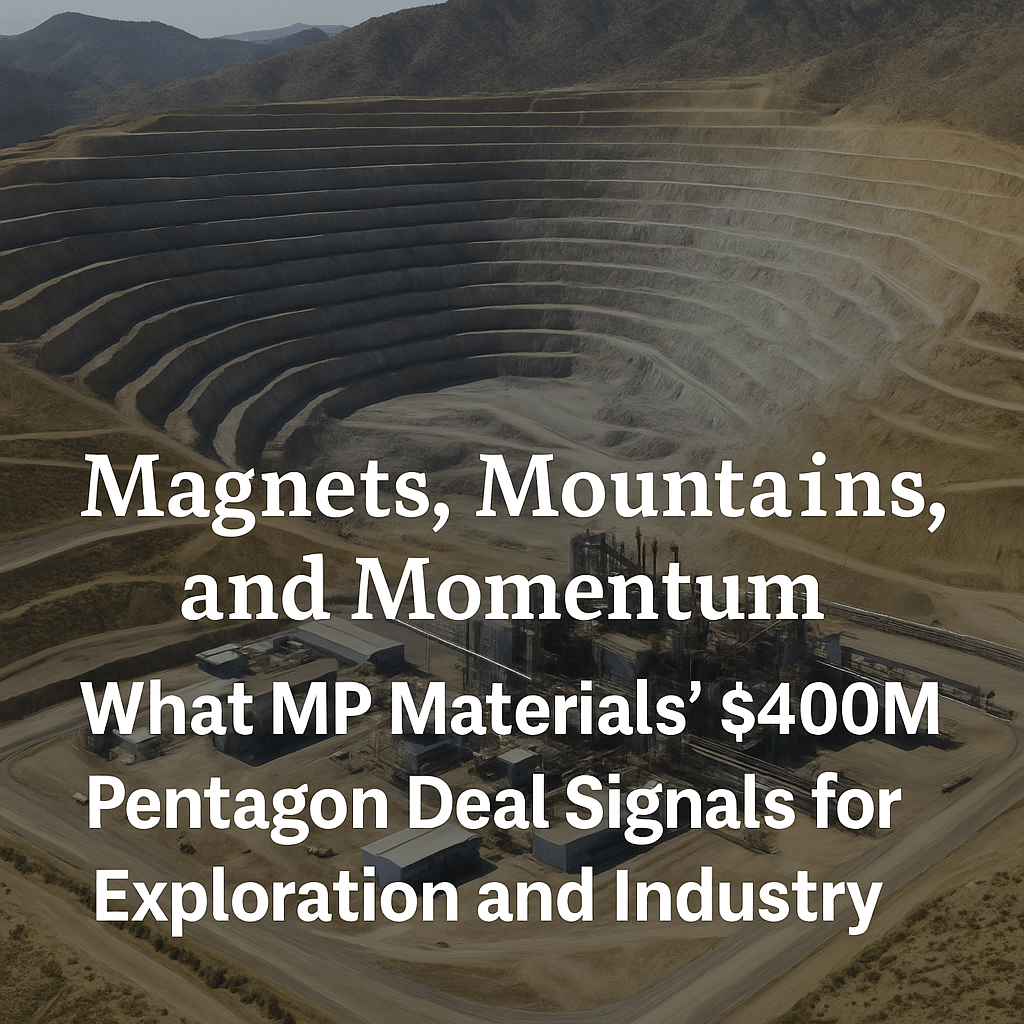
Just one week after MP Materials landed a $400 million deal with the U.S. Department of Defense, tech behemoth Apple swooped in with a stunning $500 million commitment to secure domestically sourced rare earth magnets. That’s not just validation—that’s velocity.
Together, these two powerhouse deals sent MP stock surging to all-time highs, but more importantly, they sent a thunderous signal to industry: this is where the future is being built.
Pentagon First, Apple Fast Follows
The sequence is telling.
The DoD’s investment was more than a show of support—it was a strategic move to anchor domestic supply chains for critical defense technologies, from fighter jets to satellites. It gave MP Materials the capital and credibility to move forward with large-scale production and magnet manufacturing out of Fort Worth, Texas and Mountain Pass, California.
Enter Apple. With an eye toward vertical integration and supply chain resilience, Apple’s deal includes co-developing neodymium magnet lines for its products, launching a rare earth recycling initiative, and helping fund the R&D needed to improve magnet performance—using U.S. materials, refined and manufactured on U.S. soil.
For a company that famously said “Designed in California,” this is now about “Sourced in America,” too.
What This Means for Exploration
Deals like this don’t just move markets—they reshape exploration narratives.
While Apple and MP Materials are focusing their initial efforts on established facilities, the next logical step is new discovery and development. And that brings us to the Bear Lodge carbonatite complex in northeast Wyoming—an underappreciated, world-class REE deposit in one of the most mining-friendly states in the U.S.
Long known by geologists and quietly held in industry circles, Bear Lodge has sat in a state of limbo due to market pricing, lack of offtake agreements, and, frankly, a lack of momentum. That changes now.
As capital floods into domestic rare earth supply chains, Bear Lodge looks like a near-term winner—especially with permitting pathways and community sentiment in Wyoming often far more supportive than coastal counterparts. Expect renewed attention, joint ventures, and perhaps a long-awaited move into production-ready territory.
And don’t sleep on Nevada. While known for lithium and gold, the state harbors critical mineral potential across a range of underexplored terrains—from bastnaesite showings to overlooked thorium-rich systems that could offer the same kind of radiometric pathfinding used at Mountain Pass.
The New ESG: Exploration, Sovereignty, and Guidance
It’s tempting to view these deals through a traditional ESG lens—jobs created, emissions reduced, supply chains localized. And that’s all true. But this isn’t your father’s ESG report.
This is ESG 2.0, where Exploration is prioritized, Sovereignty is defended, and Government plays a guiding hand—not by overregulating, but by strategically investing to de-risk the private sector’s next move.
Apple didn’t just show up with a half-billion dollars out of pure idealism. They responded to a roadmap set by the federal government. The Pentagon pointed, and Apple followed—not blindly, but confidently. This is what good governance looks like: coaxing industry in the right direction by reducing risk and increasing reward.
That’s not just smart policy. That’s nation-building—from the periodic table up.
Final Thoughts
In the wake of these historic deals, one thing is clear: the age of foreign rare earth dominance is over. America is not just responding—it’s repositioning.
Exploration geologists, developers, and entrepreneurs—take note. Whether you’re sampling carbonatite in Wyoming or chasing radiometric highs in Nevada, the tide has shifted. The question is no longer if domestic supply chains will grow, but where you want to stand when they do.
Now is the time to stake, explore, invest, and build—because the future of tech is being built from the bedrock up.
The bedrock just shifted — and not because of tectonics.
MP Materials, the sole U.S. producer of rare earth elements, has inked a $400 million deal with the Department of Defense. The investment cements the Pentagon as its largest shareholder and catalyzes a deeper realignment of America’s critical minerals strategy. But this isn’t just a finance story — it’s a geological one, a strategic one, and potentially a transformational one.
Let’s crack it open.
From Mountain Pass to Magnet Hubs: Rebuilding a Domestic Value Chain
The heart of this deal is vertical integration. MP Materials will use the funding to construct a second magnet manufacturing facility — dubbed the “10X Facility” — bringing total planned U.S. magnet output to 10,000 tonnes per year by 2028. Meanwhile, the Mountain Pass mine in California, already a rare example of integrated mining and refining, will undergo a major upgrade to process heavy rare earths, a capability that’s currently nonexistent within U.S. borders.
Together, these efforts represent the scaffolding of a fully domestic mine-to-magnet supply chain — a national security asset in its own right, with magnets destined for F-35s, EV drivetrains, satellites, and hypersonic missiles alike.
The Pentagon isn’t dabbling here. This is a decade-long offtake agreement, a price floor of $110/kg for NdPr, and a $1B private financing commitment to ensure downstream buildout. It’s the kind of market-making intervention that turns a company into a cornerstone — and an industry into a priority.
A Signal to the Mining Sector: This Is Industrial Policy in Action
For those of us swinging hammers in the field and flipping core trays in the trailer, this deal resonates loud and clear: Critical minerals are no longer just a speculative asset class. They are now the subject of coordinated national policy.
This move sets a precedent. The government isn’t merely supporting production; it’s underwriting it — mitigating price risk, anchoring demand, and becoming a shareholder in the supply it wants to see developed.
That playbook doesn’t end at rare earths. Expect copycats — or cousins — across lithium, cobalt, niobium, tellurium, and even uranium. The message is: if it feeds national defense, the energy transition, or technological sovereignty, the U.S. is now willing to back it with more than words.
For geologists and explorers, this means:
Increased funding for early-stage discoveries in critical mineral belts.
Stronger pull-through for domestic projects that show scale, purity, and ESG performance.
More favorable permitting conditions when aligned with national goals.
A growing appetite for substitutes and analogues — think heavy REEs outside China, battery materials outside Congo, or even thorium and scandium as byproducts.
Pathfinders in the Radiogenic Shadows: Thorium, REEs, and the Exploration Model
The Mountain Pass model — carbonatite-hosted rare earths with a radioactive signature — remains one of the most studied (and still underutilized) exploration templates in North America.
Thorium, often treated as a nuisance, is actually the glowing breadcrumb in the geochemical hunt for similar deposits. Mountain Pass was identified in part because of elevated thorium readings during postwar radiometric surveys — a technique that’s ripe for revival with modern tools.
Imagine reanalyzing old radiometric surveys across the Basin and Range or Rockies with a critical minerals lens. With airborne gamma spectrometry, machine learning, and hyperspectral satellite data now at our fingertips, we’re not just walking old ground — we’re re-seeing it.
This deal should reignite interest in:
Thorium pathfinder anomalies in alkaline systems and pegmatites.
Heavy REE-enriched districts in Wyoming, Texas, and Alaska.
Tailings and waste rock with underexplored critical mineral content.
REE byproducts in carbonatite-associated copper or phosphate systems.
Mountain Pass wasn’t a fluke — it was the result of recognizing radiogenic clues and metallogenic context. We have the maps. We have the data. What we need now is the will.
What’s Downstream is Upstream’s Business Now
This is a case where downstream developments — like magnet manufacturing — change the calculus upstream. With the Pentagon as a guaranteed buyer and long-term partner, magnet supply chains gain the financial predictability needed to invest in innovation, expansion, and diversification.
And that demand rolls uphill.
Copper miners could find offtake markets for dysprosium or terbium as trace byproducts.
Phosphate producers may re-evaluate their monazite waste streams.
Uranium explorers, especially in thorium-rich systems, might start looking at REE recovery circuits.
Industrial mineral companies, often ignored, could become critical suppliers if they sit on the right fluorite, barite, or bastnaesite-hosted systems.
Where once there was only risk, now there is signal — a big, bold signal saying Build it here. Mine it here. Sell it here.
Final Thoughts: A Turning Point for Geologists, Not Just Manufacturers
This MP–Pentagon deal is more than capital infusion — it’s a tectonic affirmation of our industry’s relevance. It says that what we explore, discover, and extract matters not just economically, but strategically.
We’re used to asking: “Is this deposit feasible?” Now we also get to ask: “Is this deposit vital?”
And the answer, more often than not these days, is yes.
So as rare earths take center stage and thorium-laced anomalies begin to glow again in the collective memory of the geological community, the message is clear: The drill rig is back in fashion — not just in markets, but in national strategy.
And that, my friends, is worth staking some ground for.
— Mark Travis, CPG Founder, Arkenstone Exploration Writer, Rock Whisperer, Advocate for the Sacred Duty of Discovery
By Mark Travis, CPG | June 23, 2025 President, Arkenstone Exploration
“In every supply chain lies a seam. And when pressure builds, the whole system can slip.”
In March, the cobalt market trembled. In June, it roared.
What began as a localized export ban in the Democratic Republic of Congo (DRC)—the world’s undisputed cobalt kingpin—has now widened into a seven-month disruption with no clear end in sight. Prices have surged. IPOs have crumbled. Investors are watching from the edge of their seats. And somewhere in the hills of Idaho, Alaska, or northern Quebec… a junior explorer is unrolling a map and whispering: Now is the time.
Let’s step back and trace the arc—from instability to opportunity—and explore what it means for the U.S., for the mining sector, and for the future of secure, ethical critical minerals.
Part I: March Madness – When the Ban First Dropped
The story began in February 2025, when the DRC suspended cobalt concentrate exports. Officials cited oversupply and weak EV demand as justification—though insiders speculated on broader motivations, from domestic processing ambitions to geopolitical posturing.
By mid-March, chaos was rippling through the global cobalt chain:
Eurasian Resources Group declared force majeure at Metalkol.
Cobalt prices hit $12.25/lb in Europe, climbing nearly 12% in China.
Analysts buzzed about “structural fragility” in a market too dependent on one country’s copper byproduct stream.
I wrote then that this disruption was a “wake-up call” for domestic mining, a rare window where investors, policymakers, and industry leaders might finally align around the urgent need for U.S.-based production.
Part II: June Reverb – The Shock That Keeps On Shaking
Now, the DRC has extended the ban by another three months—pushing the total supply interruption to over half a year, and pulling an estimated 100,000 tonnes of cobalt off the global market.
The price reaction was swift and sharp:
Cobalt futures on China’s Wuxi Exchange surged 9% overnight to $35.34/kg.
Cobalt sulphate—critical to EV battery cathodes—has rebounded 80% from January lows.
Glencore, the world’s #2 cobalt producer, followed ERG in declaring force majeure.
Cobalt Holdings scrapped its anticipated $230M London IPO, spooked by instability.
While CMOC claims its Congo-based operations remain steady, the market at large is anything but.
Behind the headlines, a deeper current is pulling: the realization that this isn’t a one-time hiccup—it’s a systemic vulnerability. One that threatens the clean energy transition at its roots.
Part III: The U.S. Response – Still Waiting for the Drill to Turn
So here’s the paradox.
We know the problem: too much cobalt comes from too few jurisdictions. We know the stakes: EVs, grid storage, military tech, even aerospace all need cobalt. And we know the solution: develop domestic resources.
Yet exploration companies still face:
Multi-year permitting timelines
Inconsistent federal support
Lack of processing capacity
Skeptical capital markets burned by previous busts
The opportunity is clear, but the runway is short. If the U.S. wants to seize this moment, we need policy shifts, capital infusions, and a cultural reawakening that mining matters.
Part IV: From Fragility to Fortitude – What Comes Next
The cobalt crisis of 2025 is more than a spike in futures charts. It’s a stress test of global supply chains, and a preview of coming attractions for lithium, rare earths, and beyond.
This is the inflection point where:
Domestic juniors can shine with the right support and strategy
Investors can reposition toward hard assets with real leverage
Governments can double down on permitting reform and resilient infrastructure
Cobalt is the canary—but it’s singing a warning in a mine shaft lined with copper, nickel, lithium, and rare earths.
Final Thoughts: The Claim is Staked—Will We Act?
As a geologist, I’ve seen firsthand how resource trends bend history. As a project manager, I’ve wrestled with the real costs of getting a mine off the ground. And as someone who believes in the long arc of human progress, I see cobalt not as a crisis, but a catalyst.
A catalyst to return to the rock, to the root, to the real work of supplying a world in transition.
Let’s not miss this window. Let’s dig deeper—literally and figuratively—into our own potential.
Mark Travis is a Certified Professional Geologist and President of Arkenstone Exploration. He believes in building resource resilience from the ground up, and writes frequently on the intersection of exploration, policy, and the human spirit.
Recently here in June of 2025, Nuclear Fuels Inc. officially kicked off its 2025 drilling program at the Kaycee Uranium Project in Wyoming’s Powder River Basin. For those of us on the ground, this marks more than the start of another drill season—it represents a strategic pivot point in America’s race to revitalize domestic uranium production.
Building on Discovery, Not Just Hype
The 2025 program plans to complete at least 100,000 feet of rotary mud drilling, expanding on successes from late 2024 when the Outpost and Trail Dust Zones were discovered. Both zones returned solid intercepts of roll front-style mineralization—textbook ISR targets.
Outpost Zone: 0.082% eU₃O₈ over 6.5 ft (GT 0.532) at 767 ft depth
Trail Dust Zone: 0.0553% eU₃O₈ over 5.5 ft (GT 0.304) at 886 ft depth
These aren’t headline-grabbing grades, but they’re meaningful, especially when contextualized within a district that hosts over 430 miles of roll fronts across a consolidated 55-square-mile land position. ISR uranium is a volume game, and Kaycee is one of the few districts in the U.S. where all three historically productive formations—Wasatch, Fort Union, and Lance—are present and mineralized.
This is no small feat. It’s been four decades since this patch of uranium country was under single-company control. That historical fragmentation is exactly why it has been overlooked—until now.
Fast-Tracking the Future? The Role of Fast-41 and Domestic Policy
It’s also no accident that this kind of momentum is happening in Wyoming, a state that not only supports energy development but also operates under “Agreement State” status, streamlining the ISR permitting process in partnership with the NRC.
Policies like Fast-41—first implemented under the Trump administration to accelerate federal reviews for critical infrastructure—are back in the conversation. And they matter. Fast-41 designations don’t just cut red tape; they elevate a project’s visibility, encourage inter-agency cooperation, and unlock capital that would otherwise sit on the sidelines due to regulatory uncertainty. In today’s geopolitical climate, where nuclear energy is being rediscovered as the linchpin of a clean and sovereign energy future, the uranium sector is moving from “interesting” to “imperative.”
M&A: Consolidation Brings Clarity
The recent announcement that Premier American Uranium will acquire Nuclear Fuels adds another layer of momentum. Once completed, the merger will create one of the largest pure-play uranium explorers in the U.S. with a portfolio of 12 key projects across several top-tier uranium basins.
We’re seeing a broader trend across the sector:
Uranium Energy Corp. continues expanding ISR capacity via South Texas and Wyoming acquisitions.
enCore Energy, our strategic partner at Kaycee, is pivoting from explorer to near-term producer.
And legacy juniors are being rolled into larger vehicles that can leverage scale and permitting strength.
These moves aren’t just about size—they’re about aligning technical teams, capital, and permitting expertise to match a coming uranium demand cycle that’s being driven by utility restocking, geopolitical stockpiling, and a resurgence of U.S. nuclear builds.
My Role in the Shift
As the Project Manager for Nuclear Fuels, and now part of the integrated team under the Premier American umbrella, my role remains the same in spirit but is growing in scope. I’ll continue overseeing the Kaycee exploration campaign—coordinating drill planning, target modeling, logging, and resource delineation. The groundwork we’re laying now isn’t just about proving pounds—it’s about positioning Kaycee as one of the next ISR uranium projects ready for resource definition and eventual development.
Being a Qualified Person under NI 43-101, I’ve reviewed and signed off on the technical content of our news releases, but I’m also deep in the field: managing contractors, monitoring lith logs, and piecing together the kind of geologic story that excites engineers and investors alike.
And I believe in that story.
A Foundation for the Next Cycle
We’re not in the discovery-for-discovery’s-sake phase anymore. The uranium sector is tightening, and developers with real ground, real data, and real people doing the work are rising to the top. The Kaycee Project has the hallmarks of a future ISR producer: favorable host formations, supportive jurisdiction, strong partnerships, and aggressive yet responsible exploration.
So here’s to another season of mud, probes, logging runs, and long drives between rotary rigs. If you’re watching the uranium space, keep your eye on Kaycee. The pieces are coming together.
Mark Travis, CPG Project Manager – Nuclear Fuels Inc. / Premier American Uranium Geologist, Permitting Liaison, and Explorer of America’s Energy Future
In a move that feels like the opening scene of a modern-day energy epic, the U.S. Department of the Interior has granted a swift green light to Anfield Energy’s Velvet-Wood uranium and vanadium project in Utah. This isn’t just another mining approval; it’s the first to benefit from a newly implemented 14-day environmental review process, a stark contrast to the years such assessments typically consume.
Why does this matter? Because it’s not just about one mine; it’s about setting a precedent. This expedited approval could be the catalyst that reignites domestic exploration and production of critical minerals, particularly uranium—a resource that’s poised to become the linchpin of our energy future.
The Velvet-Wood Project: A Glimpse into the Future
Anfield Energy’s Velvet-Wood project isn’t starting from scratch. It’s a revival of the historic Velvet mine, coupled with the development of the nearby Wood deposit. Together, they boast an estimated 4.6 million pounds of uranium oxide equivalent (eU₃O₈) in measured and indicated resources, with an additional 552,000 pounds in inferred resources. The vanadium-to-uranium ratio stands at an impressive 1.4:1, adding another layer of value to the operation.
But the real game-changer? The plan to reopen the Shootaring Canyon uranium mill, one of only three licensed, permitted, and constructed uranium mills in the U.S. This facility will process the ore into uranium concentrate, reducing our reliance on imports—a staggering 99% of the uranium used by U.S. nuclear power plants in 2023 came from countries like Russia, Kazakhstan, and Uzbekistan.
A New Frontier for Exploration
This fast-track approval doesn’t just benefit Anfield; it sends a clear signal to the entire industry. The message? The U.S. is serious about securing its mineral future. For geologists, explorers, and investors, this is a clarion call to action. The regulatory landscape is shifting, and with it, the opportunities for domestic exploration are expanding.
Imagine the untapped potential in regions like the Colorado Plateau or the Wyoming Basins. With streamlined permitting processes, these areas could see a surge in exploration activities, leading to new discoveries and a revitalized domestic mining sector.
Investing in Uranium: The Next Oil Boom?
Drawing parallels between uranium today and oil in the early 20th century isn’t just poetic—it’s prophetic. Back then, early investors in oil companies reaped astronomical returns as the world transitioned to petroleum-based energy. Today, as we pivot towards low-carbon and nuclear energy solutions, uranium stands at the cusp of a similar boom.
Consider this: the global oil and gas market recorded revenues of $5.95 trillion in 2024 . The U.S. oil and gas sector alone is valued at over $1.5 trillion. If uranium follows a similar trajectory, early investors could see returns that mirror those historic oil booms.
The Bigger Picture: Energy Security and Sustainability
Beyond the financial incentives, there’s a broader narrative at play. Fast-tracking projects like Velvet-Wood aligns with national interests—reducing dependence on foreign adversaries, bolstering energy security, and promoting sustainable, low-carbon energy sources.
As we navigate the complexities of the 21st-century energy landscape, uranium offers a bridge between our current fossil-fuel dependence and a future powered by clean, reliable nuclear energy.
In Conclusion
Anfield Energy’s Velvet-Wood project isn’t just a mining operation; it’s a symbol of what’s possible when policy, industry, and innovation converge. For those with the foresight to see the writing on the wall, the uranium sector offers not just a lucrative investment opportunity but a chance to be part of a transformative chapter in America’s energy story.






 Mineral Exploration Geology - finding value in the world around us