
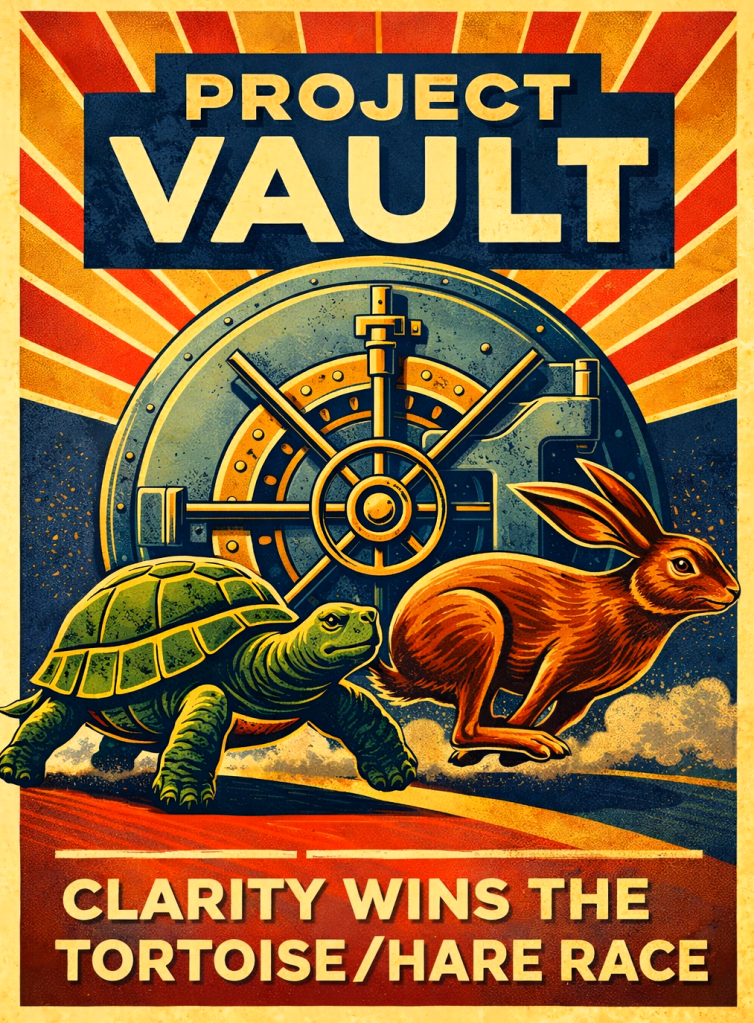
There are moments in industry when the ground stops shifting beneath our feet and starts tilting. Project Vault — the newly launched, $12 billion U.S. strategic stockpile of critical minerals — is one of those moments. It’s not another headline. It’s the first real policy-to-market mechanism that treats minerals not as commodities, but as infrastructure. (Reuters)
This is the point where the tortoise — the team that thinks deeply, understands value chains, and models risk upstream — begins to outpace the hare sprinting on press releases and tickers.
1. Project Vault Is Not a Policy Toy; It’s Market Architecture
Project Vault isn’t an academic “we should do something.” It’s operational. It’s backed by a record-setting $10 billion Export-Import Bank commitment, paired with private capital, to buy, hold, and manage critical minerals such as rare earths, lithium, and cobalt for industry use. (Reuters)
Modelled after the Strategic Petroleum Reserve but aimed at industrial supply chains rather than emergency energy stocks, Vault formalizes the idea that mineral supply isn’t just a cost input — it’s economic infrastructure. This reframing changes where the value resides: not at the smelter door, not at the consumer end, but at the point of consistent, dependable access over time.
2. Price Stability Doesn’t Remove Risk — It Re-Locates It
Here’s where the tortoise pulls ahead: Vault’s price stabilization mechanics — fixed-price commitments and inventory drawn down in disruptions — don’t eliminate volatility. They push the burden upstream, into the realm of producers, explorers, and project developers.
In other words: if the U.S. government is willing to anchor a stockpile, then the question becomes less about demand trajectory and more about upstream certainty — geological quality, permitting timeliness, cost discipline, and credible timelines.
3. The Long Game Is Upstream Clarity
When price volatility is dampened downstream, capital doesn’t disappear — it educates itself. Boards, investors, and ICs ask harder questions:
- What is your resource confidence on a fundamental, auditable basis?
- How real are your timelines when you strip away storytelling?
- Can your project survive scrutiny — not just optimism?
Well-informed decisions win here, and not because they are fashionable, but because certainty compounds when risk is transparent.
This is where the tortoise runs ahead: precision beats velocity when ambiguity carries cost.
4. The Sovereign Lens Changes the Game
Project Vault signals that supply insecurity is now a national economic concern. That shifts the investment landscape in a subtle but profound way:
- Projects with defensible geologies and clear access paths become infrastructure partners, not speculative assets.
- Regulatory clarity — what gets permitted, where, and when — suddenly shows up on balance sheets in ways it never did before.
- Capital rewards narratives backed by data and defendable risk mitigation, not optimistic plaques.
This is why a thoughtful developer with rigorous data and realistic paths to sanction is better positioned over time than a headline-driven story that excels in pitch decks but falters on execution.
5. When the Hare Beats Itself
Fast money loves a narrative. But narratives without substance fracture in environments built to buffer supply disruptions. Vault’s structure — anchored by obligations to replenish, caps on pricing, and participation tied to contractual commitments — is designed to reveal where the real risk lives.
That’s not a gotcha. It’s a clarion call: underwrite certainty, not ambiguity. Over-optimistic projections, opaque cost curves, and unvalidated timelines become expensive liabilities, not leadership moments.
In this new regime:
- Companies that lean into data discipline, not buzzwords
- Projects that earn their risk premiums through demonstrable geology and execution pathways
- Teams that speak to timelines and permits like they’re balance sheet items
…these are the players that win the long race.
6. The Tortoise’s Advantage Is Structural, Not Psychological
This isn’t a moral endorsement of slow and cautious over fast and daring. It’s a structural observation: once policy elevates materials to strategic status, the cost of being wrong rises faster than the cost of being slow.
Investors, operators, and governance bodies will learn this on a hard curve. Markets will increasingly differentiate between:
- Narrative optionality — stories that expect markets to bend toward them — and
- Structural substantiation — evidence that markets can and will support stability if the fundamentals align.
Project Vault doesn’t just change headlines. It changes decision calculus.
7. Here’s Where Informed Positions Will Pull Ahead
To navigate this environment, success will look like:
a) Geological Certainty as Value
Not “potential,” not “target,” but validated, defensible, and independently auditable resources that can feed industrial off-take and strategic reserve obligations.
b) Predictable Execution
Permitting, logistics, processing plans — these become as important as grades because Vault treats supply continuity as infrastructure resilience.
c) Structural Transparency
Capital will flow to teams that can explain risk with clarity, not charm. Ambiguity costs money where stability is the commodity.
d) Integrated Value Chains
Projects that bridge from extraction to processing — or partner with those who do — will reduce choke points that Vault is designed to mitigate.
Final Thought: Dreams End Where Decisions Begin
Project Vault may be $12 billion in headline capitalization, but its real capital is certainty — certainty that the U.S. will not be blind-sided by supply disruptions the way it has been before. (Financial Times)
And certainty, when it becomes measurable, becomes investable.
In the race between the hare and the tortoise, the finish line isn’t about who talks the loudest — it’s about who can look stakeholders in the eye and deliver what was promised, when it was promised.
Here’s the twist: that’s always the slow money — but in a world built to reward clarity over chaos, the slow runner becomes the one leading the field.

