• Strategic Advisory
  • About Me
  • Blog
Mineral Exploration Geology  –  finding value in the world around us

ARKENSTONE EXPLORATION – Exploring for the Heart of the Mountain

Mineral Exploration Geology – finding value in the world around us

About Me
Strategic Advisory
Blog
  • Clarity Is Expensive — Ambiguity Is Worse

    February 3rd, 2026

    Mining likes to talk about execution.

    Meters drilled. Samples collected. Budgets spent. Timelines met.

    But beneath all of that visible activity sits a quieter truth the industry rarely names out loud:

    Most of the real work in mining isn’t execution at all — it’s judgment.

    And judgment, when left unstructured, has a way of moving risk downstream until someone else is holding the bill.


    The Myth of “Execution” in Mining

    We often describe mining work as if it were mechanical:

    • Drill the holes
    • Log the core
    • Run the assays
    • Build the model

    But none of those steps are neutral.

    Every one of them is guided by decisions about:

    • where to drill
    • what matters
    • which signals are meaningful
    • when uncertainty is acceptable

    That is judgment. Not labor. Not execution.

    Judgment determines whether capital compounds or evaporates. It decides which risks are taken deliberately — and which ones sneak in uninvited.

    Yet judgment is rarely treated as the scarce resource it actually is.


    Why Ambiguity Feels Efficient (Until It Isn’t)

    Ambiguity has a seductive efficiency, especially in exploration.

    For juniors:

    • Ambiguity keeps stories alive
    • Optionality delays hard choices
    • “We’ll figure it out later” buys time

    In strong markets, this works. Capital is patient. Narratives carry weight. The system tolerates blur.

    But ambiguity does something subtle in the background:

    It relocates risk.

    Decisions still get made — they just aren’t named, structured, or owned.


    How Risk Quietly Moves Downstream

    When judgment isn’t clearly contained, it doesn’t disappear. It migrates.

    Often downward.

    Toward:

    • geologists
    • technical advisors
    • project teams closest to the data

    These are the people interpreting incomplete information, flagging uncertainty, and making directional calls — frequently without the authority, mandate, or governance to match the responsibility.

    Meanwhile:

    • accountability remains upstream
    • ownership stays abstract
    • clarity is deferred

    This isn’t malicious. It’s structural.

    And it works — until it doesn’t.


    What Happens When Cycles Turn

    Downcycles are ruthless auditors.

    Suddenly:

    • clarity becomes urgent
    • governance matters
    • roles harden
    • decisions need names attached

    Questions surface that sound new, but aren’t:

    “Why didn’t anyone tell us this earlier?”

    They did.

    But judgment without structure doesn’t travel well across time, teams, or capital cycles.

    When ambiguity finally collapses, the cost of clarity is no longer theoretical. It’s visible. And expensive.


    Ambiguity Isn’t the Enemy — Unstructured Judgment Is

    To be clear: ambiguity isn’t evil.

    In exploration, it’s unavoidable. Sometimes it’s even useful.

    But like leverage, ambiguity carries interest.

    When judgment operates without:

    • defined authority
    • clear containers
    • aligned incentives

    risk accumulates silently — and asymmetrically.

    Those closest to the work carry it.
    Those furthest from the work retain control.
    Misalignment grows quietly.

    Until reality asserts itself.

    That’s not drama.
    That’s geology.


    The Real Advantage: Clean Containers for Judgment

    The most resilient projects — and teams — aren’t the ones with the least uncertainty.

    They’re the ones with the cleanest structure for decision-making.

    That means:

    • naming who decides
    • defining what information informs the decision
    • aligning authority with responsibility
    • making judgment visible before cycles force it

    This isn’t rigidity. It’s alignment.

    And alignment upstream is one of the most cost-effective risk controls mining has — even if it rarely shows up on a balance sheet.


    A Better Question for the Industry

    Instead of asking:

    • Did we execute well?

    We might ask:

    • Who was asked to decide — and under what structure?

    Because in mining, clarity always arrives eventually.

    The only real choice is whether we pay for it early — or pay for it later.

  • Minerals as Infrastructure: Why Clarity Wins the Tortoise/Hare Race in the Project Vault Era

    February 2nd, 2026

    There are moments in industry when the ground stops shifting beneath our feet and starts tilting. Project Vault — the newly launched, $12 billion U.S. strategic stockpile of critical minerals — is one of those moments. It’s not another headline. It’s the first real policy-to-market mechanism that treats minerals not as commodities, but as infrastructure. (Reuters)

    This is the point where the tortoise — the team that thinks deeply, understands value chains, and models risk upstream — begins to outpace the hare sprinting on press releases and tickers.


    1. Project Vault Is Not a Policy Toy; It’s Market Architecture

    Project Vault isn’t an academic “we should do something.” It’s operational. It’s backed by a record-setting $10 billion Export-Import Bank commitment, paired with private capital, to buy, hold, and manage critical minerals such as rare earths, lithium, and cobalt for industry use. (Reuters)

    Modelled after the Strategic Petroleum Reserve but aimed at industrial supply chains rather than emergency energy stocks, Vault formalizes the idea that mineral supply isn’t just a cost input — it’s economic infrastructure. This reframing changes where the value resides: not at the smelter door, not at the consumer end, but at the point of consistent, dependable access over time.


    2. Price Stability Doesn’t Remove Risk — It Re-Locates It

    Here’s where the tortoise pulls ahead: Vault’s price stabilization mechanics — fixed-price commitments and inventory drawn down in disruptions — don’t eliminate volatility. They push the burden upstream, into the realm of producers, explorers, and project developers.

    In other words: if the U.S. government is willing to anchor a stockpile, then the question becomes less about demand trajectory and more about upstream certainty — geological quality, permitting timeliness, cost discipline, and credible timelines.


    3. The Long Game Is Upstream Clarity

    When price volatility is dampened downstream, capital doesn’t disappear — it educates itself. Boards, investors, and ICs ask harder questions:

    • What is your resource confidence on a fundamental, auditable basis?
    • How real are your timelines when you strip away storytelling?
    • Can your project survive scrutiny — not just optimism?

    Well-informed decisions win here, and not because they are fashionable, but because certainty compounds when risk is transparent.

    This is where the tortoise runs ahead: precision beats velocity when ambiguity carries cost.


    4. The Sovereign Lens Changes the Game

    Project Vault signals that supply insecurity is now a national economic concern. That shifts the investment landscape in a subtle but profound way:

    • Projects with defensible geologies and clear access paths become infrastructure partners, not speculative assets.
    • Regulatory clarity — what gets permitted, where, and when — suddenly shows up on balance sheets in ways it never did before.
    • Capital rewards narratives backed by data and defendable risk mitigation, not optimistic plaques.

    This is why a thoughtful developer with rigorous data and realistic paths to sanction is better positioned over time than a headline-driven story that excels in pitch decks but falters on execution.


    5. When the Hare Beats Itself

    Fast money loves a narrative. But narratives without substance fracture in environments built to buffer supply disruptions. Vault’s structure — anchored by obligations to replenish, caps on pricing, and participation tied to contractual commitments — is designed to reveal where the real risk lives.

    That’s not a gotcha. It’s a clarion call: underwrite certainty, not ambiguity. Over-optimistic projections, opaque cost curves, and unvalidated timelines become expensive liabilities, not leadership moments.

    In this new regime:

    • Companies that lean into data discipline, not buzzwords
    • Projects that earn their risk premiums through demonstrable geology and execution pathways
    • Teams that speak to timelines and permits like they’re balance sheet items

    …these are the players that win the long race.


    6. The Tortoise’s Advantage Is Structural, Not Psychological

    This isn’t a moral endorsement of slow and cautious over fast and daring. It’s a structural observation: once policy elevates materials to strategic status, the cost of being wrong rises faster than the cost of being slow.

    Investors, operators, and governance bodies will learn this on a hard curve. Markets will increasingly differentiate between:

    • Narrative optionality — stories that expect markets to bend toward them — and
    • Structural substantiation — evidence that markets can and will support stability if the fundamentals align.

    Project Vault doesn’t just change headlines. It changes decision calculus.


    7. Here’s Where Informed Positions Will Pull Ahead

    To navigate this environment, success will look like:

    a) Geological Certainty as Value

    Not “potential,” not “target,” but validated, defensible, and independently auditable resources that can feed industrial off-take and strategic reserve obligations.

    b) Predictable Execution

    Permitting, logistics, processing plans — these become as important as grades because Vault treats supply continuity as infrastructure resilience.

    c) Structural Transparency

    Capital will flow to teams that can explain risk with clarity, not charm. Ambiguity costs money where stability is the commodity.

    d) Integrated Value Chains

    Projects that bridge from extraction to processing — or partner with those who do — will reduce choke points that Vault is designed to mitigate.


    Final Thought: Dreams End Where Decisions Begin

    Project Vault may be $12 billion in headline capitalization, but its real capital is certainty — certainty that the U.S. will not be blind-sided by supply disruptions the way it has been before. (Financial Times)

    And certainty, when it becomes measurable, becomes investable.

    In the race between the hare and the tortoise, the finish line isn’t about who talks the loudest — it’s about who can look stakeholders in the eye and deliver what was promised, when it was promised.

    Here’s the twist: that’s always the slow money — but in a world built to reward clarity over chaos, the slow runner becomes the one leading the field.

  • The Rarest Commodity in Mining Right Now Isn’t a Metal

    February 1st, 2026

    It’s Clarity.

    There’s no shortage of headlines in mining right now.

    Capital raises. Government stakes. Billion-dollar takeovers. Uranium buying sprees. Gold reframed as insurance. Copper earnings “surprises” that somehow surprise no one.

    On the surface, it looks like momentum.

    But beneath it—quietly, persistently—something else is happening.

    A hesitation.
    A narrowing of options.
    A subtle but unmistakable drift toward safe decisions.

    Not good decisions.
    Not right ones.

    Safe ones.


    Everyone Has Data. Fewer Have Conviction.

    Geological data has never been more abundant.
    Models are sharper. Geophysics is better. Databases are cleaner.

    And yet—
    greenfield discovery slows,
    projects stall mid-cycle,
    and companies increasingly choose to buy certainty rather than build it.

    That’s not a geological failure.

    It’s a decision failure.

    Somewhere between the rock and the boardroom, clarity gets lost.


    When Governments Buy Equity, Pay Attention

    When governments start taking equity positions instead of writing policy papers, it’s not symbolism—it’s signal.

    Minerals are no longer treated as commodities alone.
    They’re strategic assets.
    Security assets.
    Timing assets.

    And yet, many companies are still framing decisions as if we’re operating in the same old technical-first vacuum.

    We’re not.

    The rules didn’t change overnight—but they did change quietly.

    Those who noticed early are moving differently now.


    The Industry Isn’t Short on Expertise

    It’s Short on Translation

    Most technical teams are excellent at what they do.
    Most executives are rational actors.
    Most boards are asking reasonable questions.

    And still, outcomes feel… tentative.

    Why?

    Because geology, capital, permitting, and narrative are still being handled in silos—then stitched together at the last possible moment and called a strategy.

    That’s not strategy.
    That’s alignment theater.

    The real work happens earlier.
    Before meters are drilled.
    Before decks are polished.
    Before narratives harden into commitments.

    That’s where clarity either exists—or doesn’t.


    M&A Is a Symptom, Not a Cause

    This wave of consolidation isn’t just about scale or synergy.

    It’s about confidence substitution.

    When internal conviction is thin, companies buy external certainty.
    When risk is hard to frame, they acquire someone else’s decisions.
    When the future feels foggy, they purchase what already exists.

    There’s nothing wrong with that—until it becomes the default.

    At that point, it’s not a growth strategy.
    It’s an admission.


    The Quiet Question No One Is Saying Out Loud

    Here’s the question hovering behind most serious conversations right now:

    “What do we actually know… and what are we just hoping holds together?”

    That question is rarely assigned.
    Rarely owned.
    And almost never answered cleanly.

    Not because the answer is unknowable—but because it requires standing outside incentives long enough to see the whole field.

    That’s uncomfortable.

    But discomfort is often where clarity lives.


    Clarity Doesn’t Shout

    It Pulls

    The people who truly understand what’s happening in this cycle aren’t the loudest voices on the timeline.

    They’re the ones:

    • asking fewer, sharper questions,
    • moving earlier than the crowd,
    • and declining opportunities that don’t align—even when the market applauds them.

    They don’t advertise certainty.

    They operate from it.


    A Closing Thought

    If it feels like mining is busy but not decisive…
    if it feels like capital is moving but conviction is thin…
    if it feels like everyone senses a shift but no one quite names it—

    That’s not confusion.

    That’s the absence of clarity being felt.

    And absence, as it turns out, can be very loud.

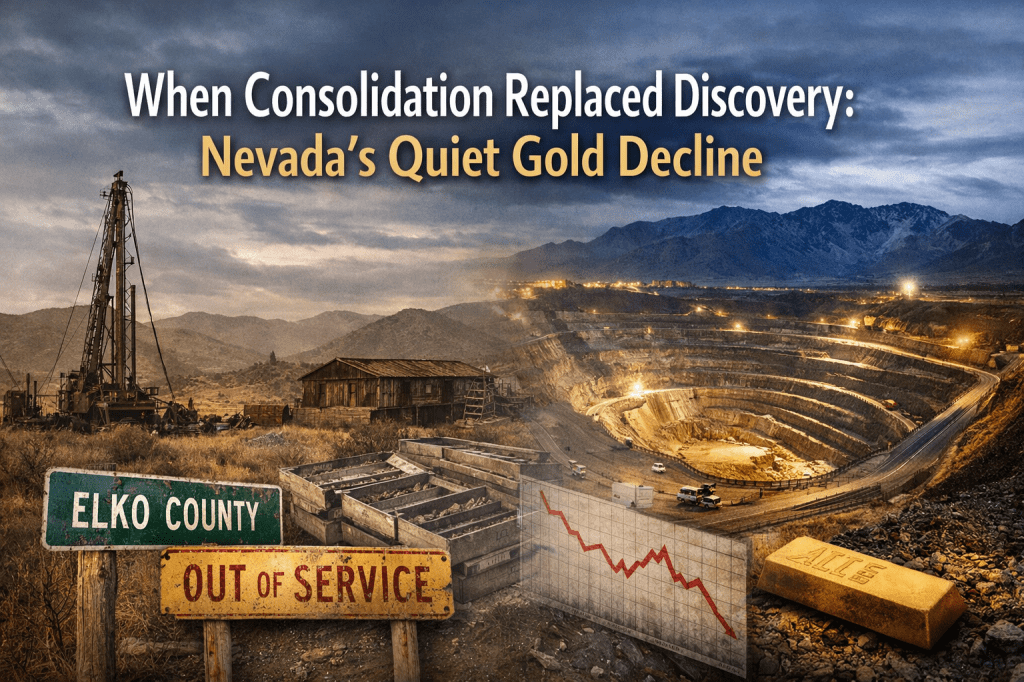
  • When Consolidation Replaced Discovery: Nevada’s Quiet Gold Decline

    January 25th, 2026

    Nevada’s Gold Problem Isn’t the Rocks

    There was a time in Elko, Nevada when you couldn’t find a spare hotel room—not because of tourism, but because exploration was booming. Drill rigs, geologists, and capital converged in a way few places on Earth could match. Discovery wasn’t an aspiration; it was an expectation.

    Nevada didn’t lose that momentum because its geology failed. It lost it because consolidation quietly reshaped the incentives that once made discovery inevitable.

    The creation of Nevada Gold Mines (NGM) was promoted as a logical efficiency play—combining assets, reducing redundancy, and maximizing output from one of the world’s richest gold districts. What followed instead was a slow erosion of competition, exploration appetite, and institutional depth, felt most acutely in the very heart of Nevada’s gold country.

    This is not a story about personalities or short-term operational decisions. It is a story about structure, and how structural choices compound over time—often invisibly—until the consequences become impossible to ignore.


    Before the Joint Venture: Competition as a Feature, Not a Bug

    For decades, Nevada benefited from a rare alignment of factors that made it exceptional on the global stage. Multiple major operators—most notably Barrick and Newmont—ran independent mines, independent exploration teams, and independent geological models within the same district.

    That competition mattered.

    It created:

    • Upward pressure on wages and benefits
    • A deep and mobile talent pool
    • Parallel interpretations of complex systems
    • A continuous push to out-think, out-discover, and out-execute

    Most importantly, exploration success belonged to the discoverer. That single incentive—clear ownership of upside—drove risk-taking, innovation, and sustained reinvestment in geology.

    The result was not inefficiency. It was resilience.


    The Structural Shift: Efficiency Without Renewal

    The formation of NGM fundamentally altered this ecosystem. Under a single operating structure, the logic of decision-making changed:

    • Exploration budgets were centralized and rationalized
    • Redundant teams and roles were consolidated
    • Geological work became more tightly tethered to near-mine needs

    From a production standpoint, this appeared sensible. But production and discovery operate on different time horizons. When exploration is framed primarily as a support function—rather than a growth engine—its role inevitably narrows.

    Over time, risk tolerance declines. Longer-dated ideas struggle to survive budget cycles. Geological creativity gives way to optimization.

    None of this happens dramatically. It happens gradually, through attrition.


    The Exploration Paradox: Capital Moved, Discovery Stalled

    One of the most striking outcomes of the past several years is this paradox:

    During a historic gold bull market, Nevada—particularly Elko County—became less exploratory.

    Exploration capital did not disappear. It migrated.

    Jurisdictions elsewhere in Nevada—Eureka, parts of Humboldt County near Winnemucca, and farther south toward Tonopah and Beatty—absorbed increasing shares of exploration spending. These areas shared a common trait: independent operators with clear discovery incentives.

    Elko County, by contrast, entered a quiet lull. Despite hosting some of the most fertile gold systems on Earth, it experienced fewer greenfield programs, fewer independent drill campaigns, and fewer new geological ideas being tested.

    This was not a failure of geology. It was a failure of incentive alignment.


    Human Capital: The Slowest, Costliest Loss

    Mining is capital-intensive, but it is equally knowledge-intensive. Geological understanding accumulates over decades, not quarters.

    As consolidation progressed:

    • Career pathways narrowed
    • Turnover increased
    • Generational knowledge transfer weakened
    • Institutional memory thinned

    Each departure carried more than a résumé—it carried context. Why a structure mattered. Where previous thinking had stalled. Which ideas were abandoned prematurely and which simply needed time.

    Communities felt this erosion as well. Stable, high-quality technical employment supports local economies, schools, and public services. When that stability weakens, the effects ripple outward—often disconnected, at first glance, from mining itself.


    Nevada’s Broader Underperformance

    These dynamics were not confined to a single county. Across the state, Nevada has underperformed in true greenfield discovery relative to its geological endowment.

    This reflects broader industry trends—shortened investment horizons, rising costs, and risk aversion—but consolidation at the top amplified those pressures. Large, centralized systems tend to favor incremental gains over foundational discovery, particularly when exploration upside is shared rather than earned.

    The irony is difficult to ignore. Nevada should have entered this gold cycle with a pipeline of discoveries ready to advance. Instead, it entered with mature assets and limited organic growth visibility.


    The IPO Moment: A Chance to Rebalance

    Today, proposed restructuring and the potential IPO of North American assets has reopened a conversation that many in Nevada have been having quietly for years.

    This moment is not about undoing the past. It is about deciding what comes next.

    If the next phase:

    • Restores independent exploration incentives
    • Rebuilds technical depth and decision autonomy
    • Encourages competition alongside scale
    • Treats discovery as a responsibility, not a discretionary cost

    Then Nevada may yet reclaim its role as the world’s premier gold discovery engine.

    If not, the state risks formalizing a model that extracts efficiently—but renews poorly.


    Conclusion: Discovery Is a Choice

    Nevada has not lost its geology.
    It has not lost its potential.

    But discovery does not occur by default. It emerges from systems that reward curiosity, tolerate risk, and empower people to think beyond the next production quarter.

    For much of its history, Nevada had those systems in place. The challenge now is whether it chooses to rebuild them.

    Because in the end, consolidation did not replace discovery by accident.

    It did so by design.

    And what is designed can—if the will exists—be redesigned.

  • Brownfield Mining Isn’t a Strategy — It’s a Confession

    January 22nd, 2026

    The mining industry is congratulating itself at precisely the wrong moment.

    A recent headline carried by MINING.COM declares that global mining is now a brownfield industry, framing the claim around a new academic study from the University of Queensland’s Sustainable Minerals Institute, published in OneEarth. The data themselves are not controversial. Brownfield capital expenditure dominates. Copper leads expansion. New mine starts have declined while production continues to rise.

    The problem isn’t the data.
    The problem is the story being told about what it means.


    Brownfield Dominance Is a Symptom, Not a Strategy

    Calling modern mining a brownfield-dominant industry implies intent, maturity, even prudence. But brownfield dominance didn’t emerge because it is optimal.

    It emerged because true greenfield, roll-the-dice exploration has been systematically starved.

    Not replaced.
    Not evolved past.
    Starved.

    What we are seeing is not strategic refinement—it is an industry retreating from discovery risk while continuing to consume discoveries made by prior generations.


    We Are Mining the Past, Not the Future

    The deposits being expanded today were not found by the system we have now. They were found by one we no longer tolerate.

    Most brownfield expansions draw from deposits that were:

    • Discovered two or three exploration generations ago
    • Permitted under less adversarial regulatory regimes
    • Financed by capital markets willing to accept discovery risk
    • Advanced when failure was still an acceptable outcome

    Brownfield mining is not proof that the system still works.

    It is proof that it used to.


    Rising Production Is a Lagging Indicator — and a Dangerous One

    The study notes that new mine starts peaked years ago for copper, gold, iron ore, and nickel—yet production continues to rise. This is often framed as resilience.

    It isn’t.

    Production can increase long after discovery collapses by accepting:

    • Lower grades
    • Higher strip ratios
    • Deeper pits and workings
    • Longer mine lives
    • Greater environmental and social intensity per unit of metal

    This is not innovation.

    This is drawdown.

    Mining is beginning to resemble a farmer celebrating a strong harvest while quietly abandoning seed for the next planting.


    Brownfields Are Politically Easier — Until They Aren’t

    There is a reason operators favor brownfield expansion:

    • Existing permits
    • Existing infrastructure
    • Existing workforces
    • Incremental approvals that avoid holistic scrutiny

    But brownfielding compounds impact over time. Longer mine lives, deeper footprints, intensified water and energy use, and growing social fatigue eventually turn “safe” expansions into the most contested projects on the landscape.

    Incremental approval does not mean incremental impact.

    It just delays the reckoning.


    The Study Accidentally Proves the Opposite of Its Headline

    One of the most revealing findings in the study is the global shift away from grassroots exploration toward mine-site work. This is presented descriptively, almost neutrally.

    It shouldn’t be.

    Exploration is not a discretionary expense.
    It is the R&D engine of mining.

    And right now, that engine is idling while the world demands acceleration.

    We want electrification.
    We want AI, data centers, grids, storage, and energy security.
    We want domestic and allied supply chains.

    But we are simultaneously underinvesting in the only activity that makes all of that physically possible.

    That contradiction is the real story.


    This Is the Exact Wrong Time to Pat Ourselves on the Back

    We are entering the most mineral-intensive era in human history.

    Brownfield dominance does not signal strength. It signals dependence—on past success, inherited discoveries, and a system no longer capable of replacing what it consumes.

    Let’s be clear:

    Brownfield expansion is not a future-proof solution.

    It is a bridge built from yesterday’s discoveries, stretching toward a future that has yet to be found.

    Calling that progress doesn’t make it so.


    The Question We’re Avoiding

    The real question isn’t why mining looks brownfield-heavy today.

    It’s why:

    • Exploration capital has been financialized out of existence
    • Discovery risk is punished rather than rewarded
    • Permitting systems optimize for delay instead of learning
    • We celebrate production while ignoring discovery collapse

    Until those issues are addressed, brownfield dominance isn’t a strategy.

    It’s a confession.

  • 100,000 Feet Later: What the Kaycee Drill Program Really Told Us

    January 20th, 2026

    Today, Premier American Uranium released results from the Kaycee Project—results I’ve been professionally sitting on since late 2025.

    The announcement details outcomes from a 100,000-foot drilling campaign at the Kaycee ISR Uranium Project in Wyoming’s Powder River Basin. On the surface, it does exactly what a well-constructed press release should do: it reports expanded mineralization, highlights multiple target areas, and reinforces Kaycee’s position within one of the most productive sandstone-hosted uranium districts in the United States.

    But press releases are, by design, distilled narratives.

    They don’t fully capture the geological work behind the results—the iterative interpretations, the subsurface pattern recognition, and the decisions made hole-by-hole that ultimately shaped where the drill went and why. Having led the geological interpretation and field integration for the Kaycee program through the 2024–2025 field season, I want to add context around how these results were generated, what they reveal about the system, and why they matter going forward.


    The Program: Footage with Intent

    The Kaycee campaign consisted of 132 drill holes totaling just over 100,000 feet, targeting multiple mineralized trends hosted primarily within Fort Union–Wasatch fluvial sandstones. From the outset, this was not a program built around headline intercepts alone.

    The objectives were deliberate and ISR-driven:

    • Delineate sand continuity and channel architecture
    • Resolve redox geometry across stacked sand packages
    • Test step-out targets guided by stratigraphy and inferred groundwater flow
    • Evaluate lateral predictability at a scale meaningful for ISR development

    In ISR uranium systems, geometry, continuity, and hydrogeologic coherence matter at least as much as grade. The Kaycee drill program was designed accordingly.


    Outpost: Discovery by Discipline

    The Outpost area represents more than a successful step-out—it reflects the emergence of a newly defined roll-front system once the subsurface framework came into focus.

    Drilling intersected uranium mineralization in 11 of 23 holes, with eight meeting or exceeding 0.02% eU₃O₈ over two feet, including several higher-grade intervals. Mineralization is concentrated near sand–organic interfaces, where permeability contrasts and localized reductants play a controlling role.

    These results did not come from random targeting. They followed from integrating:

    • Channel-scale sand geometry
    • Stratigraphic stacking relationships
    • Organic distribution within otherwise clean fluvial sands

    Once these elements were reconciled, mineralization at Outpost behaved as a coherent roll-front system, not a collection of isolated anomalies. That distinction is critical for ISR evaluation.


    Rustler and Stampede: Continuity Is the Point

    At Rustler, drilling confirmed a north–south-trending redox corridor extending for several miles, with 22 of 81 holes intersecting mineralization and 15 meeting ISR-relevant grade-thickness thresholds.

    Mineralization occurs within laterally continuous sands, with thickness and grade modulated by subtle changes in permeability, organic content, and redox position rather than abrupt lithologic breaks.

    Stampede further demonstrated continuity between adjacent trends, reinforcing the interpretation that these targets are expressions of a larger, connected redox system operating across multiple sand packages.

    From an ISR standpoint, this is exactly the behavior you want to see:
    not just mineralization, but systematic, predictable architecture across space.


    A Subtle Geological Signal Worth Noting

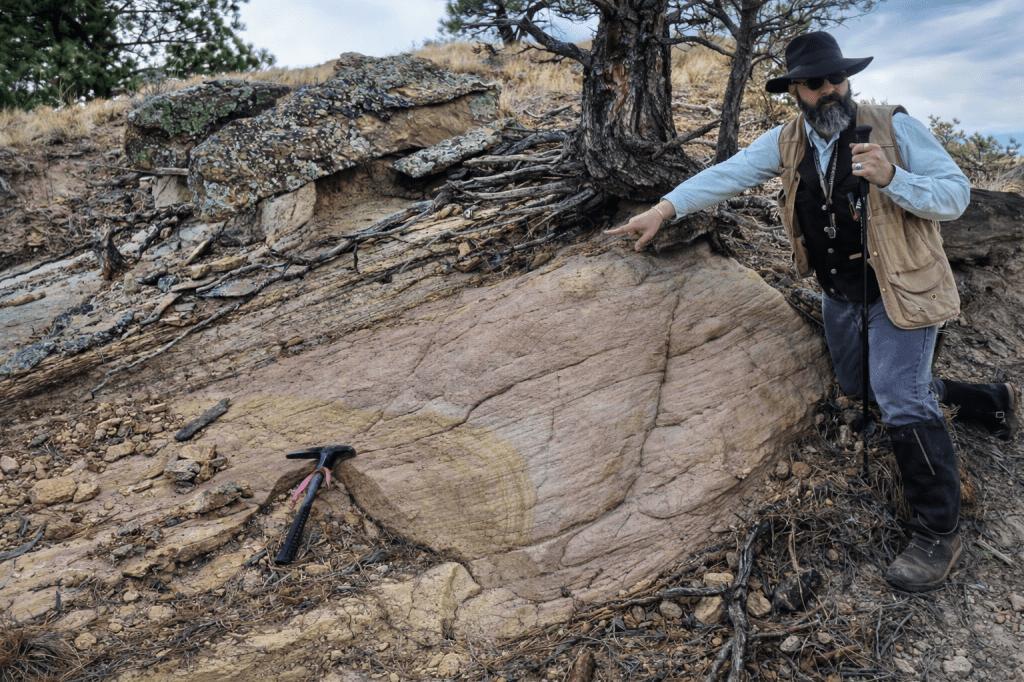
    One detail embedded within the results—likely to stand out to experienced Powder River Basin practitioners—is that several mineralized intervals do not exhibit the classic orange to brick-red oxidation typically associated with textbook roll-front models.

    Instead, uranium locally occurs within pale, carbonate-cemented sands adjacent to thin organic horizons, where elevated background gamma persists despite muted visual alteration. Feldspathic sands commonly show bleaching and subtle diagenetic effects rather than strong iron-oxide staining.

    This observation does not contradict roll-front uranium models. Rather, it highlights the influence of carbonate buffering, limited reactive iron, and organic-controlled reduction in shaping how redox fronts express themselves in certain Powder River Basin settings.

    I’ll leave that observation right there, for now.


    What This Means for Kaycee

    Taken together, the Kaycee results demonstrate:

    • A large, laterally continuous uranium system
    • Multiple mineralized trends with geometry appropriate for ISR development
    • New discovery potential beyond historically drilled ground
    • A geological framework that rewards disciplined subsurface interpretation over surface-level assumptions

    These outcomes did not emerge from a single dataset or a single idea. They are the result of iterative geological work—building sections, reconciling logs, testing competing interpretations, and letting the system resolve itself through careful drilling.

    That process is the difference between drilling footage and building confidence.


    Looking Ahead

    In just over a month, I’ll be presenting a technical talk at SME, where I’ll explore these results in greater depth—particularly what subtle redox expression and carbonate-buffered systems mean for ISR exploration strategy and model selection.

    For now, the public data speaks clearly enough:

    Kaycee works.
    The system is coherent.
    And 100,000 feet of drilling has sharpened—not simplified—the questions worth asking next.

  • The Great Re-Anchoring: Gold, Silver, and the Exploration Renaissance of 2026

    January 11th, 2026

    There are moments when markets don’t move incrementally—they declare a regime change.

    Gold starting 2026 above $4,500 per ounce is one of those moments.
    Silver holding north of $80 per ounce is another.

    These are not late-cycle excesses. They are early-cycle admissions that something foundational has shifted: trust in fiat systems, confidence in sovereign balance sheets, and belief that the financial world can continue to levitate without consequence.

    2026 is not shaping up to be another commodity bull market. It is shaping up to be a re-anchoring of value—from abstraction back to physical reality, from promises back to atoms, from leverage back to scarcity.

    And when that happens, the industry best positioned to matter again—after a decade in the wilderness—is mineral exploration.


    This Is Not a Commodity Cycle. It Is a Trust Cycle.

    Commodity cycles are about growth rates and substitution.
    Trust cycles are about belief.

    Gold’s current role is no longer subtle. It is not merely an inflation hedge or a portfolio diversifier. Gold has become a referendum on monetary credibility—a non-yielding asset chosen precisely because it is no one else’s liability.

    Silver, however, is playing a more dangerous and more powerful role.

    Silver is where monetary distrust collides with industrial necessity. It is embedded in electrification, solar, defense, grids, and high-spec electronics—and yet it still carries thousands of years of monetary memory. When silver rises alongside gold, it is not echoing sentiment. It is confirming scarcity.

    Gold speaks to confidence.
    Silver speaks to reality.

    When those two agree, repricing is inevitable.


    Let’s Call the Shot: The 2026 Middle-Case Prices

    This is the line in the sand—the part we own.

    Assuming no global financial collapse, no return to fiscal discipline, and no meaningful increase in primary metal supply, the middle-case outcome for this cycle looks like this:

    Gold: $6,500–$7,500 per ounce
    Silver: $150–$200 per ounce

    Not as spikes.
    Not as blow-off tops.
    As structural repricing levels that reflect capital reallocation, not panic.

    These numbers assume continued central-bank accumulation, modest but persistent Western portfolio reallocation, and a growing recognition that real assets are no longer optional ballast—they are foundational.

    If these numbers prove wrong, they will be wrong because discipline returned faster than history suggests. That would be a welcome surprise.

    But markets are not currently pricing discipline. They are pricing erosion.


    Capital Is Remembering Gravity

    For fifteen years, capital floated upward—into technology, financial engineering, and narratives untethered from physical constraint. That worked in a world of cheap money and unquestioned institutions.

    That world is gone.

    Capital is rediscovering gravity, and gravity pulls toward assets that cannot be printed, frozen, rehypothecated, or redefined by policy memo. This is why serious institutions—JPMorgan Chase & Co. among them—are increasingly attentive to real assets, infrastructure metals, and the financing mechanisms that sit beneath them.

    They are not chasing price. They are positioning for control of supply chains, optionality, and future scarcity.

    That distinction matters.


    Why Exploration Finally Breaks Out in This Cycle

    Exploration has always been cyclical, but this cycle is structurally different.

    There is no inventory cushion.
    There is no excess discovery pipeline.
    There is no fast way to replace what was not found ten or twenty years ago.

    Silver supply is brittle. Gold discoveries are rarer, deeper, and more expensive. Uranium, copper, and critical minerals face the same constraint: you cannot conjure new deposits on demand.

    At $6,500 gold and $175 silver, exploration stops being a discretionary gamble and becomes strategic manufacturing of future supply. Governments understand this. Majors understand this. Capital is beginning to understand this.

    The result will not be a flood of capital—it will be selective, intelligent funding, which is exactly what exploration has lacked for a decade.


    The Flywheel That Changes Everything

    Here is how the next phase unfolds.

    Gold stabilizes the monetary narrative.
    Silver compresses time.

    Producers re-rate first as margins expand and balance sheets heal. Developers follow as stranded projects suddenly make sense again. Exploration becomes scarce—not because there are fewer rocks, but because there are fewer credible teams with real targets and the ability to execute.

    Capital structures evolve. Royalties, streams, joint ventures, sovereign partnerships—complexity returns because simplicity no longer works. Bad geology is exposed quickly. Good geology is rewarded earlier than anyone expects.

    This is how an exploration renaissance actually begins—not with hype, but with constraint forcing competence.


    Silver Is the Accelerator

    Gold brings institutions.
    Silver brings urgency.

    Silver’s market is small enough to move violently and essential enough to matter. At $150–$200 silver, exploration budgets do not merely grow—they multiply. Drill rigs return. Talent returns. Entire districts that have been dormant for a generation come back into focus.

    Silver does not drift into new price regimes.
    It jumps, and in doing so it forces capital to act.


    This Is a Renaissance, Not a Bubble

    Bubbles are narrative-first and supply-responsive.
    This cycle is physics-first and supply-constrained.

    There is no excess capacity waiting to be turned on. There is only geology, time, and expertise. That reality re-elevates the people who understand rocks, systems, and risk—not as cost centers, but as the front end of value creation.

    Mining did not suddenly become interesting again.
    Reality became unavoidable.


    The Call, on Record

    If January 2027 looks back on January 2026, this is the line that should still hold:

    2026 will be remembered as the year capital decisively rotated back into physical truth—when gold repriced trust, silver repriced scarcity, and mineral exploration re-emerged as one of the most important strategic industries on Earth.

    If we’re wrong, we’ll be wrong loudly and honestly.

    But if we’re right, this won’t read like commentary.
    It’ll read like a field note from the moment the cycle turned.

    Let’s publish it.

  • Humanity’s New Fire, Revisited: AI, Energy Density, and the Return of the Atom

    January 9th, 2026

    Three years ago, I wrote about uranium as humanity’s new fire—a phrase meant to reframe the atom not as a weapon or a controversy, but as a fundamental leap in how civilization accesses energy. At the time, it felt like a contrarian stance. Nuclear was tolerated, debated, sometimes defended—but rarely embraced.

    That hesitation is gone.

    Not because minds were changed in op-eds or hearings, but because reality arrived carrying a power bill.

    Artificial intelligence has done what decades of climate arguments, geopolitical warnings, and grid stress tests could not: it has made nuclear energy unavoidable.


    The Load That Ended the Debate

    When Meta signed agreements to secure up to 6.6 gigawatts of nuclear power—enough electricity to supply millions of homes—it wasn’t a branding exercise or a political statement. It was load planning.

    Those agreements, spanning utilities and advanced reactor developers, were designed to power data centers and AI infrastructure, including Meta’s Prometheus supercluster in Ohio. This followed an earlier 20-year nuclear power purchase agreement with Constellation Energy, reinforcing the message: this is not speculative demand. It is contracted, long-term, and mission-critical.

    Six gigawatts is not ideology.
    It is physics, written in ink.


    AI Doesn’t Run on Vibes

    Artificial intelligence is different from every prior wave of electrification. It is not flexible. It does not pause politely when the sun sets or the wind calms. It requires:

    • Continuous, 24/7 power
    • Tight voltage and frequency control
    • Massive energy density in a small footprint
    • Zero tolerance for unplanned downtime

    In other words, baseload.

    Wind and solar play important roles in modern grids—but at scale, AI exposes their limits. The storage required to smooth intermittency at data-center magnitude is staggering, costly, and still bounded by materials, land use, and physics.

    AI doesn’t run on vibes.
    It runs on electrons—and electrons don’t care about politics.


    Why Nuclear Won This Time

    This is not nuclear’s first comeback attempt. The industry’s past is littered with projects that ran late, over budget, or both. The cautionary tale most often cited is NuScale, whose flagship SMR project collapsed under rising costs and withdrawn power-purchase commitments.

    So what changed?

    Two things—both decisive.

    First, the customer. Today’s nuclear buyers are not utilities hoping regulators approve future rate recovery. They are technology companies with fortress balance sheets, global competition breathing down their necks, and no patience for unreliable power.

    Second, the urgency. AI infrastructure is not optional. It is strategic. As Goldman Sachs Research has noted, data-center electricity demand is projected to surge dramatically this decade. This demand is not hypothetical—it is already being built.

    Nuclear did not win because it became cheaper overnight.
    It won because it became necessary.


    The Uranium Signal

    When downstream demand hardens, upstream signals follow—and nowhere is that clearer than in uranium markets.

    The Sprott Physical Uranium Trust has continued accumulating physical uranium, pushing holdings to historic levels and reinforcing price stability well above long-term averages. These purchases are often dismissed as “financial flows,” but that misses the point.

    Physical uranium inventory tightens the market precisely when utilities and developers are locking in future supply. The result is not hype—it is structural support.

    For explorers and developers, the message is plain:
    future reactors require present-day pounds.


    Energy Density Is Destiny

    At its core, this moment is not about AI, climate policy, or even uranium prices. It is about energy density—the quiet variable that governs everything from industrial growth to geopolitical stability.

    Every major leap in civilization has been powered by denser energy:

    • Wood to coal
    • Coal to oil
    • Oil to uranium

    Each transition unlocked more capability with less material, less land, and fewer constraints. Nuclear sits at the top of that ladder—not because it is perfect, but because nothing else delivers so much energy in so small a space, so reliably, for so long.

    AI has simply forced us to admit it.


    The Return of the Atom

    The nuclear debate did not end in a courtroom or a legislature. It ended in server halls, where engineers stared at uptime requirements and crossed everything else off the list.

    This is not a revival driven by nostalgia or ideology. It is a return driven by necessity—by grids that must work, by data that must flow, and by a civilization that has once again reached the limits of its current fire.

    Humanity’s new fire was never extinguished.
    It was waiting—for the moment when nothing else would do.

    That moment has arrived.

  • The Multi-Lane Super Cycle: Price Is the Dashboard Light — The Road Is the Story

    December 19th, 2025

    There are moments in commodity markets when price ceases to be a conclusion and begins to function as a signal. Not the fleeting kind that flashes during a speculative frenzy or vanishes with the next headline, but something quieter and more consequential. A recognition embedded in the numbers themselves that the underlying rules have shifted.

    This is not a story of a single spike or a short-lived squeeze. It is not the familiar choreography of hot money chasing momentum before slipping back out the side door. What we are seeing instead is a deeper reorientation, where pricing begins to reflect a change in how the world expects to operate—how it intends to power itself, secure itself, and hedge its own uncertainties.

    As we look ahead to 2026, that reorientation is becoming increasingly difficult to dismiss. Gold, silver, copper, and uranium are not moving in perfect harmony, nor are they responding to the same immediate pressures. Each is rising for its own reasons, shaped by distinct demand drivers and structural constraints. Yet taken together, their trajectories form a recognizable pattern. Less a traditional boom-and-bust cycle, and more a system of parallel flows—multiple lanes advancing at different speeds, carrying different forms of value, all bound for the same horizon.

    This is the multi-lane super cycle. And the prices flashing across the screen are not the destination. They are the dashboard lights, telling us that something fundamental is already in motion beneath the hood.


    Gold: When Insurance Becomes Collateral

    Gold’s move toward the $5,000-per-ounce range is not being driven by fear in the traditional sense. This is not a panic trade, nor a reflexive rush for safety. What is unfolding is better understood as a process of re-anchoring—a recalibration of what constitutes stability in an increasingly unstable financial landscape.

    Central banks, in particular, are no longer approaching gold as a hedge reserved for moments of crisis. Instead, they are treating it as a structural reserve asset: a form of value that sits outside political alignment, credit risk, and fiscal experimentation. In a world where neutrality is difficult to find and trust is unevenly distributed, gold’s political indifference has become one of its most valuable attributes. Alongside this shift, private capital is rediscovering gold for similar reasons—not as an emotional refuge, but as a rational counterbalance to long-duration fiscal policies whose ultimate outcomes remain uncertain.

    As prices push into the $4,800–$5,500 per ounce range, gold begins to behave differently within portfolios. It stops functioning as insurance you hope never to claim and starts acting as collateral you expect to rely on. That distinction matters. Collateral invites institutional participation, and institutions do not move on impulse. They allocate deliberately, often for long periods, embedding assets like gold more deeply into the financial architecture.

    Viewed through this lens, gold’s role in 2026 is less about protection and more about positioning. It occupies the quiet lane of the multi-lane super cycle—steady, deliberate, and largely unglamorous, yet foundational to everything moving alongside it.


    Silver: The Torque Beneath the Hood

    Silver occupies a very different lane from gold, and it makes no effort to be subtle. Where gold moves with measured confidence, silver responds with acceleration. The long-standing notion that silver somehow belongs in the $20–$30 range has already been overtaken by events. Prices brushing $70 per ounce, with credible pathways toward $100, are not an anomaly so much as a long-delayed correction.

    This is not simply a story of silver “catching up” to gold. It is silver being repriced for what it actually is: a metal that sits at the intersection of monetary psychology and industrial necessity. Unlike gold, silver is consumed. It is embedded in solar panels, power electronics, data infrastructure, and the physical systems required to electrify modern economies. These are not speculative end uses or distant forecasts; they are embedded in policy frameworks, capital budgets, and energy security strategies already being executed.

    In this context, silver’s volatility is often misunderstood. It is not a weakness of the market, but a function of its structure. Thin markets move quickly when attention arrives, and silver has always been exquisitely sensitive to shifts in focus. When gold establishes a new price regime, it tends to pull silver into the conversation, and once that happens the response is rarely linear.

    If gold serves as the anchor of the multi-lane super cycle, silver provides the torque. And torque, by its nature, does not move gently—it amplifies force, turning steady pressure into rapid motion.


    Copper: Pricing the Physical World

    Copper occupies the most load-bearing lane of the super cycle. It is heavier, louder, and far less forgiving than the metals moving alongside it. Where gold and silver trade on trust and attention, copper answers to something more basic: the physical requirements of a modern, electrified world.

    At prices and forecasts ranging from $5.00 to $7.00 per pound, copper is no longer being priced on regional growth narratives or short-term manufacturing cycles. It is being priced on physics. Power grids, data centers, electric vehicles, renewable energy systems, and the expanding infrastructure behind artificial intelligence all depend on one unyielding constant—large volumes of conductive metal delivered reliably and at scale. There are no clever substitutes waiting in the wings.

    In this environment, the price story cannot be separated from the supply story. Copper’s geology is becoming more difficult just as its demand profile steepens. Declining head grades, aging mine fleets, extended permitting timelines, and growing social and environmental constraints ensure that new supply arrives slowly, if at all. Recycling and scrap recovery provide important support, but they are incremental solutions in the face of structural demand growth, not cures.

    By 2026, copper no longer fits comfortably into the category of a speculative commodity. It is a civilization input, being repriced to reflect the true cost—and growing difficulty—of keeping modern systems powered, connected, and running without interruption.


    Uranium: When Time Becomes the Scarce Commodity

    Uranium moves through the super cycle on a very different clock. It occupies the most unusual lane, governed less by daily sentiment and more by long planning horizons that suddenly compress when reality intrudes. Unlike most commodities, uranium does not trade continuously on mood or momentum. It reprices episodically—sometimes abruptly—when utilities recognize that time, rather than price, has become the binding constraint.

    That recognition is no longer theoretical. Long-term contracting cycles are reasserting themselves as reactor life extensions, restarts, and new builds quietly reset demand expectations across the global fleet. At the same time, years of underinvestment in primary supply and fuel-cycle capacity have left the market with limited elasticity. When demand moves forward, supply struggles to follow, and the gap is measured not just in pounds, but in years.

    Within a forecasted $90–$140 per pound range, uranium prices are signaling more than the cost of fuel. They are reflecting the value of security of supply, the friction points within conversion and enrichment, and a broader shift in how nuclear energy is perceived. Once politically fraught, nuclear power has become increasingly indispensable—particularly in a world that now depends on reliable, round-the-clock electricity to sustain digital infrastructure, data centers, and emerging technologies.

    Uranium’s market remains thin, its signals easy to miss until they suddenly dominate the conversation. But when utilities act, they do so with urgency born of necessity. And urgency, as markets have learned repeatedly, has little patience for yesterday’s price anchors.


    Price as Prelude

    Taken together, the price trajectories of gold, silver, copper, and uranium do not point to a synchronized peak or a speculative crescendo poised to collapse under its own enthusiasm. They point instead to something far more durable: a broad repricing of materials that sit at the foundation of monetary trust, electrification, and energy security. Each metal is moving for its own reasons, within its own lane, yet all are responding to the same underlying signal—the growing recognition that the systems we depend on are materially constrained.

    What matters is not that prices are higher, but that they are staying higher, settling into new ranges that reflect structural realities rather than temporary dislocations. Markets are beginning to internalize the cost of complexity: the time it takes to permit, to build, to finance, and to operate in a world where friction is no longer an exception but a baseline condition. Price, in this context, becomes less a verdict and more a messenger, carrying information about what can no longer be taken for granted.

    And that message does not stop at the trading desk.

    Once prices move into these new regimes, they begin to alter behavior. Capital reallocates. Risk tolerances shift. Projects once considered marginal suddenly warrant a second look, while others are re-evaluated not on headline grade or scale, but on deliverability. The conversation moves away from “Is there demand?” and toward “Can this actually be built, permitted, financed, and processed in time to matter?”

    This is where the repricing radiates outward—into exploration strategies, permitting pathways, processing decisions, and even national policy. Higher prices validate effort, but sustained prices justify commitment. They encourage drilling programs that would have seemed premature a few years ago, accelerate timelines that were once comfortably elastic, and force a reckoning with bottlenecks that markets previously ignored.

    In that sense, price is not the story’s climax. It is the opening note. What follows is the reshaping of an industry—and a set of strategic priorities—around the physical realities those prices now reflect.


    The Ripple Effects: What Follows Price

    When price regimes shift, behavior follows. Not immediately, and not uniformly—but inevitably. Capital is patient until it isn’t. And as we look toward 2026, the second half of this story is already coming into focus, shaped by decisions made quietly over the past year and validated by the successes of 2025.

    What is emerging is not a frenzy, but a recalibration.

    Exploration activity, particularly drilling, is re-accelerating—not in euphoric waves, but in disciplined, data-driven programs aimed squarely at near-term relevance. This is not the return of “drill everything everywhere.” It is a more selective revival, guided by price signals that have proven durable enough to justify effort, but not so frothy as to reward indiscretion. Grassroots targets are being dusted off where geology and access align. Brownfields are being re-examined with fresh eyes. Districts once dismissed as “too complex” are being revisited as processing technology, infrastructure, and policy alignment begin to converge.

    Permitting, long regarded as the immovable choke point of Western mining, is also beginning to show signs of selective thaw. Not a wholesale loosening, but a meaningful shift in tone. The regulatory temperature is changing—not because standards have disappeared, but because priorities have sharpened. High-profile approvals and procedural milestones achieved in 2025 have done something subtle but powerful: they have reintroduced precedent.

    FAST-41, in particular, has made permit timelines to matter again—not as a slogan, but as a framework. Projects that align clearly with national supply-chain priorities, energy security, and critical-minerals objectives are finding pathways that were previously opaque. The message from regulators is no longer “nothing moves,” but rather “some things now move faster than others.” That distinction changes behavior across the entire development pipeline.

    The most telling ripple, however, is the elevation of processing and metallurgy from afterthought to strategy.

    When governments, defense agencies, and industrial planners begin investing directly in mills, refineries, and modular processing solutions, they are acknowledging a hard truth that markets long preferred to ignore: raw materials without processing capacity are liabilities, not assets. Concentrates trapped behind geopolitical bottlenecks or absent domestic refining pathways offer little real security, regardless of how impressive the resource looks on paper.

    This recognition is already reshaping priorities across the sector:

    • Processing is becoming policy, not just engineering
    • Metallurgy is moving upstream, influencing exploration decisions earlier
    • Modular and distributed milling concepts are gaining traction where centralized capacity is constrained
    • Defense and energy security frameworks are now intersecting directly with mine planning

    As a result, exploration itself is being reframed. Ore quality, mineralogy, and metallurgical behavior are gaining weight relative to sheer tonnage. Proximity to infrastructure and processing options is no longer a footnote—it is central to valuation. Complexity, once a reason to walk away, is increasingly viewed as a source of optionality in a world willing to invest in solutions.

    In this environment, the winners are not simply those with the biggest deposits, but those whose projects can move—through permitting, through processing, and ultimately into supply chains that now care deeply about origin, reliability, and timing.

    Price opened the door.
    2025 proved that it could stay open.
    2026 is shaping up to be the year the industry walks through it.


    Beyond the Rocks

    The multi-lane super cycle does not end at the edge of a pit or the closing bell of a market. It extends outward, shaping decisions far beyond mines and balance sheets. It is already visible in geopolitics and defense planning, in energy strategy and industrial policy, and even in the cultural conversation about what progress costs and what restraint truly means. These metals are not just inputs; they are signals of intent.

    What is unfolding is not a scramble for resources in the old sense. It is a reprioritization—a quiet but consequential recognition that materials underpin systems, and that systems, in turn, underpin societies. Reliability now matters as much as efficiency. Origin matters alongside price. Time, once treated as flexible, has reasserted itself as a constraint. In this environment, price becomes the first language these realities speak, but it is not the last.

    By the time 2026 fully arrives, the question will no longer be whether gold, silver, copper, or uranium deserved higher prices. That debate will feel quaint. The more pressing question will be whether sufficient groundwork was laid while prices were still doing the explaining—whether exploration was advanced, permits secured, processing capacity built, and supply chains reinforced before urgency replaced deliberation.

    Because once the super cycle moves from the dashboard to the roadway, change accelerates. Capital commits. Policies harden. Timelines compress. The landscape reshapes itself not in theory, but in practice.

    And through it all, the rocks remain patient witnesses. They do not argue. They do not persuade. They simply record the choices we make and the signals we choose to heed.

    They have been telling this story all along.

  • From “Too Hard” to Too Important

    December 15th, 2025

    How Modular Processing Is Rewriting the Economics of Complex Ore Systems

    Something fundamental has shifted in how the United States is thinking about minerals—and it didn’t start with a mining company.

    It started with the U.S. Army.

    In December, Reuters reported that the U.S. military is actively developing small, modular refineries for critical minerals, beginning with antimony and potentially expanding to other strategically essential elements. These are not conceptual studies or policy white papers. They are physical facilities—designed to be compact, deployable, resilient, and secure.

    Let that reality settle in.

    The U.S. military is no longer assuming that global processing markets will be there when it needs them. It is no longer content to rely on foreign refining capacity for materials essential to defense, technology, and national security. Instead, it is moving processing closer to home—and deliberately shrinking the scale at which it must occur.

    That single decision quietly rearranges the board.

    Because once processing can be modular, localized, and purpose-built, a whole class of deposits long written off as “too hard” suddenly demands a second look.

    Why Antimony Matters—and Why It’s Just the Beginning

    The choice of antimony as the starting point is not accidental. Antimony is critical for ammunition, alloys, flame retardants, and a range of defense applications. Yet the United States is almost entirely dependent on foreign refining capacity, with China dominating global processing.

    At nearly the same moment, Perpetua Resources announced a partnership with Idaho National Laboratory to build a domestic antimony processing facility tied to the Stibnite project—explicitly framing metallurgical capacity as a matter of national security rather than just mining economics.

    Taken together, these moves signal something deeper than a single metal or project. They represent a recognition that processing itself—not just mining—has become strategic infrastructure.

    These are not isolated developments. They are load-bearing beams.

    The Quiet Inversion of Value

    For decades, mineral exploration carried a quiet graveyard of ideas.

    Districts left behind.
    Deposits labeled uneconomic.
    Projects shelved not because the geology failed—but because the metallurgy did.

    They were too polymetallic. Too complex. Too awkward for clean flowsheets and tidy concentrates. Penalty elements loomed. Recoveries weren’t elegant. And by the standards of their time, the economics never quite cleared the bar.

    But geology, like history, has a way of reworking old material under new conditions.

    What we are witnessing now—almost beneath the noise of quarterly earnings calls and policy press releases—is a structural inversion of value. The very attributes that once doomed complex ore systems are becoming the reasons they matter.

    This is the critical minerals framework at work.

    Criticality isn’t about elegance.
    It’s about vulnerability.

    When Processing Stops Being a Liability

    For much of modern mining history, success meant fitting neatly into an existing industrial mold: single-commodity recovery, conventional flotation, and concentrates that slid smoothly into global smelter networks.

    Anything outside that template was discounted, deferred, or abandoned.

    But once processing becomes localized, modular, and strategic, the logic flips.

    Polymetallic systems—especially carbonate replacement deposits (CRDs) across Nevada and the broader Great Basin—often host exactly the element suites now appearing on critical minerals lists: antimony, zinc, lead, copper, silver, bismuth, arsenic pathfinders, and more.

    What used to be metallurgical “noise” becomes strategic signal.

    Complexity no longer disqualifies a deposit. In some cases, it enhances it.

    Nevada’s Second Act

    Consider historic silver or strategic-metals districts in the Great Basin and other polymetallic systems scattered across Nevada.

    Historically, they faced familiar headwinds: multiple metals complicating recovery, elements that triggered smelter penalties, and project scales that struggled to justify bespoke processing solutions. In previous cycles, that complexity pushed them to the margins.

    Under today’s conditions, those same attributes begin to look different.

    Multiple metals become optionality rather than burden.
    Complex metallurgy becomes leverage rather than liability.
    Domestic processing capacity becomes a priority rather than an afterthought.

    The emergence of small-scale, modular refining—whether military-led, government-assisted, or public–private—reshapes the economic calculus. Not every district reopens overnight. Not every deposit becomes viable. But the door that was once bolted shut is now undeniably open.

    Mining as Remediation, Not Relic

    There is an uncomfortable truth the broader conversation often avoids: the best way to clean up legacy mine sites is to mine them again—properly.

    Modern mining is not the mining of the past. Today’s operations rely on precision drilling, advanced modeling, closed-loop water systems, electrified fleets, and far tighter environmental controls.

    Abandoned sites do not heal themselves. They oxidize, leach, erode, and persist.

    Responsible redevelopment isn’t regression. It’s reclamation with intent—and with a business plan.

    The System Assembles

    Step back far enough and the pieces begin to interlock.

    Mining produces the metals that feed battery supply chains.
    Batteries electrify mining fleets and industrial equipment.
    Nuclear power delivers dense, reliable, carbon-free energy.
    Critical minerals underpin AI, defense systems, and grid resilience.
    Domestic processing closes the loop.

    This isn’t contradiction. It’s recursion.

    Mining metals to build batteries that power mining equipment, fueled by nuclear energy, to produce the materials that sustain a low-carbon, high-technology civilization.

    Yes, it means more mining. But it also means smarter, cleaner, more intentional mining—guided by geology, enabled by technology, and reinforced by national strategy.

    The Real Keystone

    The lynchpin isn’t a single policy, deposit, or refinery.

    It’s the recognition that complexity is no longer a flaw.

    What was once “too hard” is now too important to ignore.

    And in that realization lies the reopening of forgotten districts, the revival of overlooked systems, and perhaps the foundation of the next industrial era—one where geology, technology, and security finally pull in the same direction.

    The rocks were always ready.

    We just needed a reason to look again.


←Previous Page
1 2 3 4 … 8
Next Page→

Blog at WordPress.com.


Loading Comments...
 

    • Subscribe Subscribed
      • Mineral Exploration Geology - finding value in the world around us
      • Already have a WordPress.com account? Log in now.
      • Mineral Exploration Geology - finding value in the world around us
      • Subscribe Subscribed
      • Sign up
      • Log in
      • Report this content
      • View site in Reader
      • Manage subscriptions
      • Collapse this bar